Office Back Pain In Noida - 8 Reasons Your Spine Is Suffering And What To Fix

Office worker experiencing lower back pain due to prolonged sitting
Noida's corporate belt is one of the most densely concentrated desk-work zones in India. Sectors 62, 63, 125, and 126 together house tens of thousands of IT professionals, call centre employees, finance analysts, and administrative workers who spend 8 to 12 hours a day seated. Add the commute, another 1 to 2 hours of sitting in a car, bus, or Metro, and the average Noida desk worker spends more than half their waking hours in a seated position.
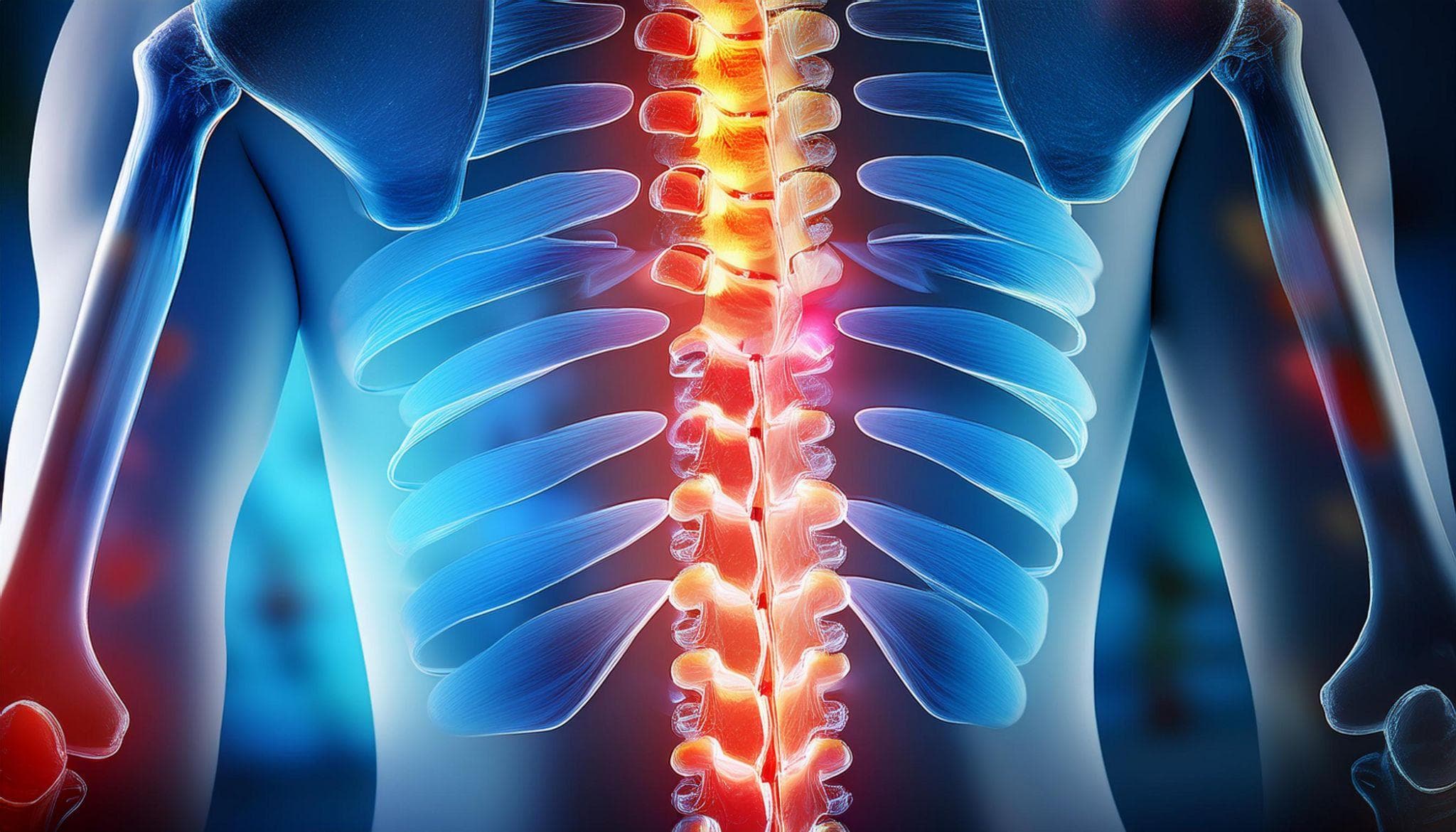
The spine was not designed for this. Back pain among office workers in Noida has reached what orthopedic specialists describe as epidemic proportions, and it's no longer a middle-aged problem. Patients in their mid-to-late 20s and early 30s are presenting with disc problems, cervical spondylosis, and chronic lower back pain at rates that would have been unusual 20 years ago.
Understanding exactly what desk work does to the spine and, more importantly, what to do about it, is increasingly a health literacy issue for anyone who works in Noida's corporate sector.
The Scale Of The Problem
A recent review found that approximately 64% of Indian IT workers report back pain and stiffness. Orthopedic clinics across Noida have reported a clear increase in younger patients presenting with spinal conditions that were previously associated with people over 50.
The primary drivers are well-identified: prolonged sitting, poor workstation ergonomics, sedentary lifestyle outside work, chronic low-grade stress, and inadequate awareness of spine health among a demographic that is otherwise health-conscious in other ways (gym membership, nutrition apps) but completely ignores their spine through the workday.
Reason 1: Prolonged Sitting Compresses The Intervertebral Discs
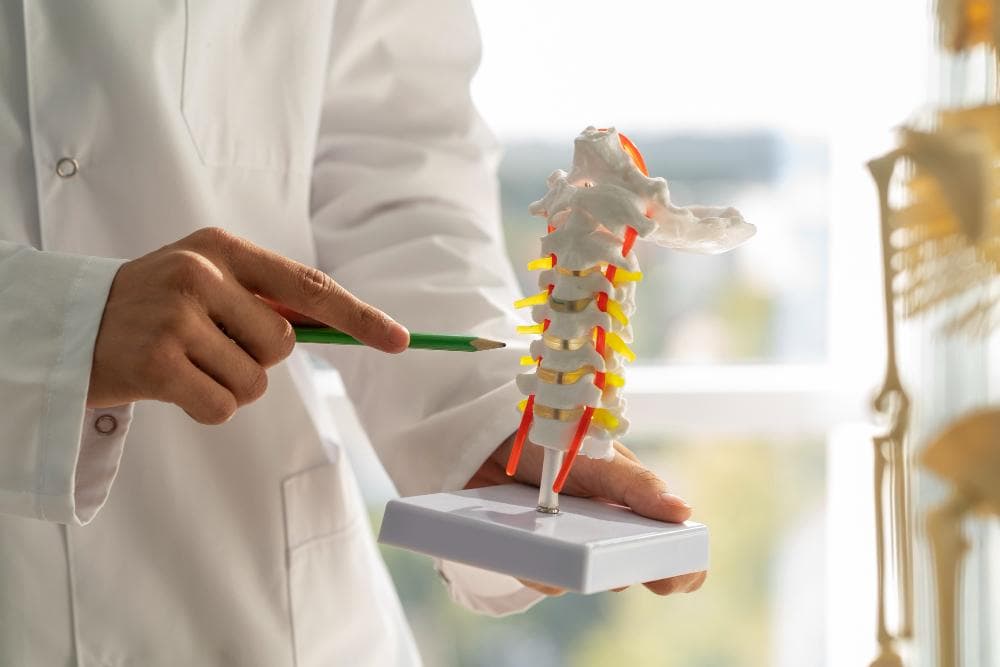
The intervertebral discs, the shock-absorbing pads between each vertebra, receive their nutrition through diffusion of fluid, driven by movement and load variation. They are not directly vascularised (they have no blood vessels). When you sit continuously for hours, this fluid exchange is impaired. The discs dehydrate. Over the years, this accelerates disc degeneration.
More immediately, prolonged sitting increases intradiscal pressure significantly compared to standing. When you sit with a slightly forward-slumped posture, the way most people naturally sit at a computer, the pressure on the lower lumbar discs increases dramatically. The classic study by Nachemson established that intradiscal pressure is actually higher during sitting than during standing or slow walking. Decades of office work with continuous sitting is a reliable recipe for early disc degeneration.
The fix: Movement breaks. Every 45–60 minutes, stand up. Walk for 2–3 minutes. The goal is not to stop sitting, it's to interrupt the continuous loading and restore disc fluid exchange. This is not negotiable as ergonomic advice; it's clinically supported.
Reason 2: The Forward Head Posture - The Smartphone Effect
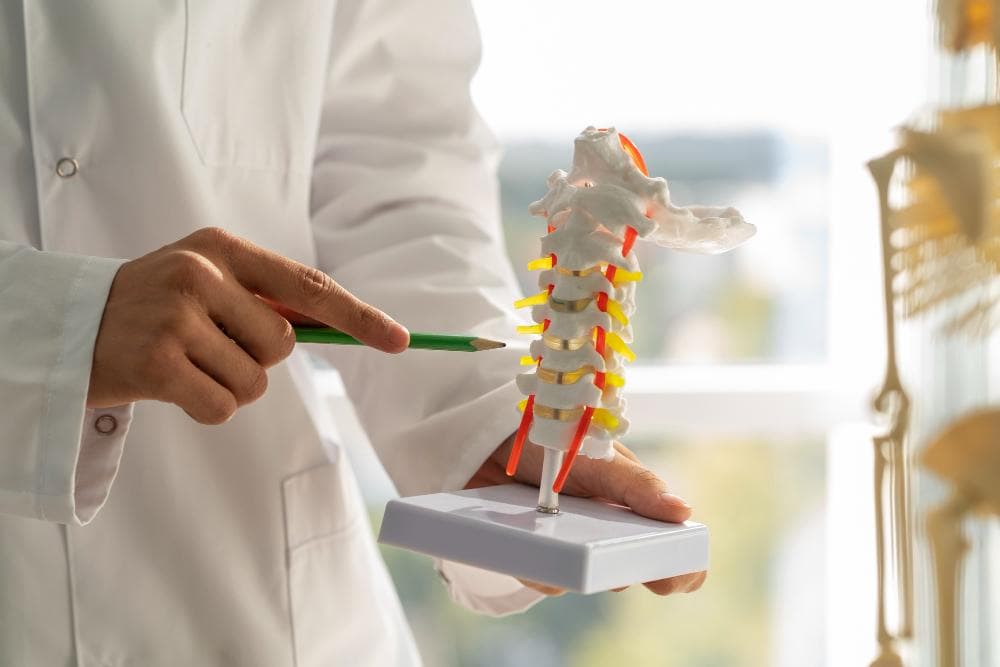
The average head weighs approximately 5 kg. When it is balanced directly above the shoulders in a neutral position, the cervical spine supports this load efficiently. But for every inch the head moves forward of that neutral position, the effective load on the cervical spine approximately doubles.
At a 45-degree forward tilt, roughly the angle of someone looking at a phone in their lap, the neck is supporting an effective load of 20–22 kg. Most desk workers in Noida alternate between looking at their laptop (head forward) and looking at their phone (head even further forward). This posture is sustained for hours.
The result: Accelerated cervical disc degeneration, cervical spondylosis developing in people in their 30s, cervicogenic headaches (headaches originating from the neck), and upper back stiffness that never fully resolves.
The fix: Raise screens to eye level. On a laptop, use a stand. On a desktop, the centre of the monitor should be at or just below eye level. When using a phone, hold it at eye level, not in your lap. Sit back against the chair back rather than craning forward toward the screen.
Reason 3: Inadequate Lumbar Support Creates Lower Back Strain
The lumbar spine has a natural inward curve (lumbar lordosis). In this position, the load is distributed across the discs and facet joints appropriately. When sitting without lumbar support, most people lose this curve, and the lower back rounds backward (lumbar kyphosis), shifting load anteriorly onto the disc and stressing the posterior ligaments.
Most desk chairs in Indian offices, even many that are marketed as "ergonomic," do not provide adequate lumbar support. And even those that do are often not adjusted correctly, or people simply don't use the support (they sit forward on the chair, or they slump).
The fix:
- Use a chair with adjustable lumbar support positioned at the curve of the lower back (the lordotic apex approximately 7–10 cm above the seat).
- Alternatively, a lumbar roll (a cylindrical cushion) placed behind the lower back achieves the same effect in a non-ergonomic chair.
- Sit all the way back in the chair, against the backrest, not perched on the front edge.
- Hips should be at or slightly higher than knees, which maintains the lumbar curve.
Reason 4: Monitor Height And Distance - Where Most Desks Get It Wrong
Too low: Most laptop users work with the screen at desk level, forcing the head and neck into continuous flexion. Even a relatively minor downward angle, 10–15 degrees below eye level, maintained for 8 hours, creates significant cervical loading.
Too high: A monitor above eye level forces the neck into extension and can worsen cervical spondylosis.
Too close: Causes eye strain, which leads to the user leaning forward to see more clearly, classic "screen lean" posture.
Too far: Leads to squinting and leaning forward for the same reasons.
The fix:
- Top of monitor at eye level (or 2-3 cm below for bifocal users).
- Screen distance: arm's length, approximately 50–70 cm.
- For laptop users: a laptop stand brings the screen to eye level, combined with a separate Bluetooth keyboard and mouse at elbow height. This is one of the most impactful ergonomic changes a desk worker can make.
Reason 5: Keyboard And Mouse Positioning - The Wrist-Shoulder-Neck Chain
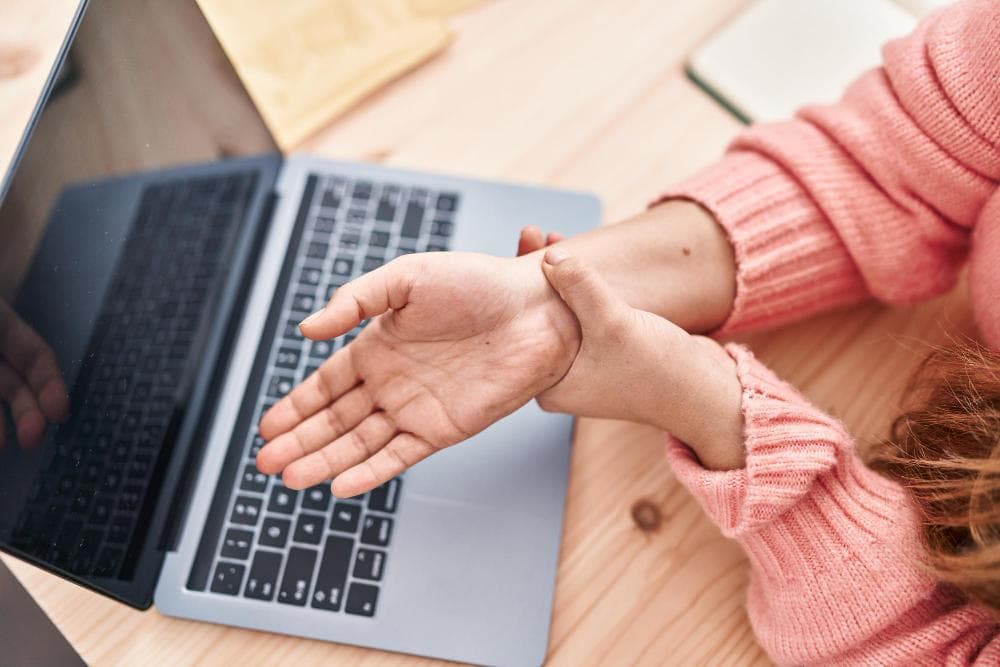
A woman working in the office with her laptop in front of her, holding her wrist in pain due to working.
Reaching forward to a keyboard that is too far away causes the shoulders to round forward, the upper back to flex, and the neck to strain. Reaching up to a keyboard that is too high elevates the shoulders, creating constant trapezius and cervical muscle tension, the classic "tech neck shoulders" that anyone who massages desk workers in Noida will recognise. A mouse that is too far to the side requires repeated lateral reach, stressing the shoulder and causing the torso to twist.
The fix:
- Keyboard at elbow height, with the upper arm close to the body.
- Keyboard angled slightly downward (negative tilt) or flat, not positive tilt (angled up).
- Mouse immediately beside the keyboard, at the same level.
- Wrists should be neutral, neither extended up nor flexed down, when typing.
Reason 6: The Chair-Sitting Duration Problem
Even a perfect ergonomic setup does not eliminate the risk of back pain if the person sits in it continuously for 8 hours. The muscles of the trunk fatigue with sustained posture. As they fatigue, they increasingly transfer load to passive structures, discs, and ligaments. This dynamic (muscles giving up, passive structures taking the load) is one of the primary mechanisms of disc injury in desk workers. A study in the Journal of Occupational Rehabilitation found that office workers who sat for uninterrupted stretches of 2+ hours had significantly higher rates of lower back pain than those who took movement breaks.
The fix:
- Standing and walking breaks every 45–60 minutes (a timer on the phone, a standing meeting, a walk to the printer or water dispenser).
- A standing desk or height-adjustable desk, used to alternate between sitting and standing, is the ideal solution, not because standing is always better than sitting, but because variation is better than either.
- Even brief standing and stretching for 2 minutes every hour creates sufficient load variation to protect the discs.
Reason 7: The Commute Adds To The Problem
Many professionals in Noida commute 45–90 minutes each way in a car, an autorickshaw, or the Metro. Sitting in a vehicle with fixed (often poor) seating, vibration, and limited movement adds to the already excessive sitting load from the workday. Particularly damaging: driving in an awkward position (leaning to one side, seat positioned too far from the wheel, headrest too low or not used), which creates asymmetric spinal loading.
The fix:
- Adjust the car seat to allow the lower back to be supported and the knees to be at approximately 90 degrees.
- Use a lumbar roll in the car if the seat back is flat.
- On the Metro: avoid leaning forward on seats, use handrails, and don't stay looking down at the phone for the entire journey.
- If driving, take a 5-minute walking break at least once during a long commute.
Reason 8: Stress, Inactivity, And The Tension-Pain Cycle
Workplace stress causes sustained muscle tension, particularly in the trapezius, upper back, and paraspinal muscles. This tension contributes to neck and back pain independently of posture. Conversely, chronic back pain increases stress, disrupts sleep, and creates a feedback loop that is difficult to break.
Furthermore, the fatigue from long work hours often means that the after-work exercise and movement that would protect spine health simply doesn't happen. The gym session gets skipped. The evening walk gets dropped. The weekends become recovery days. The spine remains deconditioned.
A study found that 64% of Indian IT workers with back pain had sedentary lifestyles outside of work, making the physical demands of the desk job the only physical load they experienced, with no compensating movement or strengthening.
The fix:
- Physical activity outside of work is not just because it makes up for desk sitting, but because it builds the spinal musculature that protects the spine during desk sitting.
- 150 minutes of moderate-intensity exercise per week is the minimum recommendation: walking, cycling, swimming, yoga.
- Targeted core strengthening: the transversus abdominis and multifidus muscles specifically support the lumbar spine during sustained sitting. 10–15 minutes of targeted core exercises (planks, bird-dogs, bridges) three times a week is meaningful protection.
The Quick Desk Setup Check
If you're reading this at your desk right now, here's a 2-minute audit:
- Chair: Back is touching the backrest. Hips and knees at approximately 90 degrees. Feet flat on the floor.
- Lumbar: Lower back has its natural inward curve, not rounded backward.
- Screen: Top of screen at eye level. At arm's length.
- Keyboard: At elbow height. Upper arms close to the body.
- Head: Balanced over the shoulders, not craning forward.
- Time since last movement break: Not more than 60 minutes.
If any of these are wrong, they're fixable today without buying anything or asking for permission.
When Desk-Related Back Pain Needs Medical Evaluation
Most desk-related back pain is mechanical it responds to ergonomic correction, physiotherapy, and exercise. But some presentations require medical evaluation:
- Pain that persists for more than 6 weeks despite ergonomic changes and self-management.
- Pain that radiates into the leg or arm with numbness or tingling.
- Weakness in a limb.
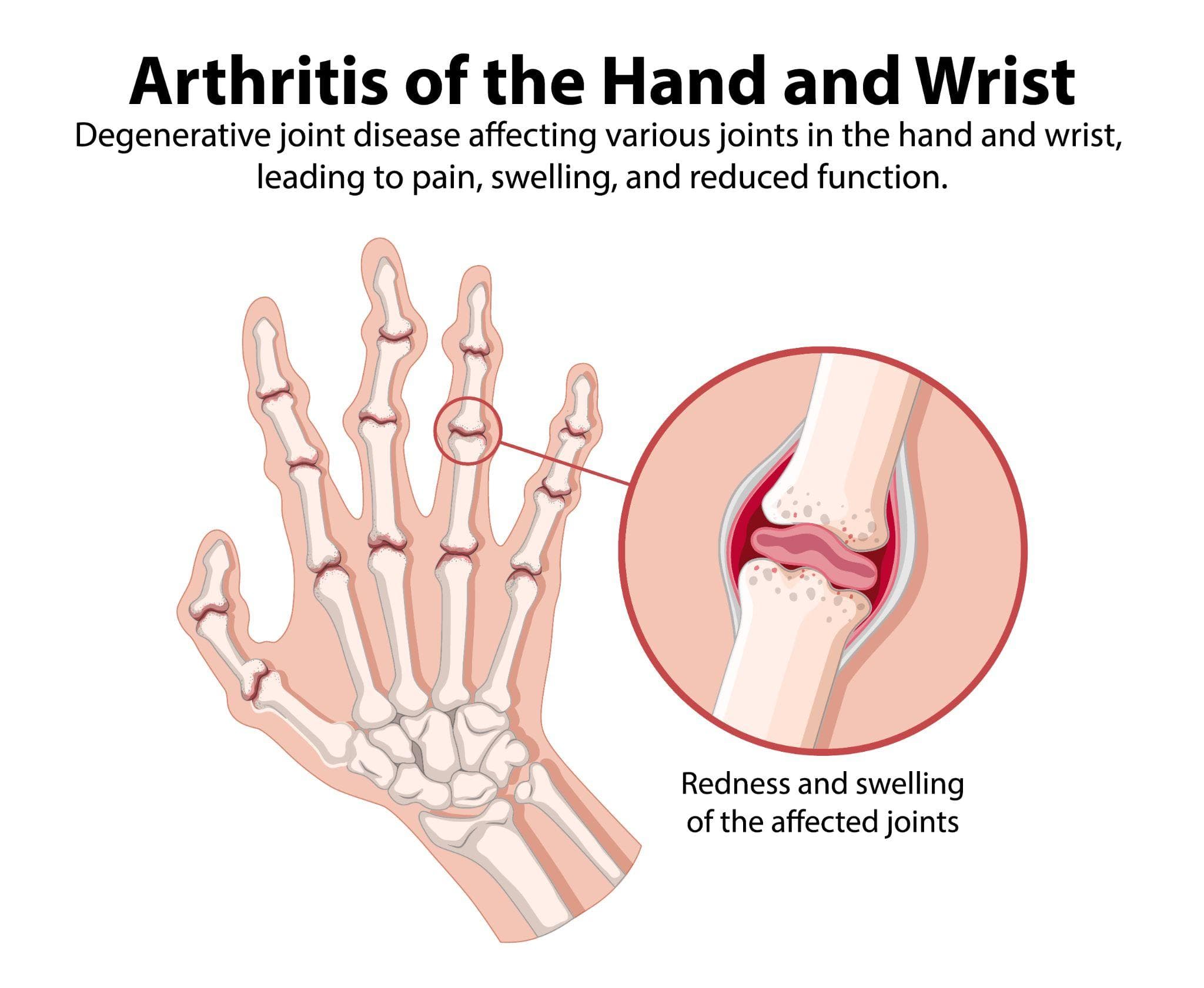
- Morning stiffness lasting more than 30 minutes (may suggest inflammatory arthritis).
- Night pain that wakes you from sleep.
If any of these apply, a proper orthopedic evaluation, including clinical examination and appropriate imaging, is necessary. Not a YouTube physiotherapy programme or a prescription from a general practitioner.
Orthopedic Assessment In Noida For Desk-Related Spine Problems
Dr. Mayank Chauhan, Senior Orthopedic Surgeon at Prakash Hospital, Sector 33, Noida, sees a significant number of working-age patients from Noida's corporate sectors with desk-related spinal problems from early cervical spondylosis and lumbar muscle strain through to disc herniation and nerve root compression.
For working professionals in Noida whose back or neck pain is affecting their productivity, sleep, or quality of life, a proper evaluation establishes the specific diagnosis and guides a treatment plan that addresses both the medical component (physiotherapy, medication, injections if needed) and the ergonomic/lifestyle component. To book a consultation, call the number listed on the website.
The Bottom Line

Young businesswoman sitting at a desk in a home office, holding her neck in pain while looking at her laptop screen, showing discomfort likely caused by prolonged computer use.
Desk-related back pain is not an inevitable consequence of working in a corporate environment. It is the predictable outcome of specific mechanical problems, prolonged sitting, poor posture, inadequate ergonomics, and physical inactivity that are all addressable.
The challenge is that addressing them requires doing several small things consistently, rather than one dramatic fix. The person who adjusts their monitor height and takes movement breaks every 45 minutes, for years, has dramatically better spinal health than the person who buys an expensive ergonomic chair and sits in it without moving for 8 hours.
To consult Dr. Mayank Chauhan, Senior Orthopedic Surgeon in Noida, call the number listed on the website.