How to Prevent Osteoporosis — Steps You Can Take Starting Today
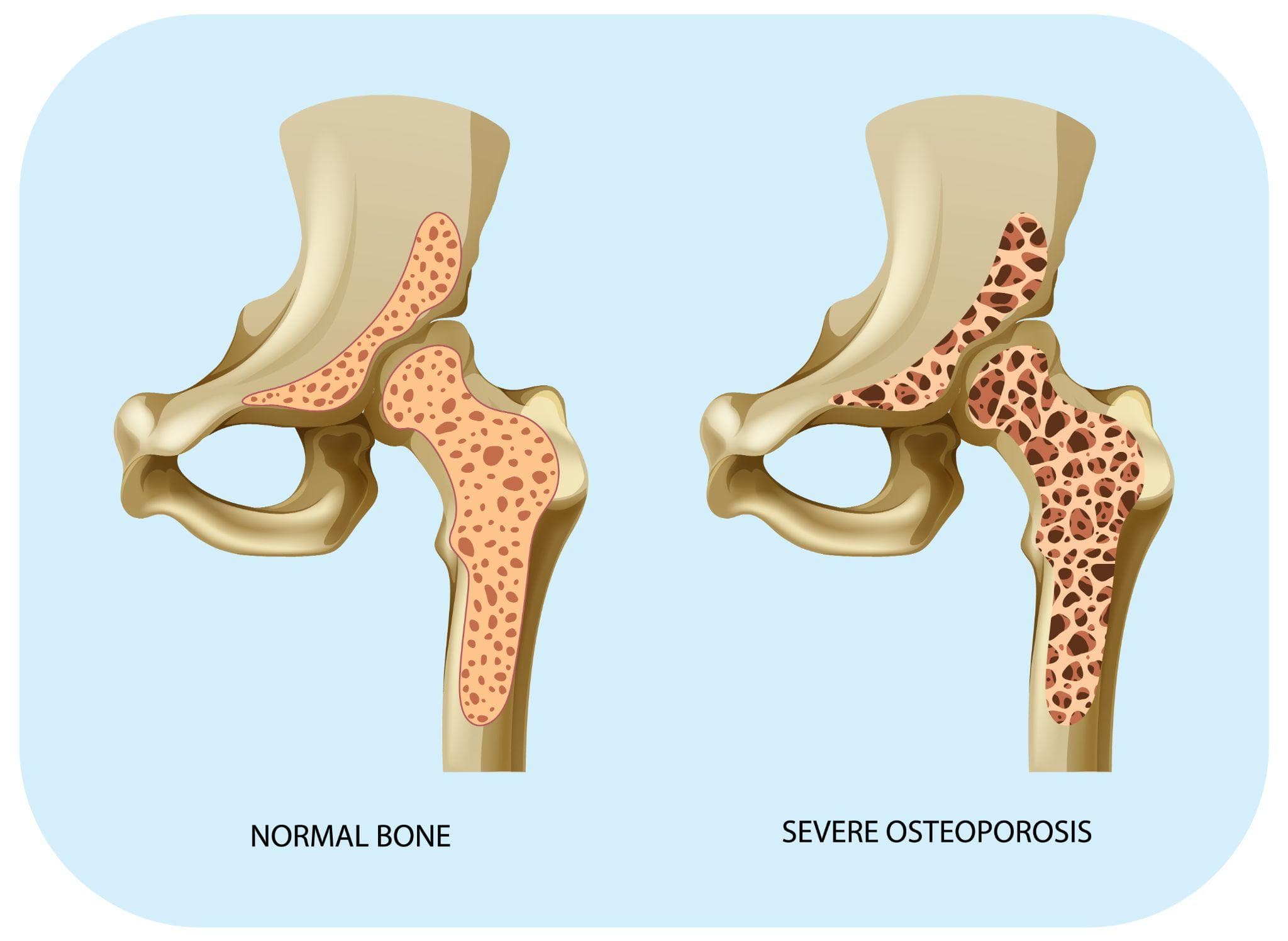
A diagram of two bones is presented, where one is shown as a normal bone and the other with severe Osteoporosis.
Osteoporosis doesn't announce itself. There's no pain, no warning sign, nothing that tells you your bones are quietly thinning until one ordinary event — a fall, stepping off a kerb, sometimes just bending awkwardly — results in a fracture that shouldn't have happened.
By then, the prevention window is largely gone.
The frustrating reality is that osteoporosis is significantly preventable. The steps that protect bones are known, evidence-based, and not complicated. What they require is starting before bone loss becomes a problem — ideally in your 30s and 40s, though meaningful intervention is possible well into your 60s.
This guide covers what actually works, specifically in the Indian context.
Understanding What You're Preventing
Osteoporosis is a condition in which bone mineral density drops below the threshold needed to reliably absorb everyday physical impact. Bones become porous and brittle. The fractures that result — most commonly at the hip, spine, and wrist — can be severely disabling.
In India, 1 in 3 women and 1 in 5 men over 50 are affected. These numbers are expected to grow significantly as the population ages.
Bone mass peaks in the late 20s to early 30s. From around age 35–40, slow but steady bone loss begins — this is normal. What's not inevitable is how much is lost. The steps below directly influence that rate.
1. Build Bone While You Still Can: The Peak Bone Mass Argument
The single most impactful thing you can do for lifetime bone health is build as much bone density as possible before peak bone mass is reached (late 20s to early 30s).
Children and young adults who exercise regularly, eat adequate calcium, and get sufficient vitamin D reach a higher peak bone mass than those who don't. A higher starting point means there's more to lose before fracture risk becomes elevated.
If you're reading this in your 30s or 40s, you can't go back and rebuild that peak — but you can absolutely slow the rate of loss from here. If you have children or teenagers, getting them eating calcium-rich foods and exercising now is one of the most long-term investments you can make in their health.
2. Get Adequate Calcium — Consistently, Not Occasionally
The recommended daily intake for adults under 50 is 1,000 mg of calcium. For those over 50, it's 1,200 mg. Most Indian adults consume 300–400 mg — less than half.
This chronic gap, repeated every day over decades, is one of the main drivers of early osteoporosis in India.
The best approach is food first. Indian diet has excellent calcium sources:
- Ragi (finger millet): 350 mg per 100 g — more than milk
- Sesame seeds: 88 mg per tablespoon
- Milk and curd: 240 mg and 120 mg per 100 ml respectively
- Paneer: 200 mg per 100 g
- Moringa (drumstick leaves): 185 mg per 100 g
- Chana, rajma, soya: 60–100 mg per serving
A practical target for most adults is two to three calcium-rich food sources per day. Ragi roti instead of plain wheat roti, a cup of curd with lunch, a tablespoon of sesame seeds added to a sabzi — changes like these add up.
When diet consistently falls short despite genuine effort, calcium supplements are a reasonable option. Calcium citrate is better absorbed without food; calcium carbonate is fine taken with meals.
3. Fix the Vitamin D Problem (Most Indians Have It)
Calcium absorption depends almost entirely on vitamin D. Without enough of it, even a calcium-rich diet will fail to adequately mineralise bone.
Around 85% of Indians are vitamin D deficient — a striking figure for a country with abundant sunshine. The reasons are well understood: urban lifestyles keep people indoors for most of the day, darker skin requires longer sun exposure to produce equivalent vitamin D compared to lighter skin, and traditional clothing covers most of the body.
The straightforward solution is 15–20 minutes of direct sun exposure (arms and legs exposed, not through glass) in the mid-morning or early afternoon, several times a week. This is enough for most people to maintain reasonable levels.
When sun exposure isn't adequate — and for many Indian adults it genuinely isn't — vitamin D3 supplementation is appropriate. Blood testing (a simple 25-OH vitamin D test) tells you where you actually stand. Deficient levels (below 20 ng/mL) typically require a loading dose followed by maintenance.
Do not guess at this. Have it tested.
4. Exercise for Bone — and the Specific Kind That Works
Not all exercise builds bone equally. Two types are genuinely effective:
Weight-bearing aerobic exercise: Activities where you carry your body weight against gravity — walking, jogging, climbing stairs, dancing. These stimulate bone maintenance in the lower body. Research is clear that 150 minutes per week (about 30 minutes, five days) produces measurable benefit.
Resistance (strength) training: Lifting weights, resistance bands, bodyweight exercises like squats and lunges. This is the superior option for actually building bone density, not just slowing loss. The key is progressive loading — gradually increasing the weight or resistance over time. Compound movements that place load on the hips and spine (squats, deadlifts, rows) are particularly effective at the sites most prone to osteoporotic fractures.
A 2025 meta-analysis of 40 studies confirmed that combined training — both aerobic and resistance — produces the greatest overall bone density benefit, particularly in postmenopausal women.
Swimming and cycling are good cardiovascular exercise but do not significantly build bone — they are not weight-bearing. If these are your primary activities, adding some resistance work is worthwhile.
Exercise 2–3 times per week is the minimum for bone benefit. More frequent is better, within the limits of recovery.
5. Stop Smoking
Tobacco use accelerates bone loss. It directly suppresses the osteoblasts (bone-building cells), reduces calcium absorption, decreases oestrogen levels in women (oestrogen is protective for bone), and reduces blood supply to bone tissue.
The bone loss from smoking is dose-dependent — heavier, longer-term smokers lose more. But it's also partly reversible: stopping smoking reduces bone loss rates, though full recovery to non-smoker levels may not occur.
There is no safe threshold. Smoking damages bone.
6. Moderate Alcohol
Regular excessive alcohol intake disrupts calcium absorption, suppresses bone-forming cells, increases the risk of falls, and can interfere with the liver's role in vitamin D metabolism.
Moderate consumption (no more than one standard drink per day for women, two for men) is associated with small or no bone loss risk. Heavier regular drinking is a genuine bone health risk.
7. Assess Your Medication List
Several commonly used medications increase osteoporosis risk when taken for extended periods:
- Corticosteroids (like prednisolone, dexamethasone): Even moderate doses used for more than 3 months significantly increase bone loss. Steroid-induced osteoporosis is a separate and serious clinical concern. If you are on long-term steroids, your doctor should be monitoring bone density and prescribing bone-protective medication.
- Proton pump inhibitors (PPIs, used for acid reflux): Long-term use reduces calcium absorption
- Some antiepileptic drugs and thyroid medications: Can affect bone metabolism
If you take any of these regularly, it's worth discussing bone health specifically with your doctor.
8. Get Screened if You Have Risk Factors
Osteoporosis prevention includes identifying those at elevated risk before fractures occur.
Risk factors that warrant bone density screening (DEXA scan):
- Women over 65 or men over 70
- Postmenopausal women under 65 with additional risk factors
- History of a fragility fracture (fracture from a minor fall or impact)
- Family history of hip fracture
- Long-term corticosteroid use
- Early menopause (before age 45)
- BMI below 19
- Significant height loss
A DEXA scan is a simple, painless, low-radiation X-ray that measures bone mineral density at the spine and hip. Results are given as a T-score. A score above -1 is normal. Between -1 and -2.5 is osteopenia (bone thinning that warrants attention). Below -2.5 is osteoporosis (that warrants treatment).
What Doesn't Work as Well as You Might Think
1. Calcium supplements alone: Supplements without vitamin D, exercise, and smoking cessation are far less effective than the full picture.
2. One-off interventions: Bone health requires consistent habits, not periodic efforts. A six-month gym phase followed by a year of inactivity does not accumulate meaningful benefit.
3. High-dose calcium without testing: Taking excess calcium from supplements (above 2,500 mg/day total) without medical guidance has potential downsides (kidney stones, possible cardiovascular effects) that outweigh any additional bone benefit.
Prevention at Any Age
The earlier you start, the more bone you protect. But meaningful benefit is possible at any age.
In your 30s–40s: Focus on diet, exercise, vitamin D, and eliminating smoking. This is when you have the most influence on lifetime bone health.
In your 50s–60s: Exercise becomes more important as hormonal changes (particularly in women post-menopause) accelerate bone loss. Resistance training is the single most impactful tool at this stage.
In your 70s and beyond: Fall prevention is as important as bone strength. Balance exercises (yoga, tai chi), home modifications (adequate lighting, grab rails), and vision correction all reduce fracture risk even when bones are already thin.
When to Consult an Orthopedic Surgeon
See a specialist if you have a fragility fracture (fracture from a fall from standing height or less), height loss of more than 2 cm over time, a family history of hip fractures, or have been on long-term steroids.
Dr. Mayank Chauhan is a senior orthopedic surgeon at Prakash Hospital, Sector 33, Noida, with experience in fracture management, bone health assessment, and joint reconstruction for patients affected by osteoporosis.
To book a consultation, call the number listed on the website.