Slip Disc Treatment at Home - What Actually Works (and What Doesn't)

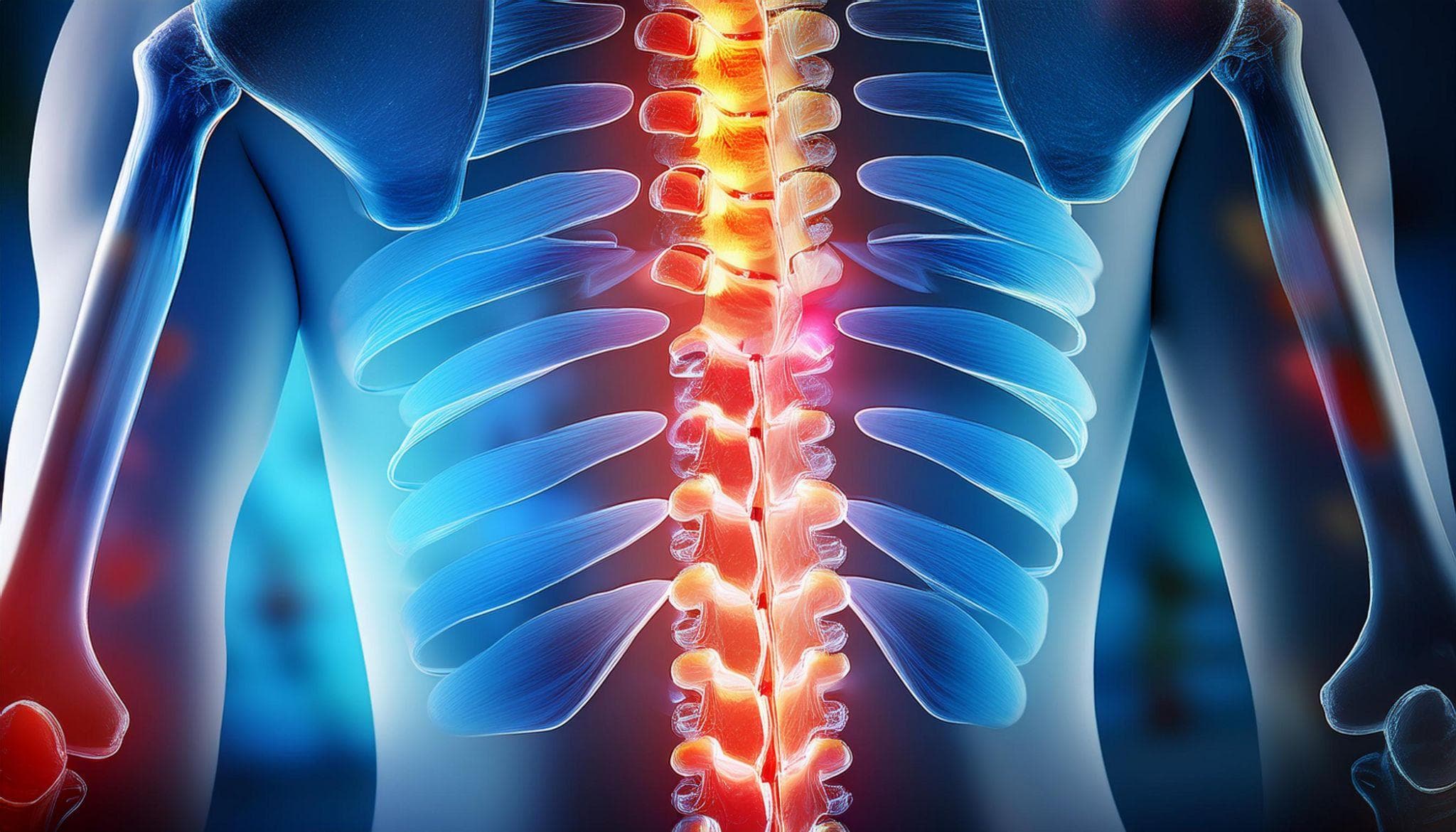
A digital 3D anatomical illustration of a human figure viewed from behind, highlighting the spine, bright red areas along the lower spine indicate inflammation or nerve compression.
When a slipped disc flares up, the first question most patients have is: "What can I do right now, at home, before I can see a doctor?" And the second question, once they've been evaluated, is: "What should I be doing between my physiotherapy sessions to help this heal faster?"
Both are good questions — and the answers are more specific than the general advice of "rest and take painkillers" that many patients receive.
This guide covers evidence-based home management for slip disc — what genuinely helps, what is neutral, and what people commonly do that actually slows recovery. It also explains clearly when home treatment is no longer appropriate and professional care is urgently needed.
The Foundation: Understanding Why You're Doing What You're Doing
Effective home management of a slipped disc works through three mechanisms
-
Reducing nerve inflammation: The pain from a slipped disc is partly mechanical (the disc pressing on the nerve) and partly inflammatory (the inflamed nerve responding to compression). Reducing inflammation reduces pain even before the disc material moves.
-
Reducing intradiscal pressure: Certain positions and activities increase the pressure inside the disc, pushing the herniated material harder against the nerve. Avoiding these positions gives the disc the best chance to gradually retract.
-
Maintaining spinal muscle function: The deep spinal muscles — the core stabilisers — protect the disc from further injury. If these muscles become deconditioned through prolonged inactivity, the disc is more vulnerable, not less.
Everything in effective home management serves one or more of these three goals.
What Works: Evidence-Based Home Management
1. Active Rest — Not Bed Rest
The most important thing to know: strict bed rest for slip disc is not recommended. It was the standard advice for decades; it is now known to be counterproductive.
The evidence is clear: patients who maintain gentle activity during a slipped disc episode recover faster than those who go to bed and stay there. Here's why:
- Prolonged bed rest causes rapid deconditioning of the spinal support muscles
- Lying still reduces disc fluid exchange — movement is actually needed for the disc to receive nutrients
- Inactivity worsens stiffness, making movement more painful when finally attempted
What active rest means in practice:
- The first 1–2 days of acute severe pain: Reduce activity significantly. Avoid things that make the pain significantly worse. Rest in the most comfortable position you can find.
- From day 2–3 onward: Begin gentle movement. Walking short distances (even 5–10 minutes at a time) is better than lying still.
- Do not stop all movement unless the pain is truly incapacitating.
2. Finding the Right Position
For lumbar (lower back) disc herniation, the most comfortable positions vary by patient, but these tend to help:
Lying on your back with knees bent (semi-recumbent): Place a pillow under the knees to keep them bent at approximately 90 degrees. This slightly flattens the lumbar curve and reduces intradiscal pressure.
Lying on your side in the foetal position: With a pillow between the knees to keep the spine neutral. Good for patients with significant leg pain.
Lying on your stomach (prone): Counterintuitively helpful for many disc patients — particularly those with an L4-L5 or L5-S1 herniation. The prone position promotes spinal extension, which tends to shift herniated disc material away from the nerve (the principle behind McKenzie extension exercises). Start with just lying flat, then progress to propping up on elbows.
What to avoid: Sitting in a slumped, bent-forward position. Sitting significantly increases intradiscal pressure compared to lying or standing. Noida's desk workers who spend their first day back from a disc injury at their desk in a conventional chair are making things worse, not better.
3. Ice and Heat — Used Correctly
Ice (first 24–48 hours): Ice wrapped in a towel, applied to the lower back for 15–20 minutes every 2 hours, reduces acute inflammation around the nerve. This is most useful in the first day or two when acute inflammation is at its peak.
Heat (after 48 hours): A warm heating pad, hot water bottle, or warm bath applied to the lower back reduces muscle spasm and promotes blood flow. Most patients with slip disc benefit more from heat than ice after the initial acute phase.
Practical Indian alternative: A cloth bag filled with heated sand or salt, commonly used in households, serves the same purpose as a heating pad.
4. Pain Medication — The Right Combination
For acute slipped disc pain, self-medication with NSAIDs available over the counter (ibuprofen 400 mg, diclofenac sodium) provides meaningful pain relief while the body's inflammatory response is at its peak.
However, for the shooting, burning, and electric leg pain (neuropathic pain) of sciatica caused by disc herniation, standard NSAIDs are less effective than nerve pain medications. Pregabalin and gabapentin — which require a prescription — specifically target neuropathic pain pathways. These should be obtained through consultation rather than self-prescribed.
What not to do: Taking high-dose painkillers continuously for more than 5–7 days without medical evaluation. Masking pain with medication to push through activity that the body is trying to restrict is a reliable way to convert a manageable disc problem into a surgical one.
5. The McKenzie Self-Assessment and Extension Exercises
This is the single most evidence-supported self-management approach for lumbar disc herniation — and it is safe to begin cautiously at home, ideally after initial instruction from a physiotherapist.
The core principle: Extension exercises (backward bending) tend to push disc material anteriorly (forward) — away from the nerve root. For most patients with posterior or postero-lateral disc herniations, this produces "centralisation" of pain — the radiating leg pain moves back toward the centre of the spine as the exercises are performed.
Starting position — prone lying: Simply lying face down with the spine relaxed. Do this for 5 minutes, several times a day. For patients who find lying prone reduces leg pain, this is a good sign — extension is likely their directional preference.
Prone press-ups: From the prone position, place your hands under your shoulders (like the start of a push-up) and gently press up through your arms while keeping your hips on the floor. The lower spine arches backward. Hold for 1–2 seconds, lower back down. Repeat 10 times.
Important self-assessment: If these exercises make the leg pain worse or significantly increase back pain, stop and seek physiotherapy assessment. Not every disc herniation responds to extension — some respond to flexion, and some need specific techniques that should be guided by a trained McKenzie physiotherapist.
6. Keeping Mobile — Walking as Therapy
Walking is one of the best things a patient with a slipped disc can do — once the acute, severe phase has passed.
Walking maintains spinal movement, promotes disc fluid exchange, prevents muscle deconditioning, and does so without significantly increasing intradiscal pressure the way sitting does.
Start with 5 minutes at a time and gradually increase. Walk on flat surfaces. Avoid walking uphill in the acute phase if it significantly increases symptoms.
What not to do: Running, jumping, heavy gym training, or any high-impact activity during acute disc episodes. These significantly increase spinal loading.
7. Sleeping Position and Mattress
Sleeping position matters. The best positions are the same as the rest of the positions described above — on the side with knees slightly bent and a pillow between the knees, or on the back with a pillow under the knees.
Sleeping on the stomach: Generally not recommended for neck problems, but for lower back disc herniation, it can actually reduce symptoms for some patients.
Mattress: A moderately firm mattress supports the spine better than an overly soft one that allows the spine to sag. However, an extremely hard mattress creates pressure points. Medium-firm is generally recommended. In Indian homes, patients who sleep on a firm floor (which many elderly patients prefer) often report good results — this is essentially the "firm surface" principle.
8. Sitting Modifications
Since sitting is one of the worst positions for lumbar intradiscal pressure, patients with acute slipped discs need to minimise sitting time and improve the sitting position when it cannot be avoided.
- Use a lumbar support or roll in any chair
- Sit only for 20–30 minutes at a time, then stand and move
- Do not sit on low, soft sofas — these force the lumbar spine into flexion
- Indian-style floor sitting (cross-legged) significantly flexes the lumbar spine and should be avoided during acute episodes
9. Avoiding Activities That Worsen Disc Pressure
While in recovery:
- No heavy lifting — particularly with a bent back
- Avoid prolonged bending forward — mopping the floor with a short-handled mop, bending to pick things up without bending the knees
- Avoid prolonged driving — car seats provide poor lumbar support, and driving vibration loads the disc
- No sudden twisting movements — rotating the trunk forcefully
What Does NOT Work (Common Mistakes)
Strict Prolonged Bed Rest
Already covered — it slows recovery. Rest briefly, then move.
Aggressive Massage Over the Disc Level
Deep, forceful massage directly over the lumbar spine during acute disc herniation can temporarily worsen symptoms by increasing local inflammation. Gentle muscle relaxation massage alongside the spine (over the paraspinal muscles) is acceptable. Heavy manipulation of the spine during acute disc episodes by unqualified practitioners is potentially dangerous and should be avoided.
Pulling or Traction Without Guidance
Some patients attempt self-traction — hanging from a bar, pulling the legs. Unsupervised spinal traction for disc herniation can be counterproductive or harmful. Traction, when indicated, should be administered by a trained physiotherapist in a clinical setting.
Continuing High-Intensity Exercise Without Assessment
Patients who are regular gym-goers sometimes try to "push through" a disc problem. Deadlifts, heavy squats, and military press with a herniated disc can convert a minor prolapse into a surgical problem. Stop gym training until properly evaluated.
Assuming the Problem Will Just Resolve
Most disc herniations do improve — but they improve with appropriate management, not with being ignored. The significant minority that doesn't improve needs to be identified so that proper treatment can be escalated.
When Home Treatment Is Not Enough — See a Doctor
Home management is appropriate for the first 7–14 days while waiting for a consultation, or as a supplement to formal physiotherapy. It is not appropriate as a substitute for medical evaluation when:
- Leg pain, numbness, or tingling is present
- Weakness in the leg or foot develops
- Symptoms are not improving after 2 weeks of home management
- Pain is severe and not controlled by OTC painkillers
- You have any loss of bladder or bowel function (go to emergency immediately)
Slip Disc Management in Noida — Dr. Mayank Chauhan
Dr. Mayank Chauhan, Senior Orthopedic Surgeon at Prakash Hospital, Sector 33, Noida, provides structured, evidence-based management for slipped disc — advising on what patients can do at home, when physiotherapy is needed, and when surgical escalation is appropriate.
For patients in Noida and Greater Noida who have been managing a disc problem at home without professional guidance, a consultation will establish the stage of the condition and what treatment is indicated. To book a consultation, call the number listed on the website.
The Bottom Line
Slip disc home management works best when it follows three principles: stay gently active (no strict bed rest), reduce positions that increase disc pressure (particularly prolonged sitting), and use targeted exercises (prone extension) that help the disc material move away from the nerve.
Home treatment buys time and supports healing. For the majority of disc herniations, it is sufficient alongside physiotherapy. For those who don't respond — see a specialist.
To consult Dr. Mayank Chauhan, Senior Orthopedic Surgeon in Noida, call the number listed on the website.