Hip Pain - How Do You Know If You Need Hip Replacement?
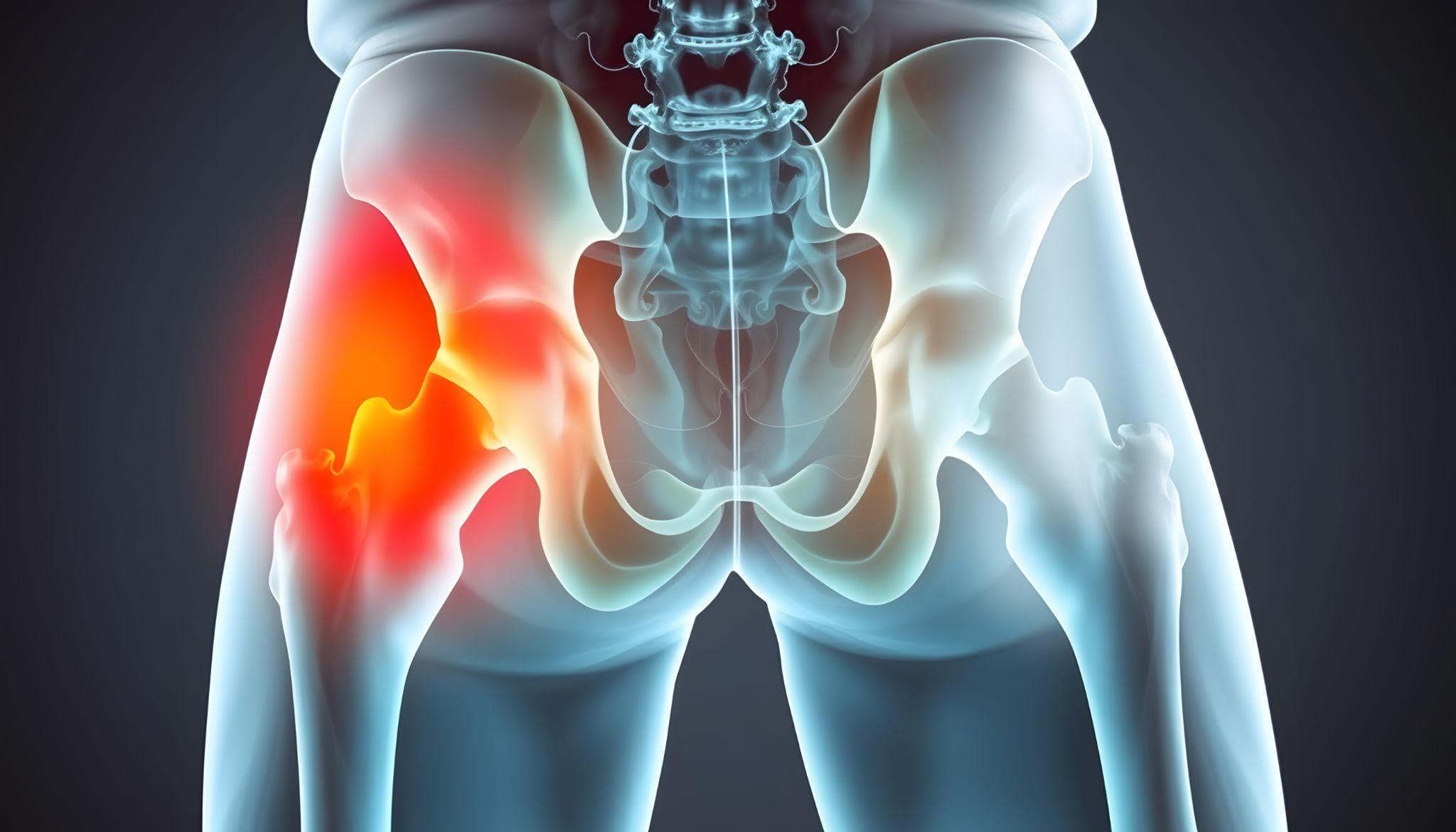
X-ray style illustration highlighting pain and damage in the hip joint.
The decision to have hip replacement surgery is not made on an X-ray report. It is not made because a radiologist writes "severe arthritis" in a report. And it is not made because a friend or family member had a replacement and recommended it. It is made carefully, honestly, and specifically 232 based on the patient's clinical picture, their functional status, their response to conservative treatment, and the degree to which hip pain is genuinely limiting their life.
Hip replacement is among the most successful surgical procedures in modern medicine. Satisfaction rates are consistently high. Pain relief is typically dramatic. But it is still major surgery, with real risks and a recovery period that demands commitment. Getting the decision right operating at the right time, on the right patient, for the right reasons is the difference between excellent outcomes and the frustration of surgery done too early or too late.
This guide explains how the decision for hip replacement is made the signs that suggest it is time, the evaluation process, and what distinguishes "hip pain that needs to be investigated" from "hip pain that warrants replacement."
The Starting Point: Where Is The Pain?
Before discussing replacement, it is essential to clarify where the pain is actually coming from, because "hip pain" is one of the most location-confused complaints in orthopedic practice. True hip joint pain (from the hip joint itself):
- Located in the groin, the deep, aching pain felt in the groin or front of the hip.
- May radiate to the inner thigh and the front of the knee.
- Associated with stiffness on internal rotation of the hip.
- Worsened by walking, stairs, and rising from low seats.
- In later stages, present at rest and at night.
Common conditions that cause lateral hip pain but are NOT the hip joint:
- Trochanteric bursitis: Pain over the outer hip/thigh, on the bony prominence of the greater trochanter. Often confused with hip arthritis but treated very differently responds to physiotherapy, stretching, and injection.
- Iliotibial band (IT band) syndrome: Outer thigh pain, particularly in runners.
- Lumbar spine referred pain: Lower back pathology commonly refers pain to the buttock and outer thigh sometimes confused with hip disease.
This distinction matters because lateral hip pain alone without groin pain and without the characteristic stiffness pattern of hip joint disease often does not come from the hip joint and will not respond to hip replacement. An experienced orthopedic surgeon can distinguish these by examination before any imaging.
What Causes Hip Joint Disease Severe Enough To Need Replacement?
The main conditions that progress to requiring hip replacement in India:
Osteoarthritis: Age-related cartilage wear, the most common cause globally. Develops over the decades. More common in patients over 55, overweight individuals, and those with a family history.
Avascular Necrosis (AVN): Bone death from disrupted blood supply, the most common cause of hip replacement in younger Indian patients. Linked to steroid use, alcohol use, trauma, and other conditions. As covered in the AVN blog, India has a particularly high burden of this condition.
Rheumatoid Arthritis: When RA destroys the hip joint, managed in coordination with rheumatology.
Post-Traumatic Arthritis: Following hip fractures, dislocations, or childhood hip diseases.
Hip Dysplasia: Shallow socket from birth, causing secondary arthritis in adulthood.
Hip Fractures in Elderly: Femoral neck fractures in elderly patients treated with partial hip replacement (hemiarthroplasty) as an emergency or urgent procedure.
The Signs That Hip Replacement May Be The Right Answer
No single sign determines the surgical decision. It is the combination of clinical findings that builds the picture.
Sign 1: Pain That Is No Longer Controlled By Conservative Treatment
The first and most important criterion: adequate conservative management has been genuinely tried and has failed to provide acceptable pain control. "Adequate conservative management" means:
- A structured physiotherapy programme targeting hip muscles (hip abductors, extensors, flexors).
- Appropriate pain medication, NSAIDs at adequate doses for sufficient duration.
- Activity modification, switching to low-impact exercise.
- Weight management where relevant.
- At least one corticosteroid injection for pain management (when appropriate).
- PRP injections for early-stage OA in younger patients.
If all of these have been tried over a period of 3–6 months without satisfactory pain control, conservative treatment has been adequately tried.
Sign 2: Pain At Rest And Pain That Wakes You At Night
Pain exclusively with activity is typical of early-to-moderate hip OA. When the pain starts occurring at rest sitting in a chair, lying in bed, it indicates inflammation is continuous rather than mechanically triggered. Night pain is particularly significant, it indicates the joint inflammation is not resolving during rest periods. This level of pain typically means the disease has progressed beyond what conservative management can address.
Sign 3: Significant Functional Limitation

A young woman is bending slightly forward, holding her hip with one hand while the other hand touches her waist, there is a red highlighting around her hip area, indicating discomfort or pain.
Hip arthritis progression is measured in activities. The sequential loss of function is characteristic:
- First: Inability to run or play sports.
- Then: Difficulty with prolonged walking (beyond 500 metres without stopping).
- Then: Difficulty with stairs.
- Then: Difficulty with daily activities, getting in and out of cars, rising from low seats, putting on shoes and socks.
- Finally: Significant limitation even with minimal activity.
When a patient can no longer walk a reasonable distance without significant pain, cannot perform basic daily activities without difficulty, and has stopped activities they previously enjoyed because of hip pain, functional limitation is clinically significant.
The Indian-specific question: For patients who sit cross-legged on the floor, use squat toilets, or perform activities of daily living involving hip flexion and rotation, the hip's range of motion and pain-free function is particularly critical. When these activities become impossible or severely painful, functional limitation impacts quality of life in a culturally specific way.
Sign 4: X-Ray Findings That Correlate With Symptoms
Hip OA is staged using the Kellgren-Lawrence (KL) grading system on X-ray:
- Grade 1: Doubtful narrowing, possible osteophytes.
- Grade 2: Definite osteophytes, possible joint space narrowing.
- Grade 3: Moderate osteophytes, definite joint space narrowing, some sclerosis.
- Grade 4: Large osteophytes, marked joint space narrowing, severe sclerosis, possibly bone-on-bone contact.
Grade 4 arthritis that correlates with the clinical symptoms is the typical X-ray finding in patients proceeding to hip replacement. Grade 3 may be appropriate in patients with severe symptoms and failed conservative treatment.
AVN staging on MRI: For AVN patients, Stage 3 (collapse of the femoral head) and Stage 4 (established arthritis) are the stages where hip replacement is the indicated treatment. Earlier stages (1–2) should be offered joint-preserving options first.
Sign 5: The Patient's Own Assessment
This is underemphasised but genuinely important: the patient's own assessment of their quality of life matters. Hip replacement is not done because a surgeon thinks it is time, it is done when the patient feels their quality of life has deteriorated to the point where the risks and recovery of surgery are worth accepting.
Validated patient-reported outcome measures, the Harris Hip Score, HOOS (Hip Disability and Osteoarthritis Outcome Score), Oxford Hip Score, capture this. When scores on these tools indicate severe disability, the patient's perspective supports the surgical indication.
Sign 6: Age-Appropriate Consideration
Hip replacement in patients over 60 with advanced OA and failed conservative treatment, the decision is relatively straightforward. The implant will likely last the rest of the patient's life, and the risk-benefit ratio strongly favours surgery. In patients under 55 with hip arthritis, the decision requires additional consideration:
- Is there a joint-preserving option? (HTO for mild dysplasia-related OA, periacetabular osteotomy for hip dysplasia, core decompression for early AVN)
- Can surgery be delayed further with additional conservative measures?
- If replacement is needed, what bearing surface and fixation will last longest in an active young patient?
When Hip Replacement Should Wait - Or Be Reconsidered
Active infection: Any active infection anywhere in the body must be treated before elective joint replacement. Bacteria in the bloodstream at the time of surgery can colonise the new implant, a catastrophic complication.
Poorly controlled medical conditions: Uncontrolled diabetes (HbA1c above 8–9%), severe heart failure, very poor lung function, these require optimisation before surgery.
Skin conditions over the surgical site: Active psoriasis or eczema over the hip area increases infection risk.
Morbid obesity (BMI above 40): Significantly increased complication rates; weight loss before surgery is recommended.
Inadequate conservative management: If physiotherapy, injection, and activity modification haven't been genuinely tried, these should be completed before surgical discussion.
Patient not ready psychologically: Some patients benefit from more time to process the decision, particularly those who have significant anxiety about surgery or unrealistic expectations. Informed consent requires a genuine understanding of the procedure, recovery, and limitations.
The Pre-Operative Evaluation For Hip Replacement
When the clinical decision for hip replacement has been made, a structured evaluation precedes surgery: Clinical assessment:
- Harris Hip Score and other functional assessments.
- Full clinical examination, range of motion measurements, leg length assessment, neurovascular status.
- Assessment of the opposite hip (bilateral hip disease is common in AVN and OA).
Imaging:
- Weight-bearing X-rays of both hips (full pelvis AP, lateral of the affected hip).
- MRI if there is diagnostic uncertainty or if AVN is suspected.
- CT scan for pre-operative templating (measuring and planning the exact implant size and positioning).
Medical assessment:
- Full blood count, kidney and liver function, blood sugar, coagulation
- ECG, chest X-ray
- Cardiology assessment where indicated
- Dental clearance
- Diabetologist reviews if diabetic
Anaesthesia assessment:
- Most hip replacements are performed under spinal anaesthesia.
- The anaesthesiologist reviews the patient's medical history and determines the safest anaesthetic approach.
Hip Replacement Evaluation In Noida - Dr. Mayank Chauhan At Prakash Hospital
Dr. Mayank Chauhan, Senior Orthopedic Surgeon at Prakash Hospital, Sector 33, Noida, evaluates every hip pain patient thoroughly before any surgical discussion, using a combination of clinical assessment, appropriate imaging, and honest conversation about what conservative treatment can realistically achieve.
For patients in Noida and Greater Noida with hip pain, whether early disease being evaluated for the first time, or established OA being considered for replacement, a consultation will provide a clear, specific picture of where the hip stands clinically and what the most appropriate path forward is.
Consultation hours: Monday to Saturday, 10 AM to 8 PM | Sunday, 10 AM to 2 PM.
To book a consultation, call the number listed on the website.
The Bottom Line

Anatomical model of a hip bone.
Hip replacement is indicated when hip joint disease causes:
- Pain not adequately controlled by completed conservative treatment.
- Significant functional limitation impacting daily life and quality of life.
- X-ray findings that correlate with the clinical picture (Grade 3–4 OA, or Stage 3–4 AVN).
- The patient themselves is ready and willing to undergo surgery and recovery.
None of these criteria alone is sufficient. Together, they form the clinical picture that justifies one of the most successful, and most life-changing operations in orthopedic medicine.
To consult Dr. Mayank Chauhan, Senior Orthopedic Surgeon in Noida, call the number listed on the website.