Hip Replacement Precautions - A Complete Guide for the Indian Lifestyle

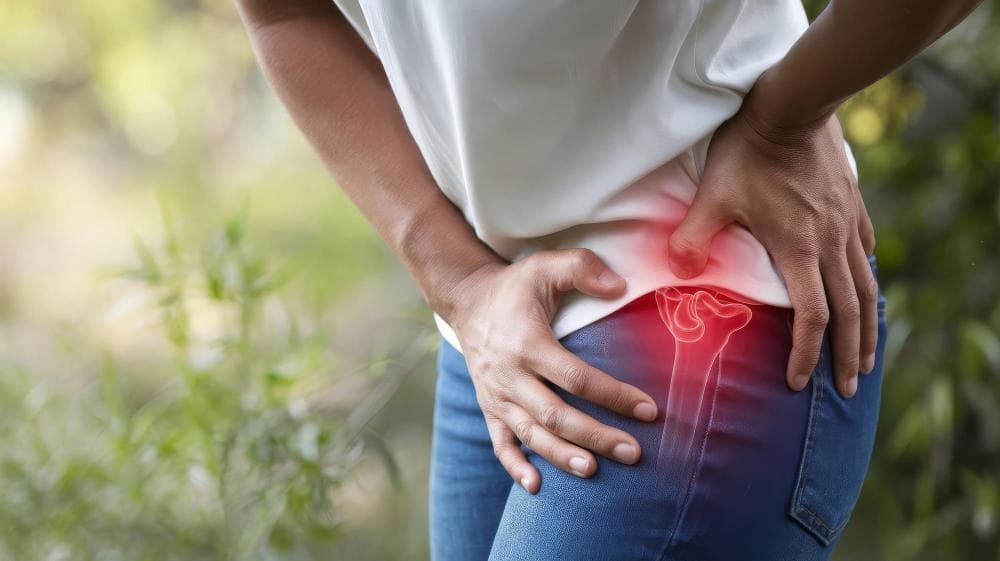
A young woman is bending slightly forward, holding her hip with one hand while the other hand touches her waist, there is a red highlighting around her hip area, indicating discomfort or pain.
The standard post-hip replacement precaution guide given to patients in most hospitals is written for a Western lifestyle. Don't sit on low sofas. Use a raised toilet seat. Don't bend below 90 degrees. Sleep with a pillow between your knees.
For patients in India — and particularly in Noida's diverse population — this generic guidance leaves enormous gaps. What about sitting cross-legged on the floor for family meals or prayer? What about using a squat (Indian-style) toilet? What about sleeping on a charpoy or chatai? What about performing namaz? What about the low wooden furniture in many traditional homes? What about travelling in crowded auto-rickshaws or Metro stations that require negotiating stairs and crowds?
These are not marginal questions — they are the daily realities of life for millions of Indian patients recovering from hip replacement. And yet they are rarely addressed in the standard discharge instructions.
This blog addresses all of them — specifically, honestly, and with the nuance that Indian patients deserve.
Understanding Why the Precautions Exist
Before addressing each specific situation, understanding the biomechanical reason for hip precautions makes the guidance more logical and easier to follow.
The dislocation risk:
A total hip replacement can dislocate — the ball can come out of the socket — in a way that a native hip joint typically cannot. The native hip has a deep socket (reinforced by the labrum), robust ligaments, and a lifetime of muscle conditioning. The new artificial hip has a shallower socket in the early post-operative period, healing ligaments and capsule, and temporarily weakened surrounding muscles.
The positions most likely to cause dislocation depend on the surgical approach
Posterior approach (the most common in India):
The capsule is opened from the back of the hip. Dislocation is most likely with combined:
- Hip flexion beyond 90 degrees (bending the hip too deeply) AND
- Internal rotation (foot turning inward) AND
- Adduction (operated leg crossing the midline)
These three movements in combination place the ball in a vulnerable position relative to the socket rim.
Anterior approach:
The capsule is opened from the front. Dislocation is most likely with combined extension and external rotation. Different precautions apply — patients should ask their surgeon specifically which approach was used.
Duration of precautions:
Posterior approach precautions are typically followed for 6–12 weeks — the time required for the capsular tissue to heal and the muscles to regain sufficient tone to dynamically protect the joint. After this period, the risk of dislocation decreases dramatically, and most restrictions are lifted.
The Most Common Indian Lifestyle Questions — Answered
1. Can I Sit Cross-Legged (Sukhasana/Padmasana) After Hip Replacement?
The honest answer: Not during the first 6–12 weeks. After that — gradually, and with surgeon confirmation.
Cross-legged sitting requires:
- Hip flexion (often well beyond 90 degrees)
- External rotation of the hip
- Adduction
The combination of deep flexion with rotation is a risky movement pattern. During the first 6–12 weeks of recovery, when the capsule is still healing, this position should be strictly avoided.
After the 6–12 week review, when the surgeon lifts the formal precautions, patients can begin cautiously experimenting with modified cross-legged positions — starting with a bolster or cushion under the buttocks (which reduces the depth of hip flexion required), and stopping immediately if any discomfort, clicking, or unusual sensation occurs.
Fully comfortable cross-legged sitting on the floor takes most patients 3–6 months — and some never regain the same ease they had before arthritis affected that position. The implant design, the depth of the socket component, and individual anatomy all influence this.
Practical alternatives during recovery:
- Sit on a firm chair with armrests, preferably raised with a cushion
- A plastic chair (mooda) at the appropriate height
- When attending floor-based family meals, sit at the edge of the group on a low firm chair rather than on the floor
2. Can I Use an Indian-Style (Squat) Toilet?
The honest answer: Not during the first 3–6 months. A raised toilet seat is essential for the first 6–12 weeks. Squat toilets should be avoided until the surgeon confirms full recovery.
A squat toilet requires near-complete hip flexion (90–120+ degrees) combined with ankle dorsiflexion, knee bending, and a lowering movement that also involves hip adduction. This is one of the riskiest positions for a recently replaced hip.
What to do instead:
- Install a raised toilet seat attachment over an Indian-style toilet (these can be purchased at medical supply shops in Noida's Sector 18, 27, or any medical equipment store — many are folding designs that can be removed when not needed)
- Use a Western-style toilet if available
- In homes where no alternative exists, a commode chair (a portable raised toilet) provides a safe solution during recovery
Timeline:
- Weeks 1–6: Raised toilet seat essential. Never use a squat toilet.
- Weeks 6–12: Western-style toilet or raised seat. Discuss squat toilet with surgeon at 3-month review.
- Month 3–6: Surgeon assessment of whether a squat toilet is appropriate. For many patients, a modified position (not fully squatted — holding a grab rail, with reduced hip flexion) becomes manageable.
3. Can I Sleep on a Charpoy or Low Bed After Hip Replacement?
The honest answer: A low charpoy creates problems. The issue is not the sleeping position itself (lying flat is fine) — it is getting in and out of a very low bed, which requires deep hip flexion to rise.
A charpoy that sits 12–18 inches off the ground requires a patient to lower themselves very deeply, risking the hip. Getting up from a low surface requires significant hip flexion and quadriceps force.
What to do:
- Temporarily raise the charpoy or bed (furniture leg risers, available at hardware stores, or blocks of wood) to bring the height to 18–24 inches
- A firm mattress on a raised platform is safer than a soft surface that sinks and makes rising more difficult
- When rising, always use the armrests or a support frame — never rise straight from lying without using the arms
4. Can I sleep on the Floor (Chatai/Mattress on the floor)?
No — during the first 3 months at least. Getting up from floor level requires:
- Deep hip flexion
- Rolling onto the hands and knees
- Standing from a very low position
All of these movements stress the recently replaced hip. After 3–4 months, with surgeon confirmation and significantly improved strength, some patients can manage floor sleeping — but this should be specifically discussed rather than assumed.
5. Can I Perform Namaz (Islamic Prayer Positions)?
The traditional prayer positions include standing, bowing (ruku — forward bending), prostration (sajdah — kneeling with forehead to floor), and sitting (jalsa — sitting on heels with knees on ground).
Sajdah (prostration) and jalsa are the positions that concern the replaced hip most:
- Prostration requires lowering the entire body to the floor — involving deep hip flexion, adduction, and rotation
- Sitting on the heels (jalsa) requires significant knee and hip flexion
During the first 3–6 months:
These positions should be modified — most Islamic scholars accept that a person recovering from medical illness may perform prayer seated on a chair, or with modified prostration (partial lowering without full floor contact). A temporary medical accommodation is both practical and widely accepted within Islamic tradition.
After 3–6 months:
Gradual return to prayer positions under surgeon guidance. Many patients fully return to their prayer positions by 6 months — but this depends on the range of motion the hip has regained and the surgeon's specific assessment.
6. Can I Sit on Low Furniture — Traditional Indian Seating?
Low sitting — the low wooden takht, traditional diwan, low cushioned seating on the floor, plastic stools — all require the hip to flex significantly when both sitting and rising.
Key rule: Any sitting surface from which rising requires more than moderate hip flexion is potentially risky during the first 6–12 weeks.
A practical test: If you can get off the seat without your knee rising higher than your hip while seated, the seat is probably at a safe height. A folding plastic chair of standard height (approximately 18–20 inches from the floor) is usually safe.
7. Travelling by Auto-Rickshaw and Metro After Hip Replacement
Auto-rickshaw:
Getting in and out of an auto-rickshaw requires a low bend and a sideways manoeuvre — less controlled than getting in and out of a car. For the first 6 weeks, auto-rickshaws should be avoided. From Weeks 6–12, with care and assistance, they become manageable. The vibration of auto-rickshaws on Noida's uneven roads is not harmful to the implant.
Metro:
The Metro in Noida involves stairs, escalators, and crowded platforms. For the first 4–6 weeks, the combination of crowds, stairs, and potential jostling makes Metro travel inadvisable. From 4–6 weeks, most patients can manage the Metro — using escalators and lifts where available, and avoiding peak-hour crowding when the risk of being bumped is higher.
Longer car journeys:
For car travel, getting into a car is usually possible from Weeks 4–6 — the operated leg leads in and the body swings after. The seat should be pushed back to allow comfortable entry without excessive hip flexion. Stop every 45–60 minutes on long journeys to walk briefly and prevent DVT-promoting venous stasis.
8. Can I Do Yoga After Hip Replacement?
During the first 6 months: Modified yoga only — specifically instructed by a yoga teacher with experience working around joint replacements. Many standard yoga postures require deep hip flexion, internal rotation, and adduction — all precaution-restricted positions.
After 6 months: Gentle yoga under an experienced teacher is an excellent activity — it improves strength, balance, and flexibility. Poses that require extreme hip rotation (lotus, pigeon pose) should be specifically discussed with the surgeon rather than assumed safe.
9. When Can I Return to Driving?
Right hip replacement: Driving requires the right foot for the accelerator and brake — reaction time and leg control must be adequate. Most surgeons clear right hip replacement patients for driving at 6–8 weeks.
Left hip replacement with automatic transmission: The left foot is rarely used; most patients are cleared at 4–6 weeks.
Left hip replacement with manual transmission: The clutch requires left leg force and control — typically 8 weeks.
Test before driving: Sit in a stopped car, simulate braking urgently — if the movement is comfortable and reactive, driving is probably safe. Always confirm with the surgeon before driving.
10. When Can I Return to Work?
Desk/office work: 4–6 weeks for most patients — including those commuting to Noida's Sector 62/63/125 corporate offices.
Standing roles (teacher, shopkeeper, certain professional roles): 6–10 weeks.
Manual or physical work: 3–4 months, with restrictions.
Signs of Dislocation — What to Do If It Happens
Despite all precautions, dislocations do occasionally occur. Know the signs
- Sudden severe pain in the hip — typically with a feeling of "something going wrong."
- The operated leg appears shorter than the other
- The foot rotates outward significantly
- Inability to move the hip at all
If dislocation is suspected: go to an emergency department immediately. Do not attempt to move the hip. Call an ambulance or go by car lying flat if possible. Dislocation is reducible under sedation in almost all cases — and treated urgently without delay.
Hip Replacement Guidance in Noida — Dr. Mayank Chauhan at Prakash Hospital
Dr. Mayank Chauhan, Senior Orthopedic Surgeon at Prakash Hospital, Sector 33, Noida, provides detailed, India-specific post-operative guidance to every hip replacement patient — covering exactly the real-life questions that Indian families need answered, not just generic Western discharge instructions.
To book a consultation or follow-up, call the number listed on the website.