Hip Resurfacing vs Total Hip Replacement - Which Is Right for You?

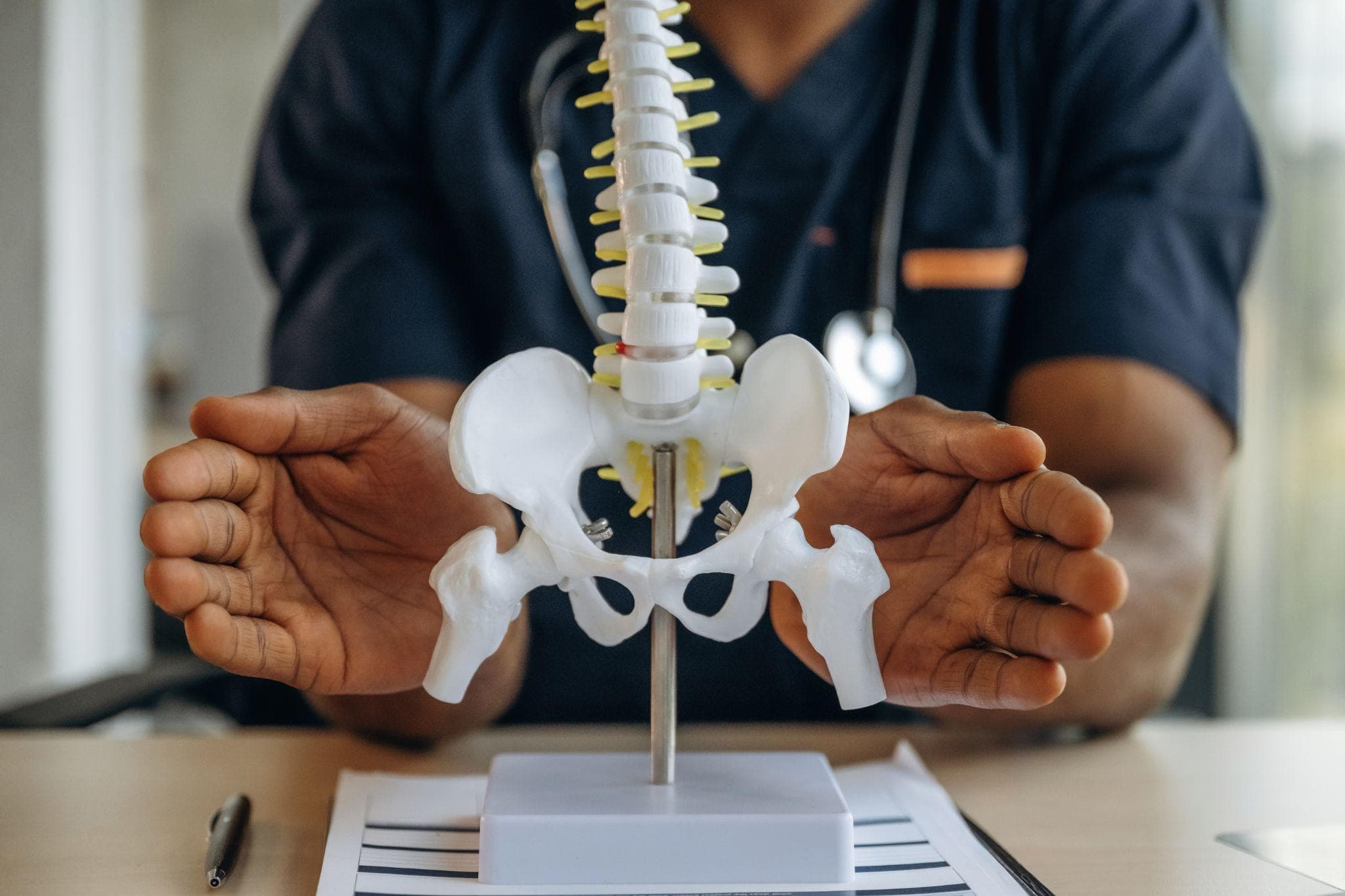
anatomical model of a hip bone
When a young, active patient in their 40s or 50s is told they need hip surgery, the conversation that follows is more complex than it would be for a 70-year-old with the same condition. A 70-year-old patient with end-stage hip arthritis is almost always best served by total hip replacement — and that implant is expected to last the rest of their life. A 45-year-old with the same diagnosis faces a fundamentally different challenge: any implant placed today will likely need revision surgery in their lifetime. The question of which surgery to have — and when — matters enormously.
Hip resurfacing is a bone-conserving alternative to total hip replacement that was developed specifically with younger, more active patients in mind. Understanding what it does differently, who benefits from it, and where its limitations lie is essential for any patient being evaluated for hip surgery before the age of 60.
What Is Hip Resurfacing?
In a standard total hip replacement, the entire femoral head (the ball at the top of the thigh bone) is removed, and a metal stem is inserted down the femoral canal (the central hollow of the thigh bone). A new ball is attached to the top of the stem. The acetabular socket is also replaced with a metal cup and a plastic or ceramic bearing surface.
Hip resurfacing takes a different approach on the femoral side:
Instead of removing the femoral head entirely, the damaged cartilage surface is shaved down, and the shaped bone is capped with a smooth metal covering — similar in principle to a tooth crown. The femoral head bone itself is preserved. On the acetabular (socket) side, the socket is similarly lined with a metal cup — creating a metal-on-metal bearing surface of a larger diameter than in a conventional hip replacement.
What this means practically:
- Femoral bone is preserved: The femoral canal is not violated by a long stem. All the native bone of the femoral head and neck remains.
- Larger femoral head diameter: The resurfacing cap is larger than the ball in conventional replacement — similar in size to the natural femoral head. This larger size provides inherent stability and dramatically reduces dislocation risk.
- More natural hip biomechanics: The larger head-to-socket ratio more closely mimics the natural hip joint's movement pattern.
Why Bone Preservation Matters for Young Patients
The most compelling clinical reason for resurfacing in younger patients is the implication for future surgery.
A 45-year-old receiving hip resurfacing today can reasonably expect that surgery to last 15–20 years — bringing them to age 60–65. At that point, if revision is needed, the preserved femoral head bone provides excellent bone stock for a straightforward conversion to conventional total hip replacement. The revision surgeon has a normal femoral canal to work with.
A 45-year-old receiving a conventional total hip replacement today faces a different revision scenario. If the implant needs revision at age 65–70, the revision involves removing a long femoral stem — a complex procedure associated with significant bone loss, higher complication rates, and less predictable functional outcomes. Revision surgery is never as good as primary surgery, and every step of complexity in that revision adds risk.
By preserving the femoral bone now, resurfacing defers and simplifies the eventual revision surgery — it is a strategy for managing a lifetime of hip surgeries, not just the first operation.
Who Is a Good Candidate for Hip Resurfacing?
Hip resurfacing is appropriate for a specific subset of patients. The selection criteria are more demanding than for conventional replacement.
Ideal candidates:
- Male, aged 45–65: The evidence for resurfacing is strongest in larger-boned males. Female patients and smaller individuals have higher complication rates with metal-on-metal resurfacing (see limitations below).
- Active patients who want to return to high-demand activities: The larger femoral head and lower dislocation risk allow a wider range of motion and greater physical activity than conventional replacement.
- Good bone quality: The femoral head bone must be healthy enough to support the resurfacing cap. Osteoporosis, significant cysts in the femoral head, or avascular necrosis affecting more than 50% of the femoral head typically contraindicate resurfacing.
- Intact femoral head geometry: The femoral head must be reasonably spherical — significant deformity (from childhood hip disease, previous fractures, or advanced collapse) makes accurate resurfacing technically difficult.
Conditions where resurfacing works well:
- Primary osteoarthritis in a young active patient with good bone quality
- Post-traumatic arthritis with a preserved femoral head
- Hip dysplasia-related OA in appropriate anatomy
- Hip arthritis secondary to childhood hip conditions (Perthes disease, SUFE) — in selected cases
Where conventional total hip replacement is preferred:
- Advanced avascular necrosis (AVN) with femoral head collapse: Once the femoral head has collapsed (Stage 3–4 AVN), resurfacing is not appropriate — the bone structure is too compromised to support a cap. This is significant in the Indian context, where AVN is very common and often presents at an advanced stage.
- Female patients: Multiple studies confirm that female sex is an independent risk factor for resurfacing failure — related to smaller bone size and hormonal effects on the metal-on-metal bearing. Many surgeons now reserve resurfacing primarily for male patients.
- Significant osteoporosis: Weak bone cannot reliably support the resurfacing component.
- Large femoral head cysts: Areas of poor bone quality within the femoral head increase the risk of resurfacing failure.
- Kidney disease: Metal ion release from the bearing surface is cleared renally — impaired kidney function contraindicates metal-on-metal implants.
The Metal-on-Metal Concern — What Patients Need to Know
All current hip resurfacing systems use metal-on-metal (MoM) bearing surfaces — typically cobalt-chromium alloy. This bearing surface has been the subject of significant regulatory and clinical scrutiny over the past 15 years.
The concern with metal-on-metal bearings:
When two metal surfaces articulate, microscopic metal particles and ions are released into the surrounding tissue and bloodstream. In the vast majority of patients with correctly positioned components, these levels are low and clinically insignificant. However, in a subset of patients — particularly those with malpositioning, smaller-sized components, or individual biological sensitivity — metal ion levels can become elevated, causing:
- ARMD (Adverse Reaction to Metal Debris): Destructive soft tissue reaction around the hip — pseudotumours (fluid collections and tissue necrosis) that can cause significant local damage and pain
- *Elevated serum cobalt and chromium levwhich Which, in extreme cases, affect the heart, thyroid, and nervous system
Several large-diameter metal-on-metal total hip systems (not resurfacing specifically) were withdrawn from the market due to high failure rates from ARMD. Hip resurfacing has fared better — component positioning is more controllable in the resurfacing context — but the concern remains real and requires monitoring.
What this means for patients:
Patients with hip resurfacing implants should have:
- Regular follow-up with blood metal ion testing (serum cobalt and chromium) — annually after the first 2 years
- Imaging (MARS-MRI or ultrasound) if metal ions are elevated or symptoms develop
- Immediate evaluation if hip pain, swelling, or weakness develops — these can be signs of ARMD
Outcomes — What Does the Evidence Show?
A 2023 systematic review and meta-analysis comparing resurfacing hip arthroplasty (RHA) with total hip arthroplasty (THA) across 18 randomised controlled trials found:
- Complication rates: No significant difference (12% RHA vs 16% THA)
- Revision rates: No significant difference (6.3% RHA vs 6.1% THA)
- Blood loss: Significantly lower in RHA
- Operative time: Longer in RHA
- Functional outcomes: Comparable between groups
In appropriately selected younger male patients, resurfacing produces excellent functional outcomes — many patients return to demanding physical activity including running, hiking, and sports that would not be recommended after conventional replacement. The larger head size and lower dislocation risk genuinely enable more active lifestyles.
In female patients and in less ideal anatomical situations, the outcomes are less consistent, and the revision rate is higher.
Return to Activity — The Key Advantage of Resurfacing
For young, active patients, the activity profile after surgery is a critical consideration.
After conventional total hip replacement:
Most surgeons advise patients to avoid running, impact sports, and activities with high fall risk permanently. The implant is not designed to withstand these loads indefinitely.
After hip resurfacing:
The larger head size and bone-conserving design allow more demanding activities. Many surgeons permit:
- Running (low volume)
- Cycling and swimming without restriction
- Golf, tennis, hiking
- Impact sports at moderate intensity
This is clinically meaningful for a 48-year-old patient who wants to continue running 3 times a week — resurfacing offers a better answer to that question than conventional replacement.
The Decision — Making the Right Choice
The choice between hip resurfacing and total hip replacement should be made after a thorough consultation with a surgeon experienced in both procedures. Key questions in the decision:
- What is the specific hip condition and its stage? (AVN with collapse → conventional replacement. Early OA with good bone → resurfacing may be appropriate)
- What is the patient's sex and bone quality?
- What are the patient's activity goals post-surgery?
- Are there any contraindications to MoM bearing (kidney disease, known metal sensitivity)?
- Is the anatomy appropriate for accurate resurfacing component positioning?
No single answer applies to all patients. The best operation is the one matched to the specific patient's anatomy, disease, and goals.
Hip Surgery in Noida — Dr. Mayank Chauhan at Prakash Hospital
Dr. Mayank Chauhan, Senior Orthopedic Surgeon at Prakash Hospital, Sector 33, Noida, evaluates younger patients with hip arthritis for both resurfacing and conventional replacement — making the recommendation based on the individual patient's specific anatomy, bone quality, disease stage, and activity goals rather than a default preference for either procedure.
For patients in Noida and Greater Noida who have been told they need hip surgery and want to understand whether resurfacing is an option for their specific situation, a consultation provides the thorough, individualised assessment that this decision requires.
To book a consultation, call the number listed on the website. Consultations: Monday–Saturday 10 AM–8 PM, Sunday 10 AM–2 PM.