Am I Too Young for Knee Replacement? What Age Actually Has to Do With It

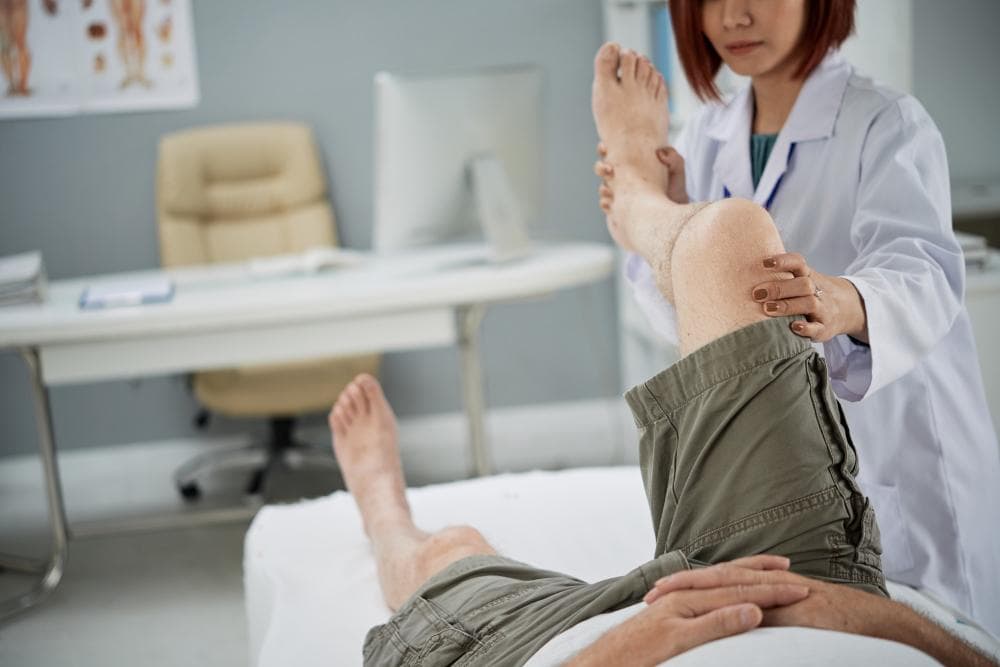
In a clinic, a female doctor is doing physiotherapy on the knee of a male patient who is lying down and looks relaxed.
"You're too young for a knee replacement."
Patients in their 40s and 50s hear this regularly — sometimes from doctors, sometimes from family, sometimes from their own instinct. The assumption is that knee replacement is something you wait for, like retirement. Something you only do when you absolutely have to, preferably after 65.
This advice has a kernel of logic to it. It also sends some patients to waste years in significant pain based on outdated assumptions about how long knee implants last and what waiting actually costs.
The truth is more nuanced than "wait" or "don't wait." The age question matters — but not in the way most patients think.
Where the "Wait Until You're Older" Advice Comes From
The historical concern is entirely understandable. Early knee replacement implants — those used from the 1970s through the 1990s — typically lasted 10–15 years. A 50-year-old having knee replacement in 1985 would statistically need a revision surgery in their early-to-mid 60s. Revision surgery is more complex and less reliable than primary replacement. Two surgeries are worse than one. So the advice was: delay the first surgery to push the revision (if ever) as late as possible.
This advice was reasonable given the technology of the time.
It is less reasonable now.
Modern knee implants — using highly cross-linked polyethylene, advanced alloys, improved cementing technique, and better surgical alignment — routinely last 20–25 years. Registry data consistently shows 82–90% of total knee replacements still functioning at 25 years. In patients under 55, studies show implant survivorship of 90–99% at 10 years and 85–97% at 20 years.
A 52-year-old having knee replacement today with a 25-year implant lifespan will reach 77 before revision becomes statistically likely. For many patients, that means one surgery for the rest of their life.
The calculation has changed. The advice hasn't always kept up.
What Waiting Actually Costs
The counter-argument to "wait" is worth making explicitly: waiting has its own costs.
Years of pain and disability: A patient in their early 50s with severe knee arthritis who is told to wait until 65 is being asked to accept 10–15 years of significant pain, reduced activity, and declining quality of life. That is not a neutral outcome. It is a real cost.
Progressive deformity: Untreated severe arthritis doesn't stay static. As cartilage and bone erode, the knee can develop varus (bow-leg) or valgus (knock-knee) deformity. Severe deformity makes the surgery technically more complex, requires larger bone resection, and is associated with less predictable outcomes. Waiting too long may, paradoxically, make the surgery harder.
Cardiovascular and metabolic consequences: Patients with severe knee pain become increasingly sedentary. Inactivity accelerates cardiovascular disease, weight gain, and metabolic deterioration. The long-term health consequences of multi-year functional disability are not negligible.
Muscle loss: Prolonged disuse atrophy of the quadriceps before surgery means a more difficult rehabilitation after it.
There is no cost-free option. Both operating and waiting carry risk. The question is which set of trade-offs is more favourable for the specific patient.
What Actually Determines Whether You're Ready for Surgery
Age is one factor. Here is what matters more:
Severity of Disease
The most important question: has the cartilage damage progressed to the point where surgery is clearly the right intervention?
This is assessed on weight-bearing X-rays. Bone-on-bone contact — where joint space has been lost entirely in one or more compartments — is the radiological sign that conservative measures are unlikely to provide sustained relief. MRI adds information about soft tissue and cartilage quality but X-ray remains the primary tool for surgical decision-making in arthritis.
A 45-year-old with grade 4 (bone-on-bone) medial compartment arthritis causing severe daily pain and functional limitation is a different case from a 45-year-old with grade 2 arthritis who has significant pain but intact joint space. The former has less to lose from surgery and less to gain from further delay.
Response to Non-Surgical Treatment
Surgery is appropriate when conservative management has genuinely failed — not when it has not been tried. Appropriate non-surgical management includes:
- Regular physiotherapy with quadriceps and hip strengthening
- Weight management
- Anti-inflammatory medication (NSAIDs in appropriate doses)
- Intra-articular corticosteroid injections when inflammation is acute
- Hyaluronic acid injections in selected cases
If these have been tried adequately and relief is insufficient, surgery becomes appropriate regardless of age.
Quality of Life Impact
Knee replacement surgery is not life-saving. Its purpose is to reduce pain and restore function. The decision to operate is therefore partly a quality-of-life calculation.
If a patient cannot walk 200 metres, cannot climb stairs without severe pain, cannot sleep through the night, and cannot perform their work, surgery at 50 may be entirely appropriate. If a patient has significant arthritis on X-ray but manages comfortably with occasional NSAIDs and physiotherapy, surgery can reasonably wait.
Overall Health and Surgical Risk
A healthy, fit 50-year-old without significant cardiovascular, respiratory, or metabolic disease is a better operative risk than a 68-year-old with poorly controlled diabetes and heart disease. Chronological age alone is not a proxy for surgical risk.
Pre-operative assessment in good-faith evaluates cardiac fitness, BMI, blood sugar control, and anaesthetic risk — not the number in the patient's date of birth.
The Younger Patient: Specific Considerations
For patients in their 40s and early 50s, some considerations are genuinely different:
Implant lifespan: Despite modern implant durability, younger patients are more likely to outlive their first implant and require revision. This is a real consideration — not a reason to refuse surgery indefinitely, but a factor to discuss.
Partial vs total replacement: In younger patients with single-compartment arthritis (medial compartment most commonly), partial (unicompartmental) knee replacement preserves healthy tissue, gives a more natural-feeling knee, and can be converted to total replacement if needed. It should be specifically discussed for eligible younger patients.
Activity expectations: Younger patients often want to return to more demanding activity after surgery. Knee replacement supports daily activity and low-impact sport very well. Running, jumping, and impact sport are discouraged because they accelerate implant wear. This is a relevant conversation to have before surgery, not after.
Activity modification post-surgery: Younger patients may need to accept modifications to certain high-impact activities. Swimming, cycling, walking, yoga, golf — these are sustainable. Regular running is not recommended. Being honest about this before surgery prevents disappointment afterward.
What Indian Data Tells Us
India is seeing a rapid increase in knee replacement surgery in patients under 60. Several factors drive this:
- Earlier onset of knee arthritis in India due to squatting habits (which place extreme loads on the knee joint) and BMI trends
- Avascular necrosis — a relatively common cause of knee destruction in India, increasingly linked to past COVID-19 steroid treatment
- Increasing awareness and reduced stigma around joint replacement in younger working-age patients
- Modern implant availability matching international standards
The surgical outcomes for younger Indian patients in published literature are equivalent to international data — strong 10-year and 20-year survivorship with modern implants.
Questions to Ask Your Surgeon
If you're in your 40s or 50s and considering knee replacement, these are the right questions:
- What grade is my arthritis on X-ray and MRI?
- Have I genuinely exhausted appropriate non-surgical options?
- Am I a candidate for partial (unicompartmental) replacement?
- What activity limitations should I expect post-surgery, and are these acceptable to me?
- What is your specific experience with knee replacement in patients my age?
- What does the implant survivorship data look like for the implant you use?
A surgeon who answers these questions clearly and without oversimplifying is worth trusting. One who dismisses the age question with "you're too young, come back when you're 65" without engaging with your specific situation deserves a second opinion.
Dr. Mayank Chauhan at Prakash Hospital, Noida
Dr. Mayank Chauhan evaluates knee replacement candidates individually — regardless of age — at Prakash Hospital, Sector 33, Noida. His assessment covers disease severity, response to conservative treatment, patient goals, and the most appropriate surgical approach, including partial replacement where indicated.
To book a consultation, call the number listed on the website.