What Is Knee Replacement Surgery? A Complete Patient Guide
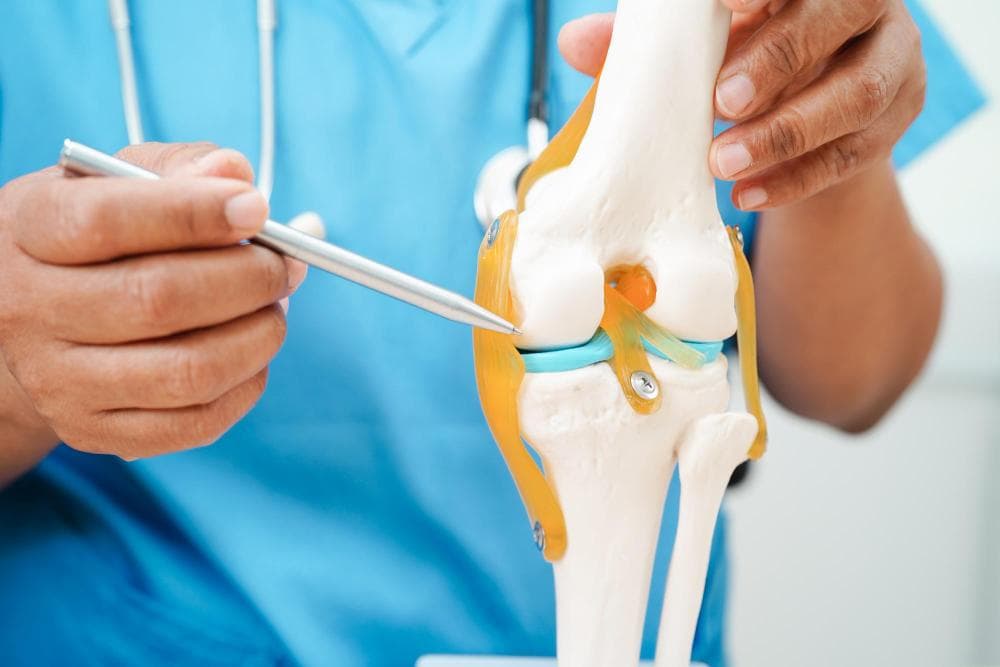
An orthopedic doctor is holding a knee joint model and using a pen to point to the area of the artificial implant to discuss the structure of knee replacement, including the ligaments and components.
You've probably heard the term dozens of times. A relative had it done. Your neighbour walks without a limp now. Your doctor mentioned it in passing during your last visit. But when you sit down and actually try to understand what knee replacement surgery involves — what happens in the operation theatre, what life looks like after, whether it's really the right call for you — the answers are harder to find than they should be.
This guide is for patients in Noida, Greater Noida, and Delhi NCR who are at that stage. Not quite ready to say yes to surgery, but done pretending the pain is manageable.
What Exactly Is Knee Replacement Surgery?
Knee replacement surgery — medically called knee arthroplasty — is a procedure where a damaged knee joint is replaced with an artificial implant made of metal and plastic. The surgeon removes the worn-out bone and cartilage surfaces and fits prosthetic components that recreate the smooth, functioning joint.
It's not a transplant. No donor is involved. The implant is manufactured — typically using medical-grade cobalt-chromium alloy on the femur (thigh bone) side and a titanium component on the tibia (shin bone) side, with a polyethylene plastic spacer in between. This plastic acts the way healthy cartilage does: as a low-friction cushion that lets the joint move smoothly.
The knee is one of the most complex joints in the body. It doesn't just bend and straighten — it also rotates slightly and carries your body weight with every step. When the cartilage protecting that joint is gone, bone rubs on bone. That's where the deep, grinding pain comes from. Knee replacement surgery removes that damaged surface entirely and replaces it with one that can function without causing pain.
Who Needs Knee Replacement Surgery?
The most common reason patients in Noida come to see a specialist for knee replacement is osteoarthritis — the wear-and-tear form of arthritis where cartilage gradually erodes. But that's not the only reason surgery gets recommended.
Conditions that typically lead to knee replacement:
- Osteoarthritis (OA): The most frequent cause. Cartilage breaks down over decades, and eventually there's no cushioning left. More common in people over 55, in those with a history of joint overuse, and in patients who are overweight.
- Rheumatoid Arthritis (RA): An autoimmune disease where the body's immune system attacks the joint lining, causing chronic inflammation and eventually destroying cartilage and bone.
- Post-Traumatic Arthritis: Arthritis that develops years after a serious knee injury — a fracture, a torn ligament, a meniscus tear that was never properly treated.
- Avascular Necrosis: When blood supply to the bone is cut off, the bone tissue dies. This can happen after a fracture or due to certain medications like long-term steroids.
- Severe Knee Deformity: A visibly bowed or knocked-knee appearance caused by decades of uneven joint wear.
What all these conditions share is this: they reach a point where medication, physiotherapy, injections, and lifestyle changes no longer provide enough relief. When that happens — when the pain is disrupting sleep, when walking becomes exhausting, when even small daily tasks feel impossible — surgery enters the conversation.
A specialist recommends knee replacement when:
- Knee pain is persistent and present even at rest
- X-rays show significant bone-on-bone contact
- Non-surgical treatments have been tried for at least 3–6 months without sufficient improvement
- Quality of life is measurably reduced
Types of Knee Replacement Surgery
Not everyone needs the same operation. There are several types of knee replacement, and the choice depends on how much of the joint is damaged and which compartment is affected.
1. Total Knee Replacement (TKR)
The most common type. All three compartments of the knee — medial (inside), lateral (outside), and patellofemoral (front) — are resurfaced. This is recommended when arthritis affects the entire knee joint. TKR has one of the highest long-term success rates of any surgical procedure in orthopedics.
2. Partial Knee Replacement (PKR / UKR)
Also called unicompartmental knee replacement, this surgery addresses only the damaged portion of the knee — typically the medial compartment. The advantage is that healthy bone and ligaments are preserved. Recovery tends to be faster, and the knee often feels more natural post-surgery. However, PKR is only an option when arthritis is truly limited to one compartment.

Doctor explaining bone structure to patient during a consultation about partial vs total knee replacement options
3. Bilateral Knee Replacement
When both knees are significantly arthritic, both can be replaced in a single surgical procedure. This means one anaesthesia event, one hospital stay, and one rehabilitation period. The recovery is more demanding, but for the right patient, it's often the most practical option.
4. Revision Knee Replacement
This is done when a previous knee replacement has worn out, failed, or developed complications. It's a more complex surgery that requires specialized expertise and implants.
5. Kneecap Replacement (Patellofemoral Arthroplasty)
A less common procedure where only the underside of the kneecap and the groove it runs in are replaced. Done when arthritis is isolated to the front of the knee.
What Happens During Knee Replacement Surgery?
Understanding the procedure often reduces the anxiety around it. Here's what the surgery actually involves, step by step.
1. Before You Go In
Pre-operative tests are done — blood work, ECG, chest X-ray, and sometimes an MRI. These confirm your fitness for surgery and anaesthesia. You'll also have X-rays taken in specific positions to help the surgeon plan the implant size and alignment.
2. Anaesthesia
Knee replacement can be performed under spinal anaesthesia (you're awake from the waist up but feel nothing below) or general anaesthesia (you're fully unconscious). Spinal anaesthesia is preferred in most cases because it reduces blood loss and the risk of clots.
3. The Surgery Itself
The operation takes roughly 90 minutes to 2 hours. The surgeon makes an incision along the front of the knee — typically around 15–20 cm long for a standard TKR. The damaged ends of the femur and tibia are precisely cut using alignment guides to ensure the implant sits at the correct angle. The patella may also be resurfaced depending on the patient's condition. The prosthetic components are then fixed in place using bone cement or a press-fit technique, and the wound is closed in layers.
4. After Surgery
Most patients in Noida are up on their feet — with a walker — within 24 to 48 hours of surgery. This early mobilisation is deliberate and important: it reduces the risk of blood clots and helps the knee begin regaining its range of motion.
Hospital stay is typically 3 to 5 days.
Recovery: A Realistic Overview
Recovery from knee replacement is a process. It's not something that happens in two weeks. But with the right guidance and physiotherapy, most patients see dramatic improvement.
Weeks 1–2: Pain and swelling are expected. Walking with a walker, keeping the leg elevated, and doing physiotherapy exercises at home.

Physical therapist evaluating a senior man's knee during pre-surgery rehabilitation for joint replacement recovery
Weeks 3–6: Most patients transition from a walker to a cane or stick. Range of motion improves. Stairs become possible with support.
Weeks 6–12: Many patients can walk without support. Driving (for the operated leg) is usually permitted around the 6-week mark.
3 to 6 months: Full recovery. Most patients report significant pain reduction and improved mobility. Some return to light activities like swimming, cycling, and walking long distances.
Important: Recovery depends on age, pre-operative fitness, weight, and how consistently physiotherapy is done. Patients who are regular with their exercises recover faster.
Risks and Complications
Knee replacement is a well-established surgery with a high success rate, but like any operation, it carries risks. A good surgeon will discuss these openly.
Possible complications include:
- Infection — the most serious risk. Strict sterile protocols in the OT reduce this significantly.
- Blood clots (DVT) — prevented with blood-thinning medications and early walking.
- Stiffness — can occur if physiotherapy is not done adequately post-surgery.
- Implant loosening — over many years, the components can loosen. Modern implants are designed to last 15–25 years.
- Nerve or blood vessel injury — rare, but possible with any knee surgery.
Choosing an experienced orthopedic surgeon significantly reduces the risk of all of the above.
Knee Replacement in Noida and Greater Noida
Residents of Noida, Greater Noida, and the wider Delhi NCR region have good access to high-quality orthopedic care. The key is choosing a surgeon with a strong track record in knee replacement specifically — not just general orthopedics.
What to look for:
- A surgeon who performs a high volume of knee replacements (volume matters in surgery)
- Proper pre-operative planning and imaging
- A team that supports you through post-operative rehabilitation, not just the procedure itself
- Clear communication about what to expect before, during, and after
Dr. Mayank Chauhan, Senior Orthopedic Surgeon at Prakash Hospital, Sector 33, Noida, specialises in knee replacement surgery including total, partial, bilateral, and robotic-assisted procedures. With a patient-first approach and a focus on long-term outcomes, Dr. Chauhan guides each patient through every stage of the process — from the first consultation to full recovery.
To book a consultation, call the number listed on the website.
Common Questions Patients Ask
1. Is knee replacement surgery painful?
The surgery itself is done under anaesthesia, so there's no pain during the procedure. Post-operatively, pain is managed with medication. Most patients report that the post-surgical pain is far more manageable than the chronic arthritis pain they were living with before.
2. How long does a knee implant last?
Modern implants are designed to last 15–25 years. Younger, more active patients may need a revision surgery later in life, but the implant is not something that needs replacing every few years.
3. Can I sit cross-legged after knee replacement?
High-flex implants designed for the Indian lifestyle allow greater bending — up to 150 degrees — which makes sitting cross-legged possible for many patients. This should be discussed with your surgeon before implant selection.
4. Is knee replacement covered by insurance?
Most health insurance policies in India cover knee replacement surgery, including the implant cost up to a limit. Cashless facilities are available at many hospitals.
5. What age is ideal for knee replacement?
There's no fixed age. The decision is based on the severity of symptoms, X-ray findings, and how much the pain is affecting quality of life. Patients in their 50s, 60s, and 70s commonly undergo this surgery.
The Bottom Line
Knee replacement surgery is not a decision made in a hurry, and a good orthopedic specialist won't push you toward it before you're ready. But for patients with severe arthritis who have exhausted conservative options, it remains one of the most effective procedures in medicine. The outcomes — less pain, better movement, improved quality of life — are well-documented and consistent.
If you're in Noida or Greater Noida and have been managing knee pain for months or years without real improvement, it may be time to get a proper evaluation. Not to commit to surgery, but to understand exactly where your knee stands and what your options are.
To book a consultation with Dr. Mayank Chauhan, Senior Orthopedic Surgeon at Prakash Hospital, Sector 33, Noida, call the number listed on the website.