Ankle Sprain: Grades, Treatment, And Recovery Time
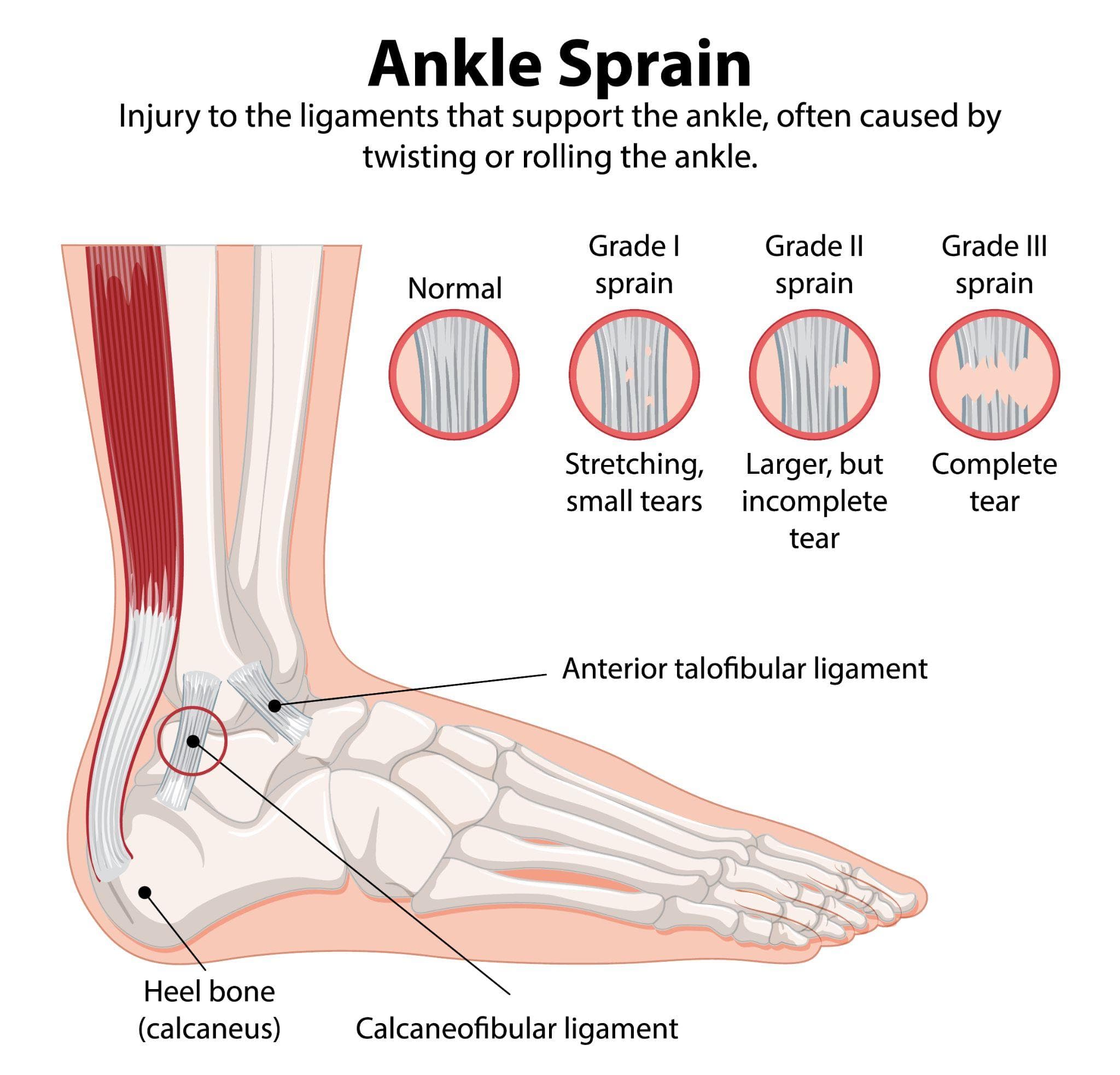
A diagram of an ankle, highlighting the different grades of a sprain.
What can seem like a small injury can turn into a long-term health problem if ignored. Ankle sprains usually result when the foot rolls or twists in an awkward position, over-stretching or rupturing the ligaments that support the ankle joint.
Many are happy to ignore mild sprains, thinking that they will just repair themselves in time. This may be the case, or a previously sprained ankle can result in future chronic pain, unstable joints, and recurring sprains. Anyone, from professional athletes to someone tripping up stairs, can injure their ankle.
It's not enough to just dismiss the injury; the grade needs to be understood, and treatment needs to be provided along with appropriate recovery time. In this guide, we will look at the grading, causes, treatment, and recovery time required for an ankle sprain.
What Is An Ankle Sprain?
An ankle sprain is damage to ligaments surrounding the ankle. Ligaments are tough fibrous tissues connecting bone to bone and helping to stabilize joints. When the ankle rolls beyond the ligaments' natural range of motion, they can either be stretched too far and torn or only overstretched, causing swelling, pain, and inability to move. The extent of damage to the ligaments indicates the severity of the sprain.
Grades Of Ankle Sprain
Ankle sprains are divided into three grades depending on the extent of the injury to the ligament:
- Grade 1 (Mild) - There is mild overstretching of the ligament without a tear; the ankle may ache slightly and swell a little, however, usually it is possible to walk.
- Grade 2 (Moderate) - There is an incomplete tear of the ligament. The ankle may be more painful, the swelling and bruising may become more noticeable, and it is painful to walk.
- Grade 3 (Severe) - There is a complete tear of the ligament. The ankle is unstable, very painful, and it is impossible to put any weight on it.
Causes Of An Ankle Sprain
Ankle sprains are generally caused by an unexpected twist or roll of the ankle, or any activity that makes the ligaments overstretch or tear. This may be an actual twist, but there are many underlying factors involved in sprains.
1. Sudden Twisting Or Rolling Of The Foot
The most frequent cause of an ankle sprain is a sudden inward or outward rolling of the foot, causing the ligaments to stretch past their normal limits, causing a tear or over-stretching of the ligament. This may happen during a stumble or after an impact, like when your foot lands incorrectly after landing a jump or during a rapid change of direction.
2. Sports And Physical Activities
The majority of ankle sprains occur during sports or physical activity due to high-impact or fast-paced sports that put a lot of stress on the joint. Activities that require jumping, running, sudden changes of direction, or quick stops can lead to an ankle sprain, such as basketball, football, netball, or tennis. Playing these types of sports with inadequate strength and technique increases the chance of injury.
3. Walking On Uneven Surfaces
Walking on an uneven surface, such as a pothole, slope, or any form of unsteady ground, can easily disrupt your balance and cause you to twist or roll the ankle. This often happens unintentionally, but more commonly when one isn't paying attention or is moving too quickly.
4. Wearing Improper Footwear
The correct footwear is essential for keeping the ankle safe. Certain footwear that can cause ankle sprains are high heeled shoes, as these will put pressure on the ankle. Loose and non-supportive shoes may also cause you to sprain your ankle by not holding the ankle securely.
5. Previous Ankle Injuries
A person with a previous ankle injury is likely to suffer from another similar one in the future, as the ankle is not likely to fully regain its original strength. The ligaments that have been previously stretched or torn may become permanently slightly longer and less tight, making the ankle more prone to future injuries, as balance may become reduced and uncoordinated, causing you to trip.
6. Weak Muscles And Poor Balance
The muscles around the lower leg support the ankle, so if they are weak, it puts more strain on the ankle joint and makes you more vulnerable to a sprain. If you have poor balance or lack coordination, you are more likely to roll your ankle when undertaking normal day-to-day activities.
7. Lack Of Warm-Up Or Stretching
Muscles that are stiff and unused are more susceptible to being torn when under stress, so warming up the muscles beforehand ensures that they can cope better with the forces placed upon them during exercise.
Common Symptoms Of An Ankle Sprain

A young man kneeling on a running track looks concerned while holding his injured ankle.
Typical signs of ankle sprain. The typical signs vary from different grades of ankle sprain. But in general, the following are symptoms:
- Pain, particularly with weight-bearing on the foot and walking.
- Swelling around the ankle.
- Discolouration (bruising).
- Restricted range of motion in the ankle.
- Tenderness on palpation of the ankle.
- Instability of the ankle joint.
Treatment Options For Ankle Sprain
There are several ways in which you can treat a sprained ankle, and the methods will depend on how badly you have sprained your ankle. Getting early and proper treatment for the injury can not only reduce pain and prevent complications but also encourage a speedy recovery. Delaying treatment and not giving the ankle adequate time to recover may lead to slower healing and recurrent injuries.
1. Non-Surgical Treatment
Ankle sprains, particularly grade 1 and grade 2 sprains, heal effectively without surgical intervention with adequate treatment. It involves aiming to reduce pain and swelling, as well as gradually restore movement and strength in the ankle.
2. R.I.C.E (Rest, Ice, Compression, And Elevation)
This should be the initial management for all ankle sprains; rest it until symptoms settle, ice for 15-20 minutes on the ankle 2-3 times daily, use compression using an elastic bandage or Tubigrip on the ankle, and raise the ankle to heart level to decrease swelling and pain. This can be applied in the first 24-72 hours post-injury.
3. Medication
Pain relief and anti-inflammatory medication will be prescribed in certain situations to control pain and swelling. The medication should not be used for extended periods, as it should be balanced with the proper rehabilitation.
4. Physiotherapy
Physiotherapy is a very important part of rehabilitation and should not be neglected even with mild sprains. It involves:
- Improves strength in the muscles surrounding the ankle
- Improves the range of motion and flexibility of the ankle joint
- Restores balance and coordination
- Decreases the chances of repeat sprains.
This helps to achieve a proper healing of the ankle before returning to activity.
5. Bracing Or Support
Ankle braces, taping, or supportive bandages can help to support the ankle joint and allow for continued but controlled activity with stability. Bracing and taping help to limit excessive movement that may irritate the ligaments and give confidence while walking. A brace may also be provided, such as a temporary walking boot, depending on the injury.
6. Return To Activity
This is one of the most common problems with ankle sprains: people return to activity too early, before sufficient recovery has been attained. The ankle requires regaining strength and stability prior to any demanding activity or sports. Gradually returning to activity will improve the strength and stability.
7. Surgery
Surgery is not commonly required for an ankle sprain, but it may be used in certain complex cases or with grade 3 injuries where the ligaments have completely torn. Surgery may also be performed if repeated ankle sprains have resulted in a chronic weakness and the ankle gives way frequently. Surgery may be performed to reconstruct or repair the torn ligaments and gain stability of the ankle.
To get the correct diagnosis and suitable treatment program in Noida, book an appointment with Dr. Mayank Chauhan.
Recovery Time For Ankle Sprain

A young man holds his injured ankle with a pained expression while sitting.
Ankle Sprain Recovery Time. Recovery can vary depending on severity and the treatments used.
- Grade 1: 1-2 weeks
- Grade 2: 3-6 weeks
- Grade 3: 8-12+ weeks
Let healing happen so the injury is less likely to recur.
When To See An Orthopedic Specialist
Sometimes ankle sprains require more than just the simplest of approaches.
- If the pain continues for more than a few days, it's wise to get an examination.
- If you are unable to walk without bearing weight on your ankle, it's a good sign that there may be a more significant injury.
- Frequent ankle sprains indicate there may be some underlying instability that needs evaluation.
- If the pain does not resolve after rest and taking pain relievers.
Final Thoughts
Although an ankle sprain may seem trivial, it may lead to serious problems later on in life. It's important to know what type of ankle sprain occurred, what treatment approach is best suited, and how long you should allow for recovery from the injury.
The right approach to the ankle sprain at its inception, with adequate healing and further supervision, allows the patient a fast return to their previous day-to-day activities as well as protection from further injury.
Dr. Mayank Chauhan in Noida provides tailored management strategies in conjunction with diagnosis to alleviate the pain as well as return your ankle range of motion.
Frequently Asked Questions
1. How long will a sprained ankle take to recover?
In mild sprains, recovery can take 1-2 weeks; in severe injuries, this can take up to 8-12 weeks.
2. Can you walk on a sprained ankle?
In mild sprains, it is possible, but for any severe ankle sprains, it is advisable to take the weight off and not walk on the sprained ankle, as you could further damage it.
3. What is the quickest way to heal a sprained ankle?
Recovery will be expedited with the R.I.C.E method alongside physiotherapy treatment.
4. When would you see a doctor about a sprained ankle?
If the sprained ankle is extremely painful, has a lot of swelling, or if you are unable to walk on the injury.