First Aid for Broken Bones: A Step-by-Step Guide from an Orthopedic Surgeon

A close-up of a foot wrapped in a medical bandage, highlighting first aid for broken bones.
A bone fractures, and panic sets in. It happens in seconds — a bad fall, a road accident, a sports collision. Most people have no idea what to do in those first critical minutes. Some try to straighten the limb. Others apply pressure directly to an open wound. Some just freeze.
The decisions made in those first few minutes after a fracture can genuinely affect outcomes — whether bleeding is controlled, whether the fracture site gets worse, whether shock sets in. This guide gives you the practical, clear information you need to act correctly when it matters most.
What Is a Bone Fracture?
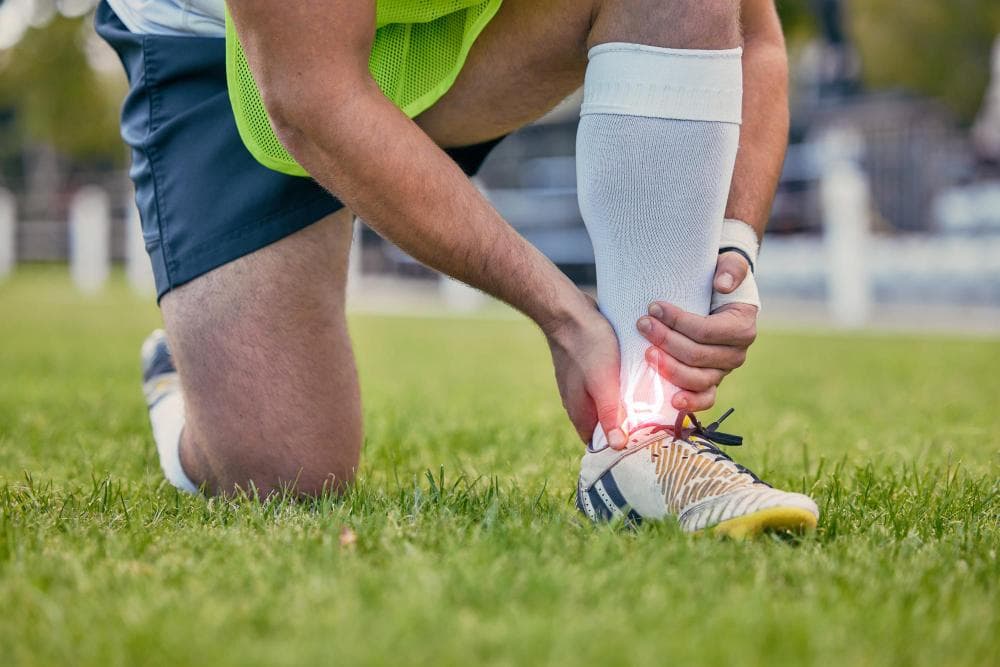
A fracture is a break or crack in a bone. They range from hairline stress fractures — small cracks that are almost invisible on X-ray — to complete breaks where the bone snaps into separate pieces. In the most serious cases, the broken bone pierces through the skin, creating what's called an open or compound fracture, which carries a significant risk of infection and bleeding.
Fractures are not just sports injuries. They happen from falls at home (especially in older adults with weakened bones), road accidents, workplace incidents, and even during everyday activities when bones are made fragile by conditions like osteoporosis. Globally, osteoporosis alone causes more than 8.9 million fractures every year — roughly one every three seconds.
Recognizing a Fracture: Signs to Look For
Before you can help, you need to recognize that a fracture has likely occurred. Not every fracture is obvious — some look like bad bruises.
Common signs of a fracture include:
- Intense, localized pain at the site of injury, which typically worsens with movement or pressure
- Swelling and bruising that develops rapidly around the affected area
- Visible deformity — the limb appears bent, twisted, or at an unnatural angle
- Inability to move the affected limb or bear weight on it
- A snapping or grinding noise heard at the moment of injury
- Numbness or tingling in the fingers or toes of the injured limb (indicates possible nerve involvement)
- Pallor or bluish tinge at the fingers or toes (indicates compromised blood circulation)
- Bone visible through the skin — this is an open fracture, a medical emergency
It's worth noting that a fracture can be hard to distinguish from a dislocation — both can cause severe pain, swelling, and deformity. Treat both the same way until professional medical help arrives.
Types of Fractures — A Quick Overview
Understanding the type of fracture helps explain why certain first aid steps are prioritized
Closed (Simple) Fracture — The bone breaks but remains within the skin. Most common type. Painful but lower risk of immediate infection.
Open (Compound) Fracture — The broken bone pierces through the skin, or there is a wound near the fracture site. High infection risk. Treat as a medical emergency.
Hairline (Stress) Fracture — A small crack in the bone, often caused by repetitive stress. Less dramatic in appearance but needs proper diagnosis and management.
Comminuted Fracture — The bone shatters into multiple fragments. Usually the result of high-impact trauma and often requires surgery.
Greenstick Fracture — Common in children, where the bone bends and partially breaks (like a green twig) rather than snapping completely.
Pathological Fracture — A fracture that occurs with minimal or no trauma due to an underlying condition weakening the bone — such as osteoporosis, bone tumors, or cancer that has spread to the bone.
Step-by-Step First Aid for a Broken Bone
Step 1: Stay Calm and Assess the Situation
Panic is natural but unhelpful. Your first job is to take a breath and assess the scene:
- Is the environment safe? (Traffic, falling objects, electrical hazards)
- Is the person conscious and breathing?
- Is there heavy bleeding?
- Could the neck or spine be injured? (This changes everything about how you move them)
If there are hazards or if the person is unconscious, unresponsive, or not breathing — call emergency services immediately. In India, dial 112 for emergency services.
Step 2: Call for Help
If any of the following are present, call emergency services without delay:
- The person is unconscious or not breathing
- Heavy bleeding that won't stop
- The bone is protruding through the skin (open fracture)
- You suspect a fracture in the neck, spine, or head
- The person shows signs of shock (pale skin, rapid shallow breathing, confusion, weak pulse)
- There is significant deformity of a large bone (femur/thigh, pelvis)
Even for less severe fractures, professional medical evaluation is always necessary. No fracture should be "managed at home" without a proper X-ray and diagnosis.
Step 3: Do NOT Move the Person Unnecessarily
This is one of the most important rules. Moving a person with a fracture — especially of the spine, pelvis, or femur — before stabilizing can cause serious additional damage, including spinal cord injury.
If the person must be moved because the environment is dangerous, do so as gently as possible, keeping the injured area as still as you can.
Step 4: Control Bleeding First (Open Fractures)
If there is an open fracture — bone through skin, or a wound near the fracture:
- Apply gentle pressure around (not directly on) the wound using a clean cloth, sterile bandage, or clean clothing
- Do not push the bone back in — this is critical
- Do not probe or try to clean the wound
- Cover the wound with a clean cloth or sterile dressing to protect it from contamination
- Elevate the injured limb above heart level if possible, but only if it doesn't cause additional pain
Step 5: Immobilize the Injured Area
Keeping the fracture site still prevents further damage to surrounding nerves, blood vessels, and tissue.
How to immobilize:
- Keep the injured limb in the position you find it — do not try to straighten it
- If a commercial splint is available, apply it above and below the fracture site (not directly on it)
- Improvised splints can be made from rigid materials: rolled-up newspapers, magazines, wooden boards, or walking sticks
- Pad the splint with soft material (cloth, foam) to prevent pressure sores
- Secure the splint with bandages or strips of cloth — firm enough to hold the limb still, but not so tight as to cut off circulation
- For spine or pelvis fractures, do not apply a splint — keep the person as still as possible and wait for emergency services
Check circulation in the fingers or toes beyond the fracture site every 15 minutes. If the skin becomes pale, blue, numb, or cold, the splint may be too tight — loosen it carefully.
Step 6: Apply Ice to Reduce Swelling
Wrap an ice pack, bag of frozen peas, or ice cubes in a cloth and apply to the area around the fracture. Do not place ice directly on the skin.
Leave the ice on for 15–20 minutes at a time. This reduces swelling and helps manage pain while waiting for help to arrive.
Never apply ice to an open fracture — this can introduce further contamination risk.
Step 7: Manage for Shock
Shock is a real risk with serious fractures, especially when there is significant blood loss or severe pain. Signs of shock include:
- Pale, cold, or clammy skin
- Rapid, shallow breathing
- Weak or rapid pulse
- Dizziness, confusion, or faintness
- Nausea
If shock is suspected:
- Lay the person down
- Elevate their legs slightly (about 30 cm / 12 inches) above the level of the heart — unless the fracture is in the pelvis, femur, or spine
- Keep the person warm with a blanket or jacket
- Do not give them food, water, or any medication
- Talk to them calmly and reassure them
Step 8: Reassure and Monitor
A person with a fracture is often frightened and in severe pain. Keep talking to them. Tell them help is on the way. Encourage them not to move the injured area. Monitor their breathing, consciousness level, and circulation in the injured limb until emergency services arrive.
Special Situations
1. Fractures in Children
Children's bones are softer and more flexible — they can sustain greenstick fractures that might not look as dramatic as adult fractures but still need medical care. Children may not always be able to describe their pain clearly. If a child is refusing to bear weight on a limb or crying persistently after a fall, suspect a fracture and seek medical attention.
Children also have growth plates at the ends of their long bones. Fractures that involve these growth plates require expert orthopedic assessment, as improper management can affect normal bone development.
2. Spinal Fractures
If you suspect a neck or back fracture — after a diving accident, a fall from height, or a high-speed collision — do not move the person. Keep their head, neck, and spine in the same position as you found them. This cannot be overstated. Moving a person with an unstable spinal fracture without proper support can cause or worsen spinal cord injury. Call emergency services immediately and wait.
3. Fractures in Elderly Patients
Older adults — particularly those with osteoporosis — can sustain fractures from surprisingly minor forces, like stepping off a pavement at an odd angle or simply sitting down too hard. Hip fractures in the elderly are particularly serious, as they are associated with significant complications and require prompt surgical management. If an elderly person falls and complains of hip or groin pain, or cannot get up from the floor, suspect a hip fracture and call for emergency help immediately.
4. Open (Compound) Fractures
Always treat these as an emergency. The risk of infection is significant. Do not attempt to clean the wound or push the bone back in. Cover it, control bleeding, keep the person still, and get them to a hospital as quickly as possible.
What NOT to Do — Common Mistakes to Avoid
These are mistakes that can make a fracture significantly worse:
- Do not try to straighten or realign the bone — ever. This can damage nerves and blood vessels further
- Do not apply a tourniquet unless bleeding is life-threatening and uncontrollable by other means — tourniquets can destroy tissue if left too long
- Do not give food, water, or medication — the person may need surgery, and these can complicate anaesthesia
- Do not ignore a suspected fracture thinking it's "just a bruise" — always get an X-ray if you're uncertain
- Do not apply ice directly to the skin or to an open wound
- Do not move someone with a suspected spinal injury without professional assistance
After First Aid — What Happens at the Hospital?
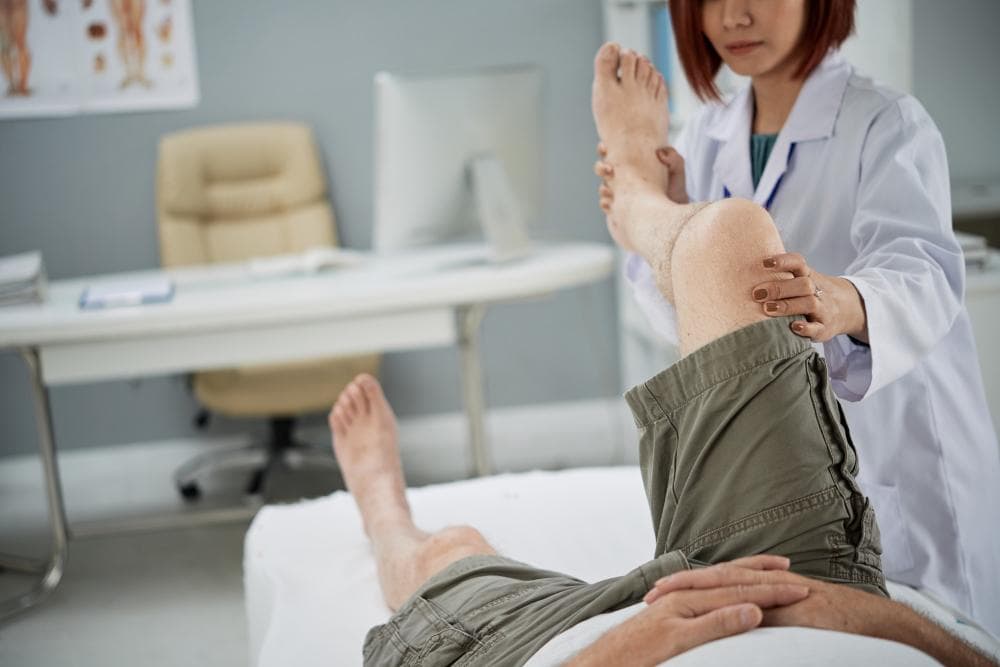
Once the person reaches a hospital or orthopedic clinic, the treating doctor will:
- Take a detailed history and examine the fracture site
- Order X-rays to confirm the fracture, assess its type and severity, and check alignment
- In complex cases, a CT scan or MRI may be ordered for detailed imaging
- Decide on the appropriate treatment:
- Casting or splinting for stable, properly aligned fractures
- Closed reduction (manipulating the bone back into position without surgery) followed by casting
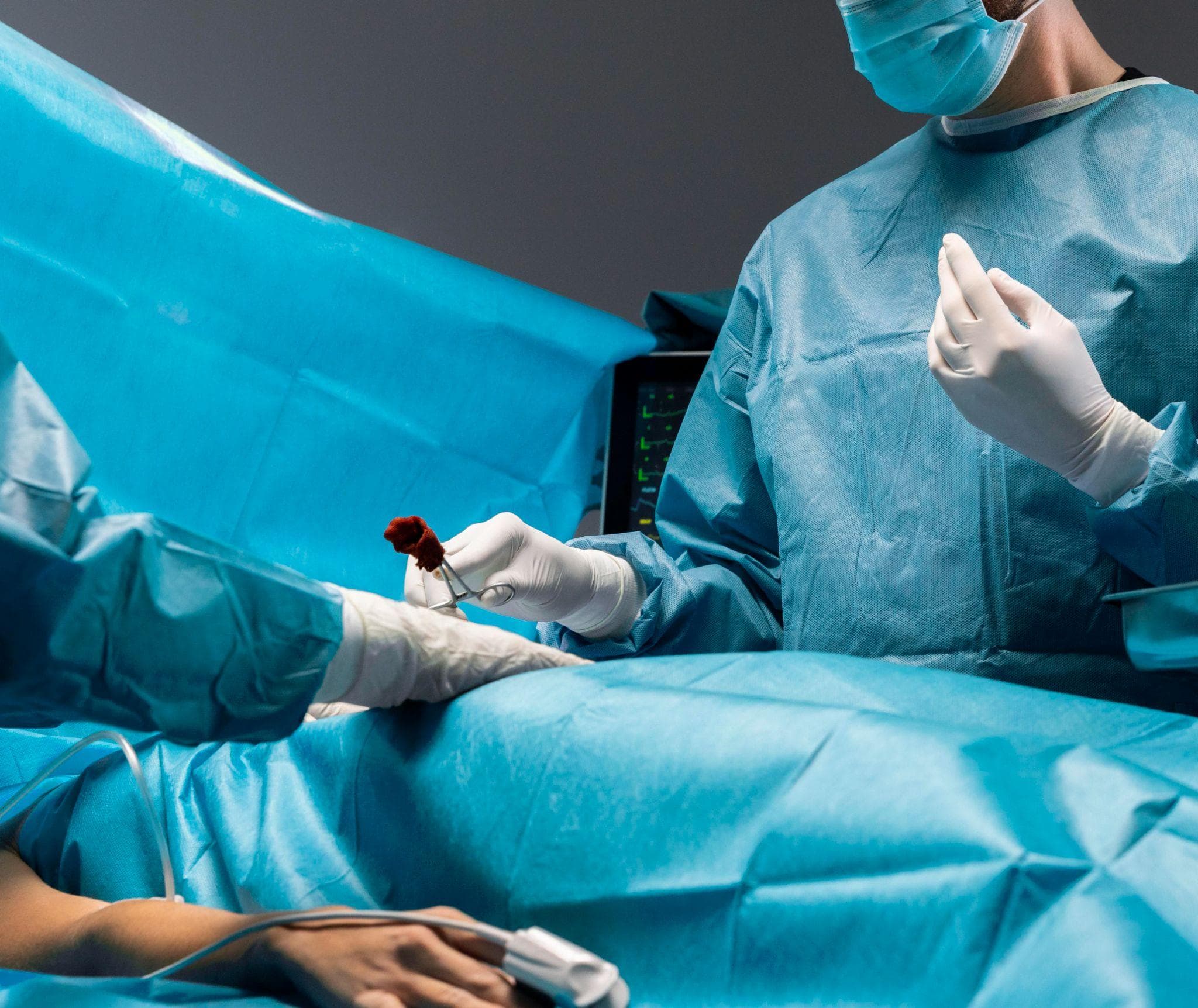
- Surgery (Open Reduction and Internal Fixation, or ORIF) using plates, screws, rods, or nails to hold the bone in correct position while it heals
- External fixation in cases where internal hardware isn't suitable
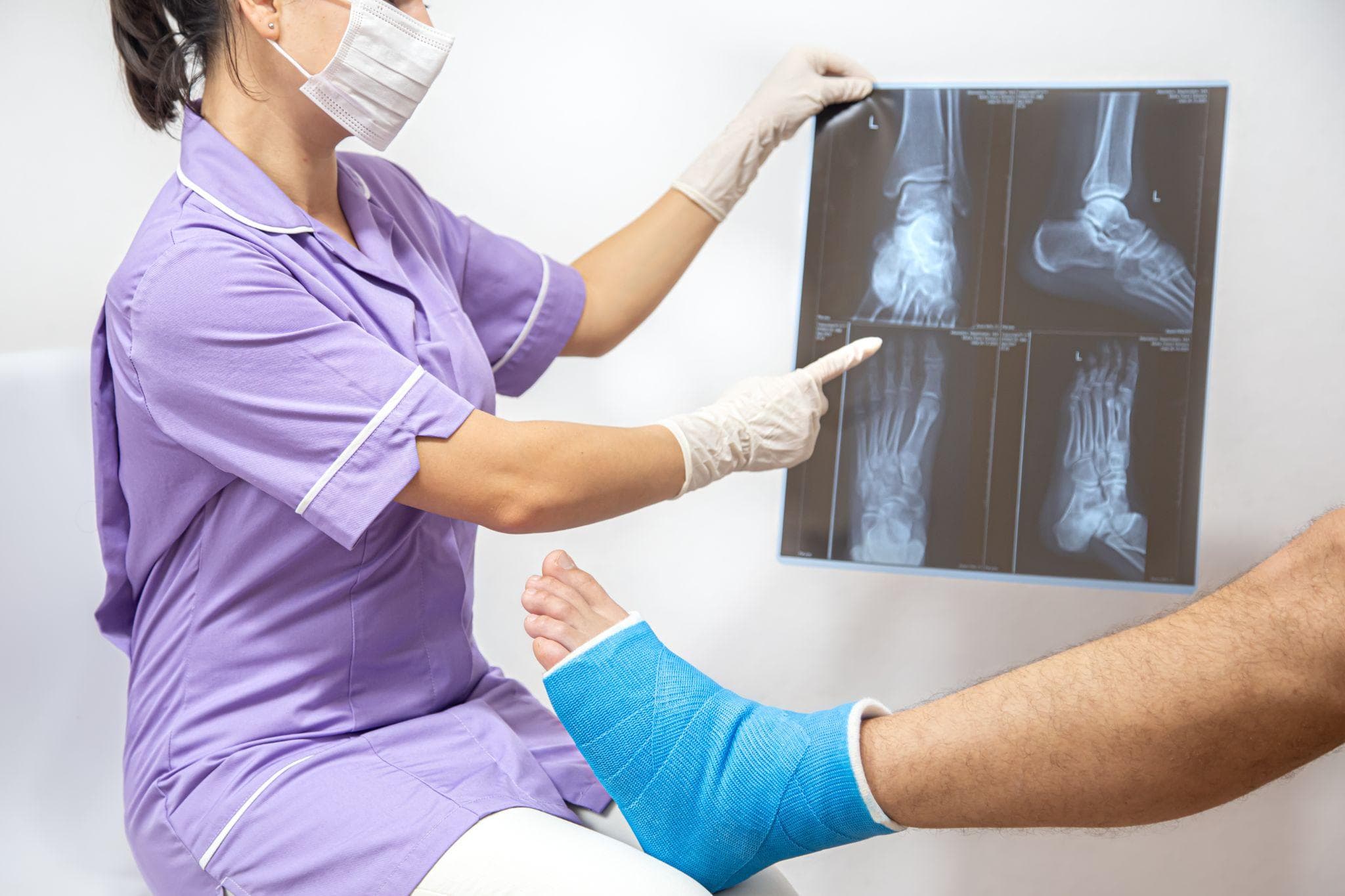
An orthopedic doctor examining X-ray images of a foot fracture in a hospital setting. X-rays help assess fracture severity and guide appropriate treatment planning.
For complex fractures — comminuted fractures, open fractures, fractures near joints, or fractures in elderly patients with osteoporosis — experienced orthopedic surgical management is critical to achieving proper healing and restoring function.
Orthopedic Fracture Care in Noida and Greater Noida
If you or someone you know sustains a fracture in Noida, Greater Noida, or anywhere in Delhi NCR, prompt, expert orthopedic evaluation is essential. Dr. Mayank Chauhan, Senior Orthopedic Surgeon at Prakash Hospital, Sector 33, Noida, offers comprehensive fracture management — from emergency assessment and reduction to complex fracture surgery, post-operative care, and rehabilitation guidance.
With over 15 years of clinical experience — including training at Apollo Hospital, international fellowship experience in South Korea, and SICOT fellowship training in Mumbai — Dr. Chauhan has managed a wide range of fracture types across all age groups.
For emergencies and appointments, call: +91 7303245544
Clinic hours: Monday to Saturday, 10 AM to 8 PM | Sunday, 10 AM to 2 PM
Location: D-12, 12A, 12B, Sector 33, Noida (next to ISKCON Temple)
Prakash Hospital provides 24/7 emergency care for fractures and trauma.
Frequently Asked Questions (FAQs) About Broken Bone First Aid
Q1. How do I know if it's a fracture or just a bad sprain?
Sprains and fractures can look very similar — both cause pain, swelling, and bruising. The key differences: a fracture often involves visible deformity, inability to bear weight, a snap heard at the time of injury, or numbness in the fingers or toes. When in doubt, always treat it as a fracture and get an X-ray. Assuming it's a sprain when it's actually a fracture can delay healing and lead to complications.
Q2. Can I drive someone with a suspected fracture to the hospital myself?
For arm or hand fractures that have been properly immobilized, this may be feasible. For fractures of the leg, femur, pelvis, spine, or any fracture with heavy bleeding, unconsciousness, or shock — call emergency services. Moving such patients incorrectly can worsen injuries significantly.
Q3. Should I give painkillers to someone with a broken bone?
Avoid giving any medication if the person may need surgery, as food and medication can delay safe anaesthesia. If surgery is not anticipated and the fracture is a minor one, an over-the-counter painkiller may be appropriate — but consult a doctor or emergency operator first.
Q4. What is an open fracture and why is it more serious?
An open fracture is one where the broken bone penetrates the skin, or where a wound is present near the fracture. The danger is infection — bacteria can enter the body and potentially reach the bone, leading to a serious condition called osteomyelitis. Open fractures always require emergency surgical treatment, thorough wound cleaning, and often intravenous antibiotics.
Q5. How long does a broken bone take to heal?
It depends on the bone, the type of fracture, the patient's age, and overall health. Small bones in the hand or foot may heal in four to six weeks. A femur (thigh bone) or pelvis fracture can take three to six months. Elderly patients and those with osteoporosis generally heal more slowly. Children heal faster than adults due to their more active bone growth.
Q6. Is physiotherapy necessary after a fracture?
In most cases, yes — especially for fractures near joints. After a period of immobilization, the surrounding muscles weaken and the joint can stiffen. Physiotherapy helps restore strength, flexibility, and normal movement. Starting physiotherapy at the right time (as directed by the orthopedic surgeon) significantly improves the final outcome.
Q7. Can a fracture heal incorrectly?
Yes — this is called a malunion (healed in a wrong position) or non-union (failed to heal). Both can result from inadequate immobilization, poor blood supply, infection, or delayed treatment. This is why proper diagnosis and orthopedic management from the beginning is important. Malunions and non-unions may require corrective surgery.
Q8. Are fractures more common in people with osteoporosis?
Significantly so. Osteoporosis weakens bone density, making fractures possible from forces that would not normally break a healthy bone. Hip fractures, vertebral fractures, and wrist fractures are particularly common in osteoporotic patients. If you have been diagnosed with osteoporosis — or if you are over 50 and have never had a bone density test — consulting an orthopedic surgeon is a sensible step.
The information in this blog is for general educational purposes only and does not substitute professional medical advice. In case of a suspected fracture, seek emergency medical attention immediately. Always consult a qualified orthopedic surgeon for diagnosis and treatment.