Sciatica vs Back Pain — How to Tell the Difference
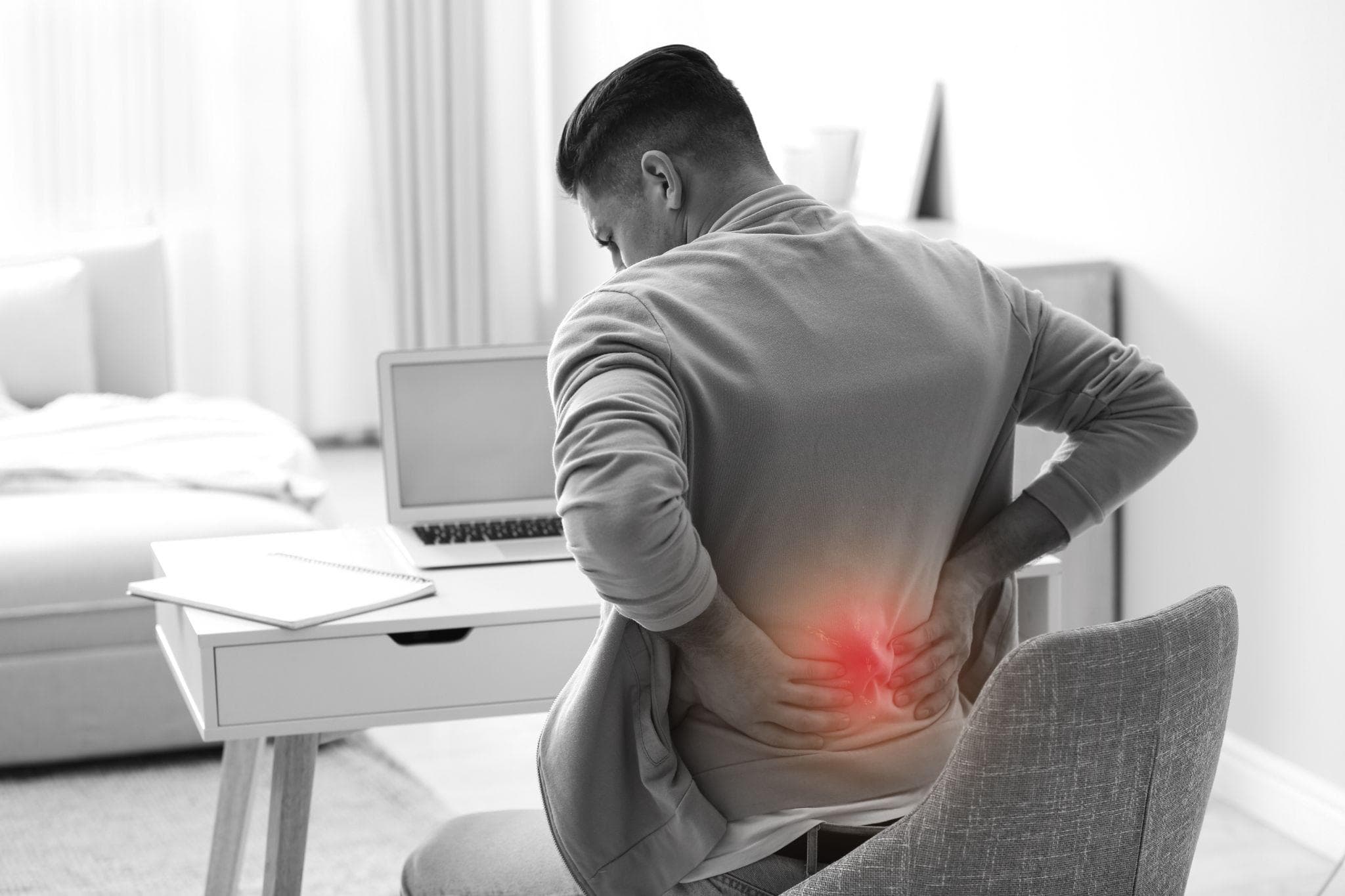
A man suffering from lower back pain while sitting, indicating slip disc due to poor posture.
Back pain is one of the most common health complaints in India. Almost everyone has it at some point — desk workers, labourers, drivers, older adults, young athletes. It ranges from an annoying stiffness that resolves in a few days to a debilitating, life-limiting condition.
Sciatica is different. The two are frequently confused, treated the same way, and managed ineffectively as a result.
Understanding which one you have is not an academic exercise. The treatment that works for mechanical back pain is often different from what helps sciatica. Confusing them delays recovery and sometimes worsens the problem.
What Is Mechanical Back Pain?
Mechanical back pain — the more common type — originates from the structures of the spine itself: the muscles, ligaments, facet joints, or discs. It has nothing to do with nerve compression.
The most typical causes:
- Muscle strain or spasm from heavy lifting, awkward movement, or prolonged sitting
- Facet joint arthritis (wear of the small joints that link vertebrae)
- Degenerative disc disease (age-related disc thinning without nerve compression)
- Poor posture sustained over time
- Sacroiliac joint dysfunction
Characteristics of mechanical back pain:
- Pain is located in the lower back, possibly spreading to the buttocks or upper thigh
- It does not typically go below the knee
- It is aggravated by specific movements — bending, twisting, prolonged sitting or standing
- It improves with rest, heat, gentle movement
- There is usually no numbness, tingling, or weakness in the legs
Most mechanical back pain is self-limiting. It improves within days to weeks with appropriate activity modification, physiotherapy, and occasional short-term anti-inflammatory medication.
What Is Sciatica?
Sciatica is not a diagnosis — it is a symptom. Specifically, it describes pain, numbness, tingling, or weakness that follows the path of the sciatic nerve down the leg.
The sciatic nerve is the largest nerve in the body. It forms from nerve roots at the L4, L5, and S1 levels of the lumbar spine, travels through the buttock, down the back of the thigh, through the knee, and into the calf and foot. When these roots are compressed or irritated, symptoms radiate along this path.
The most common causes:
- Herniated lumbar disc: The soft inner gel of a disc pushes through the tough outer ring and presses on a nerve root. The most common cause of sciatica, particularly in patients under 50.
- Lumbar spinal stenosis: Age-related narrowing of the spinal canal or exit foramina, compressing nerve roots. More common after 50.
- Spondylolisthesis: One vertebra slips forward over the one below, narrowing the nerve exit.
- Piriformis syndrome: The piriformis muscle in the buttock irritates the sciatic nerve passing near or through it. Often misdiagnosed as lumbar sciatica.
- Disc osteophyte complex: Combined disc degeneration and bony overgrowth that narrows nerve space.
Characteristics of sciatica:
- Pain typically starts in the lower back or buttock and radiates down one leg — often below the knee, sometimes to the foot
- Affects one leg (sciatica from a herniated disc is almost always unilateral)
- Often described as sharp, burning, electric, or shooting — quite different from the dull ache of muscular back pain
- Accompanied by numbness, tingling ("pins and needles"), or weakness in the affected leg or foot
- Worsened by sitting for prolonged periods, coughing, sneezing, or straining (which increase disc pressure)
- May feel better walking than sitting still
The Key Question: Does Your Pain Go Below the Knee?
This is the most useful practical question to start with.
Back pain that stays in the lower back and buttock, or at most reaches the back of the thigh, is likely mechanical back pain.
Pain that travels past the knee — into the calf, ankle, or foot — points strongly toward nerve involvement. This is characteristic of sciatica.
That said, buttock pain alone can occasionally be sciatica (with the nerve irritated high up), and upper thigh pain can also be sciatic in origin. The below-the-knee distinction is a guide, not an absolute rule.
How Doctors Distinguish Between Them
1. History
A careful history of pain location, character (dull vs shooting), aggravating and relieving factors, timing, and associated symptoms (numbness, weakness, bladder/bowel changes) is usually enough to form a strong clinical impression.
2. Physical Examination
Several tests help identify nerve involvement:
Straight leg raise (SLR) test: The patient lies flat. The examiner slowly lifts the straight leg. If pain radiating down the leg is reproduced between 30–70 degrees of elevation, this suggests nerve root compression. A positive SLR with leg pain (not just back pain) is highly specific for disc herniation.
Crossed SLR: The asymptomatic leg is raised, and pain is reproduced in the symptomatic leg. This suggests a central disc herniation with more severe nerve compression.
Neurological examination: Checking reflexes (knee jerk at L4, ankle jerk at S1), muscle strength (hip flexors, knee extensors, foot dorsiflexors, great toe extensors), and sensation in dermatomal patterns. Loss of ankle reflex suggests S1 involvement. Foot drop (difficulty lifting the foot) suggests L5 involvement.
3. Imaging
X-ray: Shows bony alignment, disc space narrowing, osteophytes. Does not show discs or nerves directly.
MRI: The investigation of choice for sciatica. Shows disc herniation, nerve compression, stenosis, and soft tissue pathology. An MRI should be obtained when the diagnosis is unclear, when symptoms don't respond to 4–6 weeks of conservative management, or when there are red flags suggesting serious pathology.
CT scan: Useful when MRI is unavailable or contraindicated, and particularly for bony detail.
Nerve conduction studies / EMG: Reserved for cases where the clinical picture and MRI don't align, or when peripheral nerve or plexus disorders need to be excluded.
Red Flags — Seek Immediate Assessment
Certain features of back pain require urgent medical evaluation:
- Bladder or bowel dysfunction with back pain (inability to pass urine, or incontinence) — this may indicate cauda equina syndrome, a surgical emergency
- Progressive weakness in both legs
- Pain after significant trauma (fall, accident)
- Back pain with unexplained weight loss, fever, or night sweats — possible malignancy or infection
- Back pain in a patient with a history of cancer
- Severe constant pain that doesn't change with position
These features require immediate imaging and specialist assessment, not watchful waiting.
Treatment: Why the Distinction Matters
1. Mechanical Back Pain
- Short-term rest followed by gradual return to activity
- Anti-inflammatory medication (NSAIDs) for pain management
- Physiotherapy: core strengthening, postural correction, flexibility training
- Heat therapy for muscle spasm
- Avoiding prolonged static postures
- Weight management
Most cases resolve within 6–12 weeks without specific intervention.
2. Sciatica
- Conservative first-line: NSAIDs, short-term rest, gentle movement (prolonged bed rest makes sciatica worse in most cases)
- Physiotherapy: Neural mobilisation exercises, specific directional movements (McKenzie method) can help centralise pain away from the leg
- Oral steroids: A short course can reduce nerve root inflammation in acute severe sciatica
- Epidural steroid injection: Guided injection of corticosteroid near the affected nerve root, reducing local inflammation. Effective for short-to-medium term relief while natural resolution occurs
- Surgery: Indicated when sciatica doesn't resolve after 6–12 weeks of conservative management, when there is progressive neurological deficit (worsening weakness), or in cauda equina syndrome (emergency). Microdiscectomy — removal of the herniated disc fragment — relieves leg pain in 70–90% of properly selected patients
What Most People Don't Know About Sciatica
Most sciatica from a herniated disc resolves without surgery. The disc herniation gradually resorbs over weeks to months — an immune-mediated process where the body naturally shrinks the herniated material. Up to 80% of patients with sciatica improve significantly without surgical intervention.
The role of surgery is to speed recovery and relieve symptoms when natural resolution is too slow, when quality of life is severely affected, or when there is neurological deterioration.
Surgery for sciatica treats the leg symptoms reliably. It does not always eliminate the back pain — the back pain often has its own mechanical component that continues independently.
Consult Dr. Mayank Chauhan at Prakash Hospital, Noida
Dr. Mayank Chauhan evaluates both back pain and sciatica at Prakash Hospital, Sector 33, Noida. He sees patients from Noida, Greater Noida, Ghaziabad, and the broader Delhi NCR region for spine pain assessment, physiotherapy planning, injection procedures, and surgical management where required.
To book a consultation, call the number listed on the website.