How Long Does Knee Replacement Last? Implant Life and What Affects It

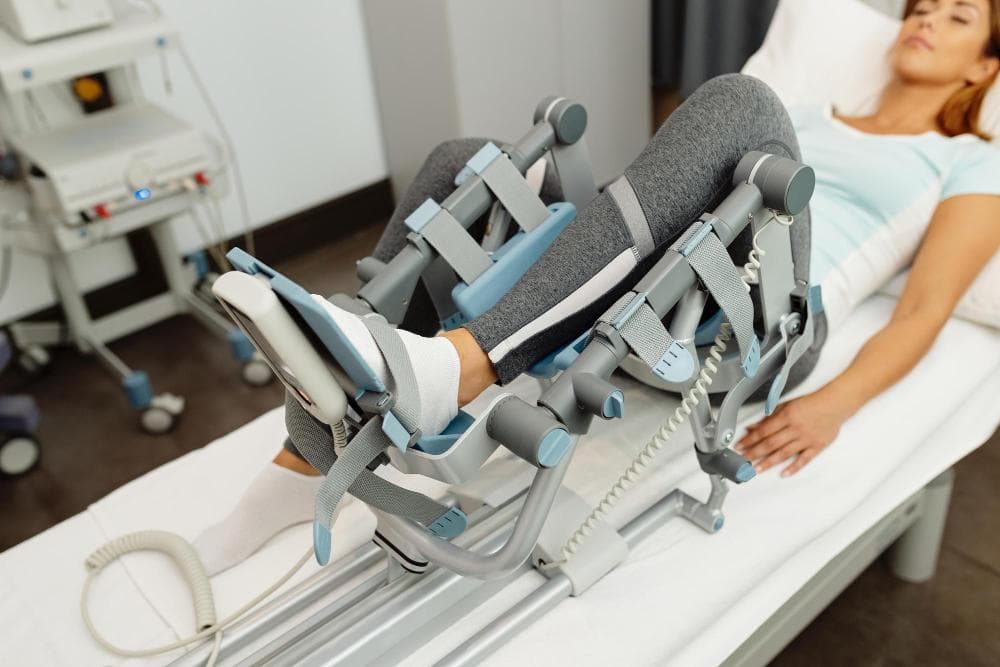
A patient is sitting with a knee brace and a doctor is examining it.
When patients are deciding whether to have knee replacement surgery, one of the first questions they ask is also one of the most important: how long will it actually last?
It's a fair question. If you're 58 years old and considering replacement, you might be looking at 25 or more years ahead. Will one surgery be enough? Or will you face a second operation in your 70s?
The answer, based on current evidence, is more reassuring than most patients expect — and more nuanced than a simple number.
What the Evidence Shows
The data on knee replacement longevity now comes from multiple large national joint registries and long-term studies covering hundreds of thousands of patients. The picture is consistent:
- More than 90% of total knee replacements are still functioning well at 15 years
- 82–90% continue to function at 20–25 years
- A landmark Lancet analysis of over 60,000 patients found 82% of knee replacements still functioning at 25 years
More recent data is even more encouraging. Long-term studies specific to modern implant designs and materials show function beyond 25 years in a significant proportion of patients — with some researchers reporting numbers approaching 90% at 25 years.
For context: a 65-year-old patient who has knee replacement surgery today has a reasonable expectation that their implant will last for the rest of their natural life without requiring revision.
For a 55-year-old, the situation is slightly different. There is a higher probability of outliving a single implant — though even here, many patients do not require revision within their lifetime.
What Makes a Knee Replacement Last
The lifespan of a knee replacement is not simply a property of the implant. It is determined by a combination of implant factors, surgical factors, and patient factors.
1. Implant Materials and Design
Modern knee implants use a combination of:
- Cobalt-chromium alloy (for the femoral component): Hard, smooth, and corrosion-resistant
- Titanium alloy (sometimes for tibial trays): Biocompatible, allows bone ingrowth in cementless designs
- Highly cross-linked polyethylene (for the tibial insert): The plastic spacer that the metal articulates against
The polyethylene insert is the component that wears over time. Highly cross-linked polyethylene — developed in the 1990s and now standard — has dramatically reduced wear rates compared to older conventional polyethylene. This is the primary reason modern implants outlast those of two decades ago.
Some patients ask about oxidized zirconium (a ceramic-coated metal) or ceramic femoral components: these produce even less wear debris and may be particularly beneficial in younger, more active patients.
2. Surgical Precision: Alignment Matters Most
The single most important surgical factor for implant longevity is correct alignment. A knee replacement component that is positioned even a few degrees outside the ideal range creates uneven stress distribution across the polyethylene insert — accelerating wear on one side and leading to premature loosening.
This is one reason robotic and computer-assisted surgery have gained traction. These systems verify alignment intra-operatively, reducing the margin of error in implant positioning from 2–3 mm to under 0.5 mm. Whether this translates into meaningfully better long-term survivorship over manual techniques performed by experienced surgeons is still under study, but the theoretical advantage is sound.
Ligament balancing — ensuring the knee is neither too loose nor too tight through its range of motion — also significantly affects longevity and patient satisfaction.
3. Patient Weight (BMI)
Every extra kilogram of body weight adds approximately 3–4 kg of load across the knee during walking, and considerably more during stair climbing or rising from a chair. Obese patients put significantly greater repetitive mechanical stress on their implants, accelerating polyethylene wear and increasing the rate of loosening over time.
This is not a reason to deny knee replacement to overweight patients who need it — the surgery is still appropriate and effective. But it does mean that weight management post-operatively meaningfully extends implant life.
4. Activity Level
High-impact activities — running, jumping, heavy squatting with load, racquet sports with explosive movements — increase the cumulative mechanical stress on the implant far more than low-impact activities.
After knee replacement, patients are advised to enjoy walking, swimming, cycling, yoga, gentle hiking, and social dance. Running and high-impact sport are generally discouraged — not because a single session will damage the implant, but because years of high-impact loading accelerate wear.
Many patients push back on this, particularly those who were runners before surgery. The honest answer: controlled data shows that implants in patients who return to running wear faster and have higher revision rates than those who stick to low-impact activity. This may be worth it for some patients — but it's a trade-off to discuss with your surgeon.
5. Patient Age
Younger patients place greater lifetime demand on their implants — more years of use, higher average activity levels, and potentially greater force through the implant (younger patients are often heavier or more physically active). This is why revision rates are higher in younger patients.
This does not mean young patients shouldn't have knee replacement. The surgery is appropriate when the quality-of-life benefit justifies it. But age is one reason why surgeons may be somewhat more conservative in recommending replacement for a 45-year-old than a 68-year-old, particularly if partial replacement or other interventions remain viable options.
6. Bone Quality
Osteoporosis affects how well the implant integrates with the surrounding bone. In osteoporotic bone, cemented fixation remains effective, but loosening can occur earlier than in patients with normal bone density. Pre-operative bone health assessment — and treatment of osteoporosis where appropriate — is part of good pre-operative planning.
Signs That a Knee Replacement May Be Failing
Understanding what failure looks like helps patients recognise when to seek review:
- Return of knee pain after a period of good function — particularly if the pain is gradually worsening
- Pain on weight-bearing that improves with rest, which can suggest loosening
- Acute swelling, warmth, and redness — infection must be excluded urgently
- The knee feeling unstable or giving way
- Progressive loss of movement that wasn't present at 6–12 months post-operatively
- A clunk or click with movement that is new
Not all of these symptoms necessarily mean surgery is required. Some — particularly mild pain — can be evaluated and managed conservatively. But they warrant assessment.
What Is Revision Surgery?
If a knee replacement fails, revision surgery — removing and replacing the failed implant — is the treatment. It is a more complex operation than the original replacement, requiring:
- Specialised revision implants (often longer-stemmed, with metal augments to manage bone loss from implant removal)
- More operating time
- Greater rehabilitation demands
- Performance at high-volume, experienced revision centres
Revision surgery has good outcomes in well-selected patients, but they are somewhat less predictable than primary replacement. Preventing the need for revision — through appropriate activity, weight management, and regular follow-up — is always the better path.
How to Make Your Knee Replacement Last
These are the practical steps that extend implant life:
Maintain a healthy weight: Every kilogram matters. Even modest weight loss reduces daily implant loading significantly.
Exercise regularly — low impact: Walking, swimming, cycling, yoga. These maintain strength and joint health without excessive implant wear.
Avoid high-impact activity: Running, jumping, loaded squatting. Discuss any specific activity concerns with your surgeon.
Follow physiotherapy protocols: Strong surrounding muscles distribute load more evenly across the implant. Patients who complete rehabilitation thoroughly generally have better long-term function.
Attend follow-up appointments: Annual or biennial review with X-rays allows early detection of loosening or wear before it becomes symptomatic or irreversible.
Report new symptoms early: Pain that returns or changes character after a good period should be evaluated, not ignored.
Control bone health: Treat osteoporosis if diagnosed. Ensure adequate calcium and vitamin D.
Dr. Mayank Chauhan at Prakash Hospital, Noida
Dr. Mayank Chauhan performs total and partial knee replacement at Prakash Hospital, Sector 33, Noida, using current alignment techniques and high-quality implants. He also evaluates patients with concerns about existing knee replacements — whether from prior surgery at Prakash Hospital or elsewhere.
To book a consultation, call the number listed on the website.