Reviewed by Dr. Mayank Chauhan
Robotic vs Conventional Knee Replacement: An Honest Comparison

The robot guides the bone cuts; the surgeon still plans and performs the operation.
If you are told you need a knee replacement, you will soon meet the word "robotic." Hospital hoardings promise precision. A relative says a neighbour had robotic surgery and walked the next day. A website claims better results, faster recovery and longer-lasting knees.
Some of this is true, and some of it is marketing. Robotic technology is a real advance in how accurately an implant can be placed. Whether that accuracy translates into a knee that feels and lasts better for you is a more complicated question, and the honest answer is that the evidence is still developing.
A quick look at both approaches
Conventional knee replacement
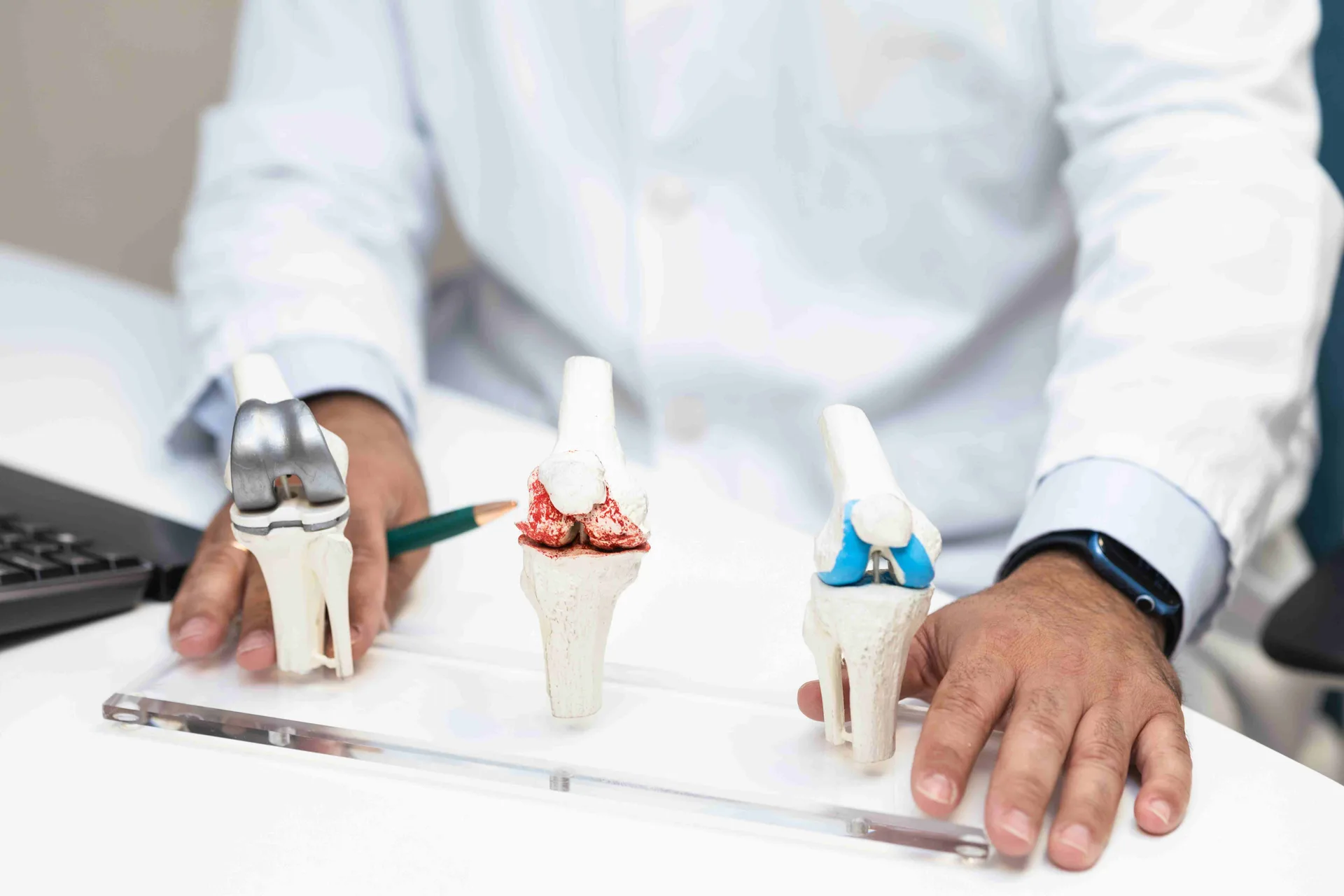
The surgeon uses mechanical cutting guides, sometimes called jigs, positioned against the bone to make the cuts, guided by X-rays, measurements and experience. The surgeon assesses alignment and balance during the operation by eye and with trial implants. It is the standard approach and the one with the longest track record.
Robotic-assisted knee replacement
A robotic system helps the surgeon plan and carry out the bone cuts. Systems differ, but generally:
- A plan is created from a CT scan or from measurements taken during surgery, mapping the patient's knee.
- The surgeon marks the anatomy, and the system tracks the bones in real time.
- The robotic arm or a guided saw restricts the cuts to the planned boundaries.
- The surgeon still performs the operation. The robot does not operate by itself.
For a closer look at how the technology works, see our guide on robotic knee replacement and who benefits.
What the research says
The most useful evidence comes from randomised trials, and several have been pooled in meta-analyses. A meta-analysis of seven randomised controlled trials, covering 1,942 knees (974 robotic and 968 conventional), reached these conclusions:
- Alignment: Robotic surgery produced significantly better alignment of the implant, meaning the leg axis was closer to the intended target.
- Function: Knee scores, including the Knee Society Score, the Hospital for Special Surgery score and the WOMAC arthritis index, were not significantly different between the two groups. Range of movement was also similar.
- Complications: The complication rate, including infection, loosening and stiffness, was similar in the two groups.
- Limitations: Most of the trials were small, used older or different systems and had varying follow-up periods. Several had some concerns about bias. The authors called for more trials using newer robotic systems.
Another recent systematic review of randomised trials reached similar conclusions in broad terms: robotic systems improve the precision of component positioning, while the improvement in patient-reported outcomes is modest and inconsistent.
So what do we actually know?
Where the evidence is solid
- Robotic systems can place implants more accurately and reduce the number of outliers (implants that end up significantly off target).
- Complication rates in the studies have not been clearly different.
- Short- and medium-term patient-reported results in trials are generally similar.
Where the evidence is uncertain
- Long-term implant survival. Better alignment is expected to lead to better longevity, but proof requires follow-up of 10 to 15 years or more, and that data is still emerging for newer systems.
- Pain and recovery. Some studies suggest less soft tissue trauma and less early pain with robotic techniques, but results are mixed.
- Which patients benefit most. Those with complex deformity, previous surgery or unusual anatomy may gain more, but this is not firmly established.
- Newer systems. Technology evolves quickly, and trials often lag behind the latest generation.
In short, a more accurate cut is a measurable benefit, but a proven better knee for every patient is not yet established.
Comparing the two approaches
| Aspect | Conventional | Robotic-assisted | |---|---|---| | Surgeon in control | Yes | Yes | | Planning | X-rays and measurements | Often CT-based or intraoperative mapping | | Cutting guidance | Mechanical jigs | Robot-assisted boundaries | | Implant alignment accuracy | Good in experienced hands | Often more precise, fewer outliers | | Soft tissue balancing | Surgeon's feel and judgement | Data-assisted balancing in some systems | | Operating time | Usually shorter | May be longer, especially early in a surgeon's experience | | Equipment and set-up | Simple | Specialised equipment and training needed | | Track record | Longest | Shorter, growing | | Patient-reported results in trials | Good | Similar in most studies | | Availability | Widely available | Limited to centres that have invested in the system |
Who might benefit from the robotic approach?
Robotic assistance may be worth considering for:
- Patients with significant deformity, such as severe bow legs or knock knees
- Those with previous fractures, implants or surgery around the knee that make landmarks difficult
- Younger, active patients for whom implant positioning matters more over a long lifespan
- Situations where the surgeon feels that precise planning will help
For a straightforward knee in an experienced surgeon's hands, conventional surgery gives excellent results, and the extra benefit of robotics may be small.
What matters more than the technology
Several studies and surgeons will tell you the same thing: the surgeon's skill and experience are bigger drivers of a good outcome than the platform. Factors that affect the result:
- Surgeon training and volume. A surgeon who performs many knee replacements and has specialised joint replacement training is more likely to achieve a well-balanced knee.
- Patient selection. Replacement is for people whose pain and loss of function justify surgery after non-surgical options have been tried. Our article on whole knee replacement and what to expect covers this.
- Implant choice and fixation.
- Soft tissue balance, so that the knee is stable and moves smoothly.
- Hospital standards, including infection control, anaesthesia and nursing.
- Pain control and early mobilisation.
- Rehabilitation. Your commitment to physiotherapy influences your range of movement and strength.
- Your general health, weight, diabetes control and smoking status.
A skilled surgeon using conventional methods will generally give a better result than a less experienced surgeon using a robot.
Questions to ask your surgeon
- Why do you recommend this approach for my knee?
- How many knee replacements do you perform each year, and how many with this technology?
- What are the risks and benefits of each option in my specific case?
- If the robotic approach is offered, what is the plan if the system is unavailable on the day?
- What implant will be used, and what is its track record?
- What does recovery involve, and how long will I stay in hospital?
- Who will be responsible for my care afterwards?
A good surgeon will answer these openly. Be cautious of anyone who promises a perfect outcome, or who dismisses the other approach without explaining why.
How a decision usually gets made
In practice, most patients and surgeons reach this decision through a few simple steps.
- Confirm that a replacement is needed. Pain, function and X-ray findings all need to point the same way.
- Look at your knee's anatomy. A straight, well-aligned knee with moderate arthritis is a very different challenge from a severely bowed knee with old injuries.
- Match the technique to the surgeon's strengths. A surgeon should recommend the method they perform well and can explain clearly.
- Weigh the practical points. Availability of the technology, planning scans, the length of the operation and the hospital's experience with the system all matter.
- Agree on the plan and the fallback. If the system cannot be used on the day for any reason, the surgeon should be fully prepared to proceed conventionally.
Patients sometimes arrive set on one approach because of something they read. It is worth keeping an open mind. A well-informed discussion usually shows that the right choice is the one that is safest and most predictable in the hands of the person operating on you.
Myths worth correcting
"The robot does the surgery." No. A surgeon plans and performs the operation. The robot assists with precision.
"Robotic surgery has no risks." It carries the same general risks as any knee replacement: infection, blood clots, stiffness, persistent pain and implant problems. Some systems also need pin sites in the bone, which can rarely cause problems.
"Robotic knees last 30 years." Implant longevity depends on many factors, and long-term data for robotic knees are still being gathered.
"Recovery is always faster." Some patients recover quickly, but trials have not consistently shown faster recovery.
"Conventional surgery is outdated." Conventional surgery remains the global standard and produces excellent, durable results.
Before you decide
- Get clarity about your diagnosis. Not everyone with knee pain needs a replacement. Exercise, weight loss, medicines and injections come first for many people.
- Talk to your surgeon about the options in plain language.
- Consider a second opinion before major surgery.
- Check that the hospital meets quality and accreditation standards.
- Make sure you understand the rehabilitation commitment.
- Check how your insurance, CGHS, ECHS or ESI coverage applies.
Knee replacement consultation in Noida with Dr. Mayank Chauhan
The best technique is the one your surgeon is trained in and recommends for your knee. Dr. Mayank Chauhan is a senior orthopedic and joint replacement surgeon at Prakash Hospital, D-12A/12B, Sector 33, Noida, next to the ISKCON Temple. He completed an arthroplasty fellowship at Hallym University Hospital, South Korea, trained at Maulana Azad Medical College, Delhi, and has more than 15 years of experience. His patients rate him 4.9 out of 5 on Google.
Prakash Hospital is a 100 bed, NABH and NABL accredited hospital with 24 hour emergency care, and works with CGHS, ECHS, ESI and major insurers. OPD hours are Monday to Saturday, 10 AM to 8 PM, and Sunday, 10 AM to 2 PM.
To book a consultation, call the number listed on the website.
This article is for general information and does not replace a medical examination. Research findings mentioned reflect published studies at the time of writing.