Reviewed by Dr. Mayank Chauhan
Hip Pain in Adults Under 50: Causes Worth Checking

In active adults under 50, pain at the front of the hip often points to a problem inside the joint, such as impingement.
Hip pain is usually associated with older age, with arthritis and fractures. So when a 28-year-old software engineer, a 35-year-old badminton player or a 42-year-old homemaker develops a deep ache in the groin that comes and goes for months, it is often brushed aside. "It's a muscle pull." "It's the sciatica." "It's the gym." Sometimes that is true. Sometimes it is a structural problem in the hip joint itself that deserves attention while it can still be treated well.
In younger adults, hip pain has a different list of causes than in older adults. Some are minor and settle with rest and exercise. A few, such as avascular necrosis or a stress fracture of the femoral neck, are time-sensitive. This article sets out the common causes, the clues that separate them and the signs that mean you should not wait.
First, where does it hurt?
The location of pain gives useful clues, though it can be misleading.
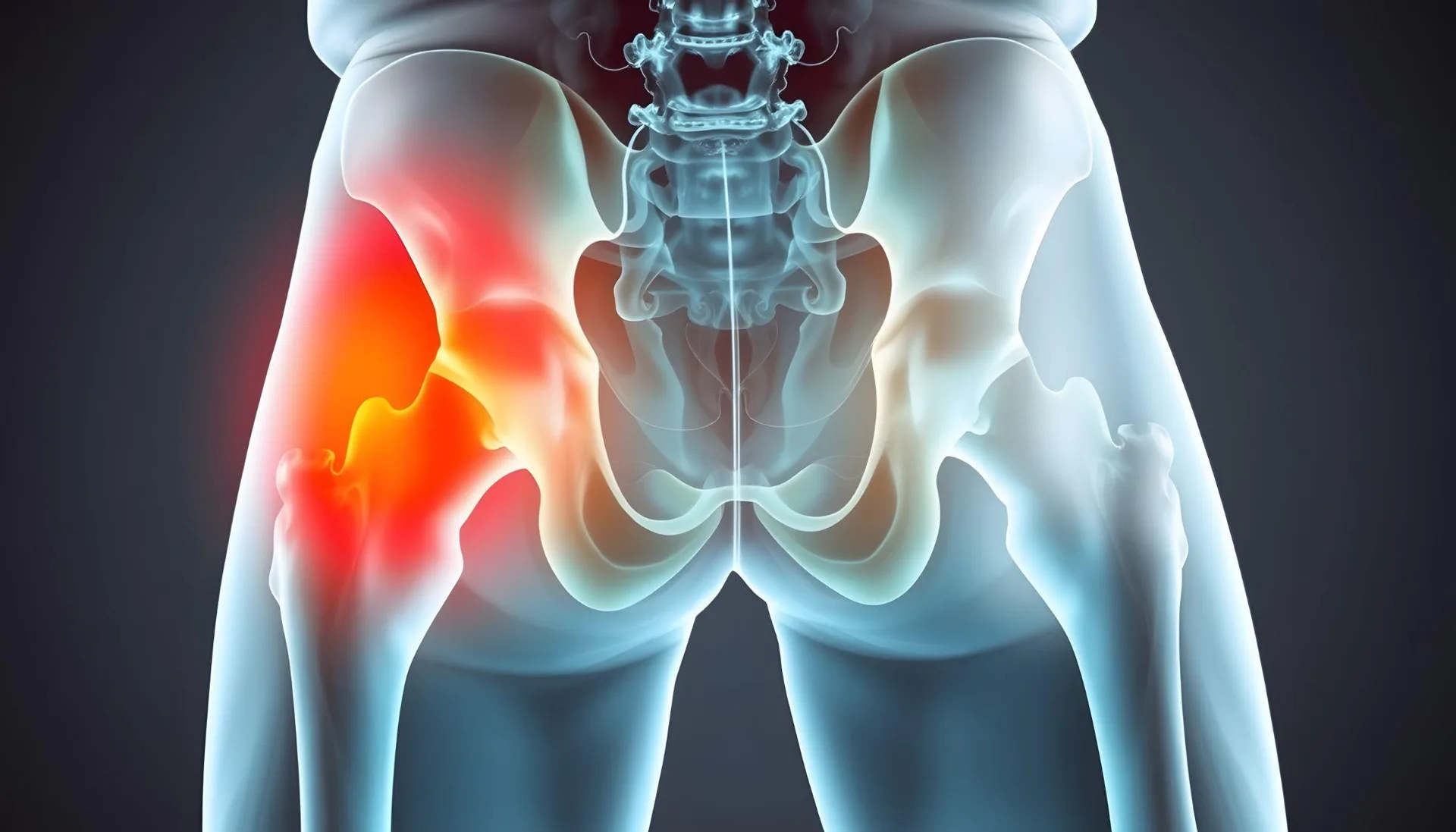
- Groin or front of the hip: typically points to the hip joint itself (impingement, labral tear, arthritis, avascular necrosis), or a muscle or tendon at the front.
- Outer side of the hip: often a tendon or bursa problem (greater trochanteric pain syndrome).
- Buttock or back of the hip: may come from the lower back, sacroiliac joint, gluteal muscles or sciatic nerve.
- Inner thigh: could be an adductor strain or a groin problem such as a hernia.
- Pain felt in the knee: hip problems sometimes refer pain to the knee, particularly in children and adolescents.
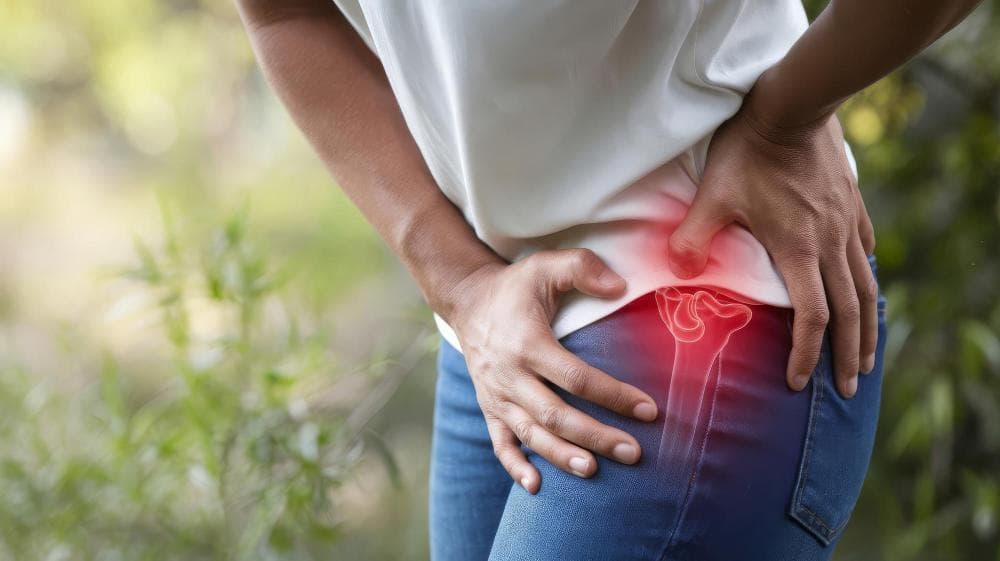
In people with femoroacetabular impingement, a common cause of hip pain in young adults, the groin and outer hip are the most frequent sites of pain. People often describe a "C" shape with the hand held around the hip.
Causes inside the hip joint
Femoroacetabular impingement (FAI)
The ball (femoral head) or the socket (acetabulum) has a slight extra bump of bone, so the two collide at the end of certain movements, such as deep flexion. Over time, this can damage the cartilage and the labrum. FAI is common in active young adults, especially those who play sports involving deep hip flexion, such as football, hockey, martial arts, dance and cricket.
Typical features: groin pain with sitting for long periods, getting out of a car, squatting, or twisting; a feeling of pinching; restricted internal rotation.
Labral tear
The labrum is a ring of cartilage that deepens the socket. It can tear, often together with FAI or after a twisting injury.
Typical features: catching, clicking or locking in the hip; sharp groin pain with pivoting; pain with prolonged sitting.
Hip dysplasia
The socket is shallow, so the ball is not well covered. This often goes unnoticed in childhood and appears as pain in the twenties and thirties, especially in women. It can lead to early arthritis if untreated.
Typical features: groin pain with activity, a feeling of instability, a family history, or earlier hip problems as a child.
Early osteoarthritis
Arthritis is not exclusively a condition of old age. Previous injury, childhood hip conditions, dysplasia or impingement can cause cartilage wear in the thirties and forties.
Typical features: stiffness, groin pain after activity, limited movement, morning stiffness.
Avascular necrosis (osteonecrosis)
The blood supply to part of the femoral head is lost, causing bone death and eventual collapse. Risk factors include long-term steroid use, heavy alcohol intake, certain blood disorders, sickle cell disease, previous hip dislocation or fracture, and in some cases no obvious cause. It is an important cause of hip pain in adults in their thirties to fifties.
Typical features: deep groin or thigh pain that gradually worsens, pain at night, limping. X-rays may look normal early on, and MRI is the best test. Early diagnosis opens more treatment options.
Stress fracture of the femoral neck
A small crack in the neck of the thigh bone, typically in runners, military recruits, athletes with low energy intake or low bone density.
Typical features: groin or thigh pain that builds with running or weight bearing, relieved by rest, then occurring even at rest. This is a high-risk stress fracture and needs prompt assessment, because a complete break can have serious consequences. Our article on stress fractures describes the pattern.
Septic arthritis (infection)
An infected hip joint causes severe pain, fever and inability to bear weight. It is an emergency.
Inflammatory arthritis
Conditions such as ankylosing spondylitis, rheumatoid arthritis and psoriatic arthritis can involve the hip, often with stiffness that is worse in the morning or after rest and improves with activity. See our comparison of osteoarthritis and rheumatoid arthritis.
Causes outside the hip joint
Greater trochanteric pain syndrome
Often called trochanteric bursitis, it involves irritation of the tendons (gluteus medius and minimus) and bursa on the outer hip. It is common in middle-aged women, runners and people who sleep on the affected side.
Typical features: tender spot on the outer hip, pain lying on that side, pain climbing stairs or standing on one leg.
Snapping hip
A snapping or clicking sensation as a tendon slides over a bony prominence, either on the outer hip (iliotibial band) or the front (iliopsoas). Often painless, but it can become painful with repetitive use, such as in dancers.
Muscle and tendon strains
Hamstring, adductor (groin), hip flexor and gluteal strains are common in sport and heavy exercise. Pain begins with a specific movement and eases with rest.
Pain from the lower back or sacroiliac joint
Disc problems, facet joint pain or sacroiliac dysfunction can cause pain in the buttock or hip. Sciatica adds leg symptoms. Our articles on sciatica symptoms and causes of sciatica help to distinguish nerve pain.
Nerve entrapments
The lateral femoral cutaneous nerve (meralgia paresthetica) causes burning or numbness on the outer thigh. Others include the obturator and sciatic nerve branches.
Groin hernia
Can cause groin pain, especially with coughing or straining, and a bulge. Needs a general surgical review.
Pelvic and gynaecological causes
In women, conditions such as endometriosis or ovarian problems can sometimes produce pain felt in the hip or groin. Persistent pain without a clear orthopedic cause may need review by a gynaecologist.
Everyday habits that make hip pain worse
- Sitting for long hours with hips bent, especially on low sofas
- Crossing legs
- Sleeping on the painful side without a pillow between the knees
- Sudden increases in exercise
- Wearing worn shoes or high heels
- Ignoring early pain in sport
- Carrying a heavy bag on one side
- Sedentary lifestyle with weak glute and core muscles
How doctors find the cause
History
Questions about where the pain is, what provokes it, how it began, sports, occupation, steroid use, alcohol, family history, childhood hip conditions and night pain.
Examination
- Walking pattern (limp, Trendelenburg gait)
- Range of movement, especially internal rotation and flexion
- Strength of the hip and thigh muscles
- Special tests such as the impingement test and FABER test, which are good at identifying a problem inside the joint, though they do not diagnose the exact cause
- Examination of the back and sacroiliac joint
Imaging
- X-ray of the pelvis and hip is the first test. It may show impingement shapes, dysplasia or arthritis, but can be normal in early or soft tissue problems.
- MRI, sometimes with contrast injected into the joint (MR arthrogram), shows the labrum, cartilage, bone marrow swelling, avascular necrosis and stress fractures.
- CT helps plan treatment for bony problems.
- Ultrasound is useful for tendons, bursae and for guiding injections.
Other tests
Blood tests for inflammation or infection if suggested, and bone health tests such as vitamin D when appropriate. A diagnostic injection of local anaesthetic into the joint can help establish whether the pain comes from inside the joint.
Treatment depends on the cause
For many causes: conservative care first
- Activity modification, avoiding painful positions and movements
- Physiotherapy to strengthen the hip, glutes and core, and improve movement control
- Short courses of anti-inflammatory medicines, as advised
- Weight management
- Correcting posture and workstation habits
- Injections in selected cases, such as a steroid injection for trochanteric bursitis or an intra-articular injection for arthritis
Early referral for specialist review is sensible if symptoms persist beyond three to six months, if they are not improving with exercise, or if you are an athlete.
When surgery is considered
- Hip arthroscopy (keyhole surgery) for selected cases of FAI, labral tears or loose bodies
- Joint-preserving procedures such as core decompression for early avascular necrosis, or realignment surgery for dysplasia
- Fixation of a stress fracture that is displaced or at high risk
- Hip replacement for advanced arthritis or collapse, including in younger patients when pain and function demand it. Our article on hip replacement in Noida explains the procedure.
The earlier the diagnosis, the more options are available.
Warning signs: do not wait
Seek urgent medical attention if you have:
- Sudden severe hip or groin pain, especially after a fall, accident or injury
- Inability to bear weight
- Fever with a painful, stiff hip
- Hip pain with a hot, red, swollen joint
- Night pain that is severe and unrelenting
- Hip pain with weight loss or a history of cancer
- Back pain with numbness around the groin, or loss of bladder or bowel control
- Sudden hip pain in a person on long-term steroids or with heavy alcohol use
Prakash Hospital in Noida has a 24 hour emergency department.
When to book an orthopedic appointment
- Hip or groin pain lasting more than two to three weeks
- Pain with sitting, squatting or twisting
- Clicking, catching or locking in the hip
- A limp
- Pain at night
- Pain that limits sport, work or sleep
- A history of steroid use, heavy drinking or childhood hip problems
Hip care in Noida with Dr. Mayank Chauhan
A clear diagnosis early in the course of hip pain helps preserve the joint. Dr. Mayank Chauhan is a senior orthopedic and joint replacement surgeon at Prakash Hospital, D-12A/12B, Sector 33, Noida, next to the ISKCON Temple. He has more than 15 years of experience, trained at Maulana Azad Medical College, Delhi, and completed an arthroplasty fellowship at Hallym University Hospital, South Korea. His patients rate him 4.9 out of 5 on Google.
Prakash Hospital is NABH and NABL accredited and works with CGHS, ECHS, ESI and major insurers. OPD hours are Monday to Saturday, 10 AM to 8 PM, and Sunday, 10 AM to 2 PM.
To book a consultation, call the number listed on the website.
This article is for general information and does not replace a medical examination.