Partial Vs Total Knee Replacement - Which One Is Right For You?

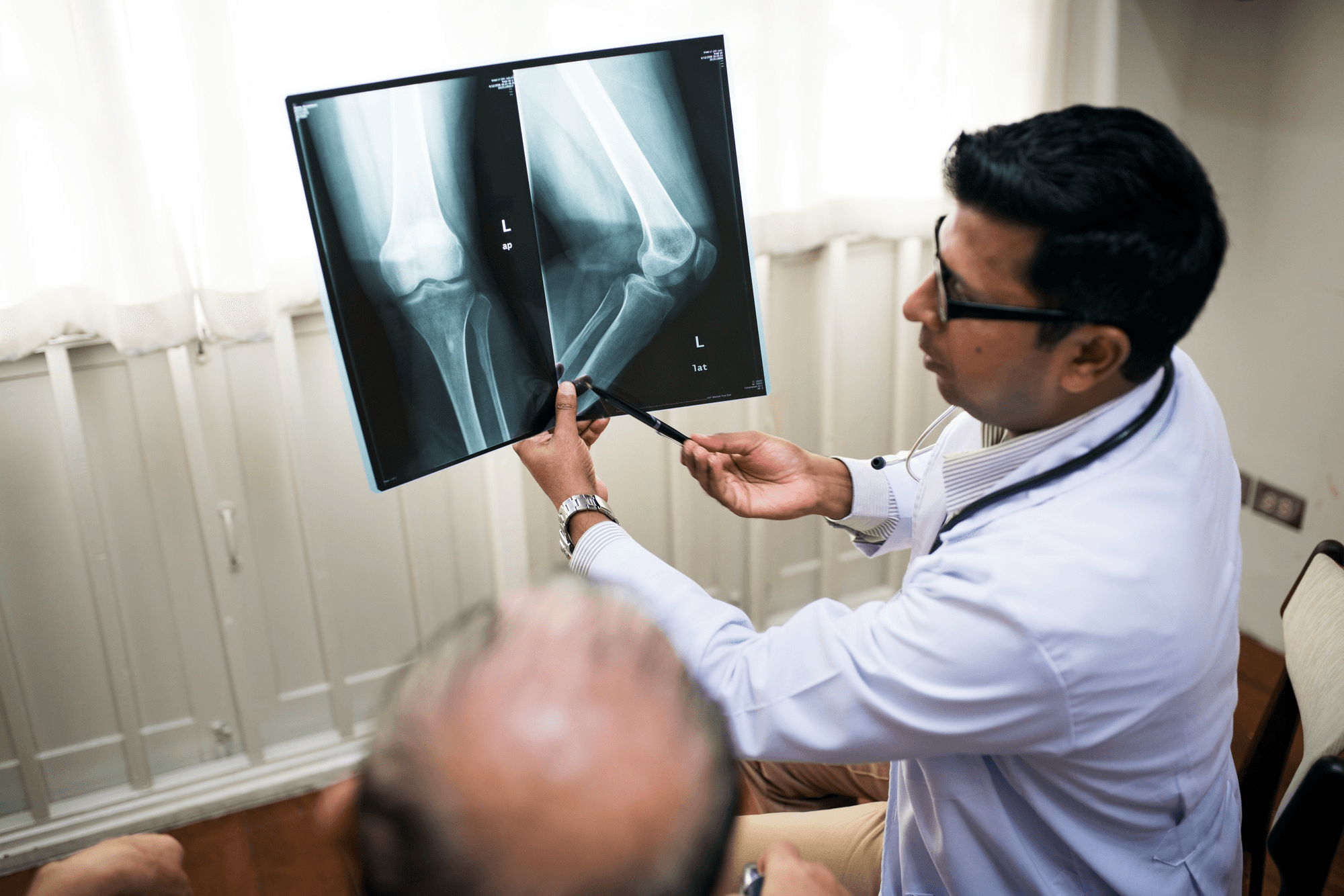
Doctor explaining knee implant components and surgical choices related to partial vs total knee replacement procedures.
If you've been told you need knee replacement surgery, there's a good chance the word "partial" came up at some point. Maybe your surgeon mentioned it. Maybe you read about it online. Maybe a friend or family member had one type, and you're wondering whether the other would have been better.
This is one of the most common decision points for patients in Noida and Greater Noida preparing for knee surgery, and one of the most misunderstood. The two procedures share the same ultimate goal, but they're genuinely different operations with different indications, different outcomes, and different recovery paths.
This guide cuts through the confusion and explains, in plain terms, what each surgery involves, who is actually suited to each, and what the differences mean for your daily life after surgery.
First - Understanding The Knee's Three Compartments
The knee joint is not a single surface. It has three distinct areas of contact, three "compartments":
Medial compartment: The inside of the knee. This is the compartment most commonly affected by arthritis, and the one most often treated with partial replacement.
Lateral compartment: The outside of the knee. Less commonly affected in isolation, but can develop arthritis, particularly after old ligament injuries.
Patellofemoral compartment: The front of the knee, the joint between the kneecap and the thigh bone. Can develop isolated arthritis, especially in younger patients.
Why does this matter? Because the type of knee replacement you need depends entirely on how many of these compartments are damaged and how badly.
What Is Partial Knee Replacement?
Partial knee replacement, also called unicompartmental knee arthroplasty (UKA) or unicompartmental knee replacement (UKR), replaces only the damaged compartment of the knee while leaving the healthy parts completely untouched. In the most common scenario, the medial (inner) compartment is affected by arthritis while the lateral compartment and patellofemoral joint remain healthy. The surgeon resurfaces only the medial side, removing the damaged bone and cartilage and fitting a prosthetic component that matches the original joint surface.
The cruciate ligaments, the ACL and PCL, are preserved. This is significant. These ligaments give the knee its natural movement patterns and stability. A knee with intact cruciate ligaments moves more naturally than one from which they've been removed. What partial replacement is good for:
- Arthritis confined to one compartment of the knee.
- Intact cruciate ligaments (especially the ACL).
- A patient with adequate bone quality and a stable joint.
- Someone whose deformity is correctable, not severely bowed or knock-kneed.
What it doesn't work for:
- Arthritis that affects two or more compartments.
- A damaged or absent ACL.
- Inflammatory arthritis (rheumatoid arthritis, psoriatic arthritis).
- Severe valgus or varus deformity of the knee.
What Is Total Knee Replacement?
Total knee replacement (TKR), also called total knee arthroplasty, resurfaces all three compartments of the knee. The damaged bone and cartilage surfaces of the femur (thigh bone), tibia (shin bone), and often the undersurface of the patella (kneecap) are all replaced with prosthetic components. TKR is the appropriate choice when:
- Arthritis has spread beyond one compartment.
- The joint shows bone-on-bone contact across multiple surfaces.
- There is a significant deformity that needs to be corrected.
- The cruciate ligaments have been damaged or are absent.
- Inflammatory arthritis has affected the entire joint.
Total knee replacement is the most commonly performed joint replacement surgery in India, and it has one of the most studied and consistently positive outcomes of any surgical procedure in orthopedics.
Comparing The Two: What Actually Differs?
1. Incision Size
Partial knee replacement uses a smaller incision than total replacement. Less of the joint is exposed, and less surrounding tissue is disturbed. This contributes to a smoother early recovery.
2. Bone Preservation
In a partial replacement, only the bone from the damaged compartment is removed. The healthy bone and cartilage in the other compartments remain completely intact. In TKR, the entire joint surface is reshaped. For younger patients in particular, preserving bone is valuable, as it makes future revision surgery technically easier if one is ever needed.
3. Recovery Speed

A patient is sitting with a knee brace and a doctor is examining it.
Most patients undergoing partial knee replacement recover faster in the early stages, walking earlier, experiencing less immediate post-operative discomfort, and returning to daily activities sooner. The difference narrows over time, and by 3–6 months, most patients from both groups have similar functional outcomes.
4. Feel Of The Knee
Because the cruciate ligaments are preserved and less of the joint is altered, many patients describe the post-operative feel of a partial replacement as more natural, closer to a normal knee. Total replacement patients typically achieve excellent functional outcomes, but some describe an awareness that "it's not quite the same," particularly with certain movements.
5. Long-Term Survival
Modern total knee replacement implants are designed to last 15–25 years. Partial replacement implants have good longevity as well, but there is a slightly higher revision rate, meaning some patients who have a partial replacement eventually need it converted to a total replacement, particularly if arthritis progresses to involve other compartments. However, conversion surgery is generally straightforward.
6. Suitability
This is the most important difference. Not everyone who needs knee replacement is a candidate for partial replacement. The criteria are specific, and meeting them requires careful pre-operative assessment, including physical examination, standing X-rays, and sometimes an MRI.
Who Is A Good Candidate For Partial Knee Replacement?
A good candidate for partial (unicompartmental) knee replacement typically:
- Has osteoarthritis confined to the medial compartment of the knee.
- Has intact cruciate ligaments (particularly the ACL).
- Has a relatively normal range of motion (can fully straighten the knee).
- Has a correctable deformity, not severely bowed or knock-kneed.
- Has bone quality and density suitable for the implant.
- Is motivated toward rehabilitation.
Age is not the deciding factor. Both younger and older patients can be suitable candidates. However, younger and more active patients particularly benefit from the bone-preserving nature of partial replacement, preserving bone, making future revision easier if needed later.
Who Should Have Total Knee Replacement?
Total knee replacement is the right choice when:
- Arthritis affects two or more compartments of the knee.
- X-rays show significant bone-on-bone contact across the joint.
- The ACL is damaged or absent.
- There is a significant varus (bow-legged) or valgus (knock-kneed) deformity.
- Inflammatory arthritis (RA, psoriatic arthritis) is the underlying cause.
- Previous knee surgery has altered the anatomy.
- The patient has failed to improve with conservative treatment and has Grade 3–4 arthritis.
For most patients with advanced knee arthritis in Noida, total knee replacement is the appropriate surgical choice, because by the time surgery becomes necessary, the arthritis has typically spread beyond a single compartment.
The Role Of Robotic Surgery In Both Procedures
Robotic assistance is now increasingly used for both partial and total knee replacement. For partial replacement in particular, robotic precision is especially valuable because the surgeon is operating very close to healthy tissue that must be preserved, and the margin for error is smaller than in total replacement.
Robotic-assisted partial knee replacement uses a CT-based 3D plan developed before surgery and a robotic arm that physically resists cutting outside the planned bone boundaries. The result is implant positioning that would be extremely difficult to achieve with manual instruments alone.
If partial knee replacement is being considered, asking whether robotic assistance is available is a very reasonable question. Dr. Mayank Chauhan at Prakash Hospital, Sector 33, Noida, performs both partial and total knee replacement, including robotic-assisted procedures for appropriate patients.
A Practical Example
Consider two patients, both in their early 60s, both presenting with knee pain in Noida:
Patient A has X-rays showing significant medial compartment narrowing with bone-on-bone contact on the inside of the knee. The lateral compartment and patellofemoral joint look healthy. The ACL is intact. He can fully straighten his knee. He is an ideal candidate for partial knee replacement, a smaller procedure, faster recovery, and preserved bone.
Patient B has X-rays showing narrowing across all three compartments. She has a significant varus (bow-leg) deformity, and her ACL is deficient from an old injury. Total knee replacement is the appropriate choice when the whole joint needs to be reconstructed.
The decision is clinical. It is based on imaging, examination, anatomy, and lifestyle, not on which procedure sounds simpler or faster.
Questions To Ask Your Surgeon
Before knee replacement surgery, these are the right questions:
- "Am I suitable for partial or total knee replacement, and why?"
- "If partial, what happens if my arthritis progresses to other compartments?"
- "Do you perform robotic-assisted surgery for partial replacement?"
- "What does recovery look like for the specific procedure you're recommending?"
- "What are the realistic outcomes that I will be able to do after surgery that I can't do now?"
Dr. Mayank Chauhan's Approach - Noida and Greater Noida

A healthcare professional examining a knee after surgery during recovery.
At Prakash Hospital, Sector 33, Noida, Dr. Mayank Chauhan conducts a thorough pre-operative evaluation before recommending any type of knee replacement. The assessment includes clinical examination, standing bilateral knee X-rays, and, in some cases, MRI or CT, to determine precisely which compartments are affected and whether partial or total replacement is the appropriate solution.
For patients who are genuine partial knee replacement candidates, those with isolated medial compartment arthritis and intact ligaments, Dr. Chauhan offers unicompartmental replacement as a procedure-sparing option that preserves healthy tissue and typically delivers faster recovery.
For patients with more extensive disease, total knee replacement remains the gold standard, and for both procedures, robotic assistance is available for patients for whom precision planning will improve outcomes. To book a consultation, call the number listed on the website.
The Bottom Line
Partial vs total knee replacement is not a question with a universal answer. The right choice depends entirely on your specific anatomy, the extent and pattern of your arthritis, the condition of your ligaments, and your age and activity goals. What matters most is getting a proper assessment from a surgeon who is experienced in both procedures and who will recommend based on your clinical picture, not based on which operation is technically easier or more routine.
If you're in Noida or Greater Noida and have been told you need knee replacement surgery, a thorough evaluation with Dr. Mayank Chauhan at Prakash Hospital, Sector 33, will clarify exactly which approach is right for you. To book your consultation, call the number listed on the website.