Best Joint Replacement Hospital in Noida — What to Look For and Why It Matters

A doctor helping a person walk.
Joint replacement surgery is not something most people do more than once in their lives. The hospital you choose, the surgeon who operates, and the quality of care you receive during and after surgery have direct consequences for how well the procedure goes and how completely you recover.
Noida and the wider Delhi NCR region have no shortage of options — from large corporate hospital chains to smaller specialty centres to mid-size multispecialty hospitals. The range in quality, however, is significant. And the criteria that actually matter are not always the ones prominently advertised.
This guide outlines what genuinely separates good orthopedic care from average, why each criterion matters, and what Prakash Hospital Noida offers for patients seeking joint replacement surgery.
The Criteria That Actually Matter
1. Surgeon's Volume and Specialisation
The single most predictive factor for surgical outcomes in joint replacement is the operating surgeon's experience — specifically, how many joint replacements they perform each year, and whether joint replacement is their primary subspecialty or something they do occasionally.
Research consistently shows that surgeons who perform higher volumes of joint replacements produce better outcomes: fewer complications, better implant alignment, lower revision rates, and faster patient recovery. The difference between a surgeon doing 20 knee replacements a year and one doing 200 is meaningful.
When evaluating a surgeon, ask directly:
- How many joint replacements do you perform per year?
- Is joint replacement your primary subspecialty or one of many?
- What is your revision rate?
A surgeon who is confident, experienced, and genuinely subspecialty-trained will answer these questions easily.
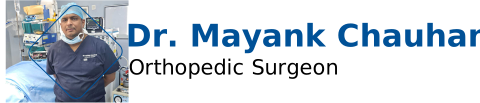
Dr. Mayank Chauhan at Prakash Hospital Noida trained at Maulana Azad Medical College — one of India's most competitive medical institutions — and holds an international fellowship in arthroplasty and joint reconstruction from Hallym University Hospital, South Korea. Joint replacement and orthopedic surgery are his primary clinical focus, with 15+ years of dedicated practice.
2. Accreditation
Hospital accreditation from NABH (National Accreditation Board for Hospitals and Healthcare Providers) is a meaningful indicator of standards, not just a certificate on the wall.
NABH accreditation involves a rigorous assessment of clinical protocols, infection control, surgical safety standards, documentation practices, nursing standards, and patient rights. Hospitals that maintain NABH accreditation are subject to ongoing surveillance and re-assessment.
Prakash Hospital Noida is NABH and NABL accredited, with over 25 years of service at its Sector 33 location and a track record of more than 50,000 successful surgeries performed.
When considering any hospital for elective surgery, verify current accreditation status. It matters.
3. Infection Control Standards
Surgical site infection (SSI) is one of the most serious complications of joint replacement. In hip and knee replacement, SSI can require return to the operating room, prolonged antibiotic treatment, or in severe cases, removal of the entire implant.
Infection rates in joint replacement surgery are heavily influenced by hospital-level factors: operating theatre air filtration and laminar flow systems, sterilisation protocols, antibiotic prophylaxis practices, and ward hygiene. These are difficult for patients to assess directly, but accreditation status provides some assurance.
Questions worth asking:
- Does the hospital have a dedicated laminar flow operating theatre for joint replacement?
- What is the hospital's protocol for antibiotic prophylaxis?
- Does the hospital have an infection control committee?
4. Physiotherapy and Rehabilitation
Joint replacement is not completed in the operating room. Recovery — the phase where the new joint is integrated into functional movement — depends enormously on physiotherapy.
A hospital with an in-house, experienced physiotherapy department that works with surgical patients from Day 1 post-operatively provides a substantial advantage over one that provides basic physiotherapy or relies entirely on outpatient referrals.
What good post-operative physiotherapy involves:
- First walking within 24 hours of surgery (in most patients)
- Progressive exercise protocols tailored to the surgery performed
- Regular physiotherapist assessment during inpatient stay
- Discharge planning that includes a clear home exercise programme
- Outpatient physiotherapy follow-up
Prakash Hospital has a dedicated physiotherapy and rehabilitation department integrated with the orthopedic surgical team.
5. Implant Quality
Not all implants are equal. Major international implant manufacturers (DePuy, Stryker, Zimmer Biomet, Smith & Nephew) have decades of outcome data and established track records. Some hospitals use implants from less established manufacturers at lower cost without disclosing this to patients.
When scheduling surgery, ask specifically:
- Which implant brand and system will be used?
- Is the implant from an internationally registered manufacturer?
- What is the expected lifespan of the implant?
You are entitled to this information and a good hospital will share it transparently.
6. Insurance and Cashless Empanelment
For many patients, insurance coverage significantly influences hospital choice. Cashless surgery — where the insurer pays the hospital directly — eliminates the need for large upfront payments.
Prakash Hospital Noida is empanelled with CGHS (Central Government Health Scheme), ECHS (Ex-Servicemen Contributory Health Scheme), ESI, and most major private insurance companies and TPAs. This broad empanelment makes it accessible for a wide range of patients, including central and state government employees, ex-servicemen, and those with private health insurance.
If insurance coverage is a factor in your decision, verify empanelment directly with the hospital's billing department and confirm that the specific procedure (knee replacement, hip replacement, etc.) is covered under your policy.
7. Location and Accessibility
Practical considerations matter, particularly during recovery. Post-surgery, you'll have follow-up appointments — and your family members will be making multiple visits during your hospital stay.
Prakash Hospital Noida is located at D-12A, 12B, Sector 33, Noida — adjacent to the ISKCON Temple, a well-known landmark in the area. It is accessible by:
- Auto-rickshaw and cab from across Noida sectors
- Metro (Noida Sector 18 and Noida City Centre stations are within practical reach)
- Private vehicle, with parking available
Patients from Greater Noida, Ghaziabad, Indirapuram, and Vasundhara regularly attend the hospital for orthopedic care.
8. Emergency Coverage
Joint replacement is elective surgery — but its complications can be urgent. DVT (blood clots), wound infection, and implant dislocation can occur in the weeks following surgery and may require immediate attention.
A hospital with 24/7 emergency coverage and on-call orthopedic support means that if something happens at 2am, you have somewhere to go that already knows your case.
Prakash Hospital has a 24/7 emergency department with on-call specialists across departments, including orthopedics.
What Patients in Noida Often Ask
Is Prakash Hospital good for knee replacement?
Prakash Hospital has been one of Noida's most established multispecialty hospitals since 2001, with orthopedics as a core department from its founding. Dr. Mayank Chauhan has performed joint replacement surgeries at the hospital for over 15 years, with a consistent 4.9/5 patient rating on Google.
Is it better to go to a corporate hospital for joint replacement?
Larger corporate hospitals have advantages in brand recognition and marketing. But surgical outcomes in joint replacement depend primarily on the operating surgeon's skill and experience — not the hospital's size or marketing budget. A subspecialty-trained joint replacement surgeon at an accredited mid-size hospital may deliver equivalent or superior results to a less experienced surgeon at a larger hospital.
Can I use my government health card (CGHS/ECHS) at Prakash Hospital?
Yes. Prakash Hospital is empanelled with CGHS, ECHS, and ESI. Verify coverage for your specific procedure with the hospital's billing department.
How do I know if I need knee or hip replacement?
The decision requires a clinical assessment. Not every patient with knee or hip pain needs replacement surgery. Dr. Mayank Chauhan evaluates each patient with X-rays and physical examination before recommending surgery — and non-surgical options are always considered first.
Seeing Dr. Mayank Chauhan at Prakash Hospital, Noida
Dr. Mayank Chauhan is a Consultant Orthopaedic and Joint Replacement Surgeon at Prakash Hospital, Sector 33, Noida. He sees patients from across Noida, Greater Noida, Ghaziabad, and the wider Delhi NCR region for:
- Knee replacement (total and partial)
- Hip replacement
- Shoulder replacement
- Joint reconstruction
- Fracture surgery
- Sports medicine
- Spine surgery
Consultation hours: Monday to Saturday, 10 AM to 8 PM; Sunday, 10 AM to 2 PM.
To book a consultation, call the number listed on the website.