Reviewed by Dr. Mayank Chauhan
Tennis Elbow vs Golfer's Elbow: How to Tell the Difference
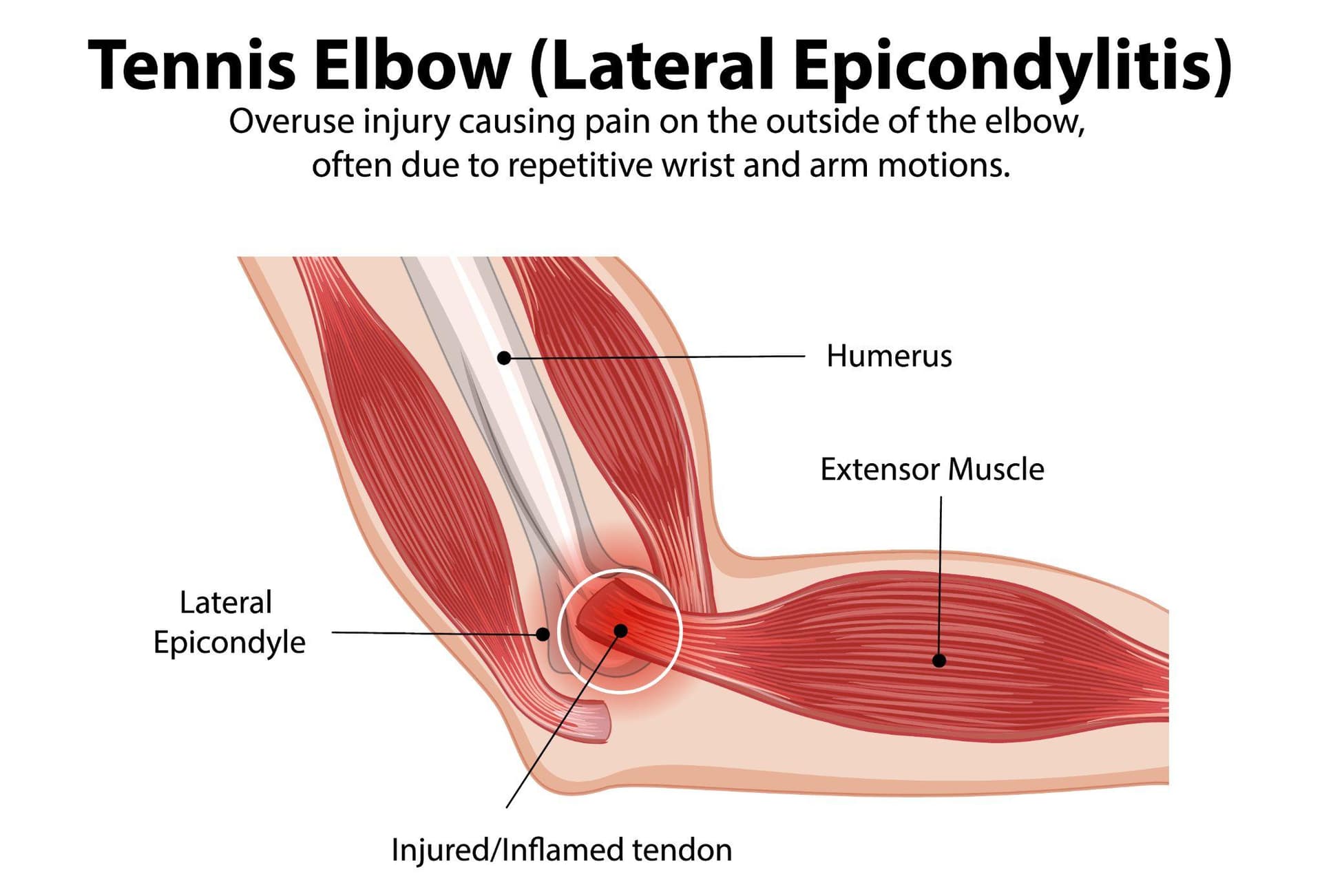
Tennis elbow affects the outer side of the elbow; golfer's elbow affects the inner side, near the funny bone.
Your elbow hurts, someone says "tennis elbow," a colleague says "no, golfer's elbow," and the internet says both. If you have never picked up a racket or a golf club, the names seem to belong to someone else's problem.
The two conditions are close cousins. Both are overuse injuries of tendons around the elbow, and both respond to a similar approach. The main difference is simply which side of the elbow hurts and which group of forearm muscles is overloaded. Getting that right matters, because it points you to the right exercises, the right changes in daily activity and, occasionally, the right search for a different problem altogether.
The one-line answer
- Tennis elbow (lateral epicondylitis): pain on the outer side of the elbow, the side away from the body when your palm faces forward.
- Golfer's elbow (medial epicondylitis): pain on the inner side of the elbow, the side closer to the body, near the "funny bone."
Neither condition is limited to sport. Tennis elbow is far more common than golfer's elbow, and both are seen in people who do repetitive hand and wrist work.
The anatomy behind the names
The forearm muscles attach to the humerus (upper arm bone) near the elbow through tendons.
- On the outer side, the wrist extensor muscles (which lift the wrist and straighten the fingers) share a common tendon that attaches to the lateral epicondyle. Overload here causes tennis elbow.
- On the inner side, the wrist flexor and pronator muscles (which bend the wrist and fingers and turn the palm down) attach to the medial epicondyle. Overload here causes golfer's elbow.
In both cases, the problem is usually not simple inflammation. Repeated strain leads to small tears and degeneration within the tendon at its attachment, which is why the medical term "tendinopathy" is often preferred.
Comparing the two
| Feature | Tennis elbow | Golfer's elbow | |---|---|---| | Location of pain | Outer elbow | Inner elbow | | Muscles involved | Wrist extensors | Wrist flexors and pronators | | Frequency | Much more common | Less common | | Typical triggers | Gripping, lifting with palm down, mouse use, racquet sports, painting | Gripping, throwing, golf swing, carrying heavy bags, pulling, weight training | | Painful movements | Extending the wrist against resistance, gripping, turning a key | Bending the wrist against resistance, pronating the forearm, making a fist | | Typical tests | Pain on resisted wrist extension, middle finger test | Pain on resisted wrist flexion and pronation | | Nerve involvement | Rarely; radial nerve problems can mimic it | Ulnar nerve irritation can accompany it, causing tingling in the ring and little fingers | | Age group | Often 30 to 50 | Often 35 to 55 |
Symptoms in more detail
Tennis elbow
- Aching or burning on the outer side of the elbow
- Pain that may radiate down the forearm
- Pain when lifting a cup or kettle, turning a door handle, shaking hands or using a screwdriver
- Weak grip
- Tenderness over the bony bump on the outer elbow
Golfer's elbow
- Pain and tenderness on the inner side of the elbow, sometimes radiating down the forearm
- Stiffness in the elbow
- Weak grip
- Pain on making a fist, or when twisting the forearm
- Tingling or numbness in the ring and little fingers, sometimes caused by irritation of the ulnar nerve as it passes behind the inner elbow
- Pain with throwing, swinging a bat or racket, lifting weights or carrying bags
What causes each?
Common causes of both
- Repetitive movements of the wrist and hand over weeks or months
- Sudden increase in activity
- Poor technique or unsuitable equipment
- Weak muscles in the forearm, shoulder and upper back
- Age, as tendon quality declines
- Smoking, which affects tendon healing
- Sometimes diabetes, thyroid disease or other conditions that affect tendons
Everyday triggers in India
- Tennis elbow: long hours on a mouse and keyboard, wringing clothes, using a heavy pan, chopping vegetables, painting walls, hammering, gardening and carrying water cans or shopping bags with a palm-down grip
- Golfer's elbow: carrying heavy bags and buckets, weight training with a poor grip, cricket and javelin throwing, hammering, swinging a bat, kneading dough, pulling or climbing activities, and some labour jobs
Similar-looking conditions to rule out
Elbow pain has other causes, and a good examination separates them.
- Radial tunnel syndrome, causing deep aching on the outer forearm, can mimic tennis elbow.
- Cubital tunnel syndrome, from ulnar nerve compression at the inner elbow, causes tingling in the ring and little fingers and can accompany or imitate golfer's elbow.
- Neck problems (cervical radiculopathy) can refer pain to the elbow and forearm. Our article on cervical spondylosis explains this.
- Elbow arthritis, causing stiffness and sometimes locking
- Ligament injuries and instability
- Bursitis at the tip of the elbow
- Fractures after a fall
Persistent numbness, weakness, pain after a fall or locking of the joint deserve a prompt assessment.
Treatment: largely the same principles
Both conditions are treated mostly without surgery. Many settle over months, as described in our article on tennis elbow causes and treatment.
1. Modify activity
Reduce the actions that provoke pain. Use both hands for heavy items, avoid forceful gripping with a bent wrist, and take regular breaks from repetitive work.
2. Ergonomic changes
- Keep the wrist neutral on the keyboard and mouse
- Use larger-handled tools
- Check racket or club grip size, weight and technique
- Carry bags with a neutral grip, close to the body, or use a backpack
3. Progressive loading exercises
Exercise is the main therapy for tendon problems.
For tennis elbow: wrist extension exercises, with isometric holds and slow lowering (eccentric) movements using a light weight.
For golfer's elbow: the same idea in reverse. With the palm facing up, support the forearm on a table. Use the other hand to lift the wrist upward with a light weight, then slowly lower it with the affected arm over three to four seconds. Add forearm rotation and grip strengthening gradually.
Typical dosing is three sets of 10 to 15 repetitions, once or twice a day, with weight increased slowly. Some discomfort is acceptable, but sharp pain is a signal to ease off. Allow 8 to 12 weeks before judging results.
4. Stretching
Gentle stretching of the forearm muscles, holding for 20 to 30 seconds. For tennis elbow, extend the arm with the palm down and flex the wrist. For golfer's elbow, extend the arm with the palm up and gently bend the wrist backward.
5. Braces and straps
A counterforce strap just below the elbow reduces strain on the tendon attachment during activity. It gives short-term relief while you rehabilitate.
6. Pain relief
Ice, topical anti-inflammatory gels and short courses of oral painkillers as advised by a doctor can help you stay active.
7. Physiotherapy
Supervised physiotherapy provides a structured loading programme, technique correction and advice on work and sport.
8. Injections
Steroid injections give quick relief but, in tennis elbow at least, a large randomised trial found worse outcomes and more recurrence at one year compared with placebo. Other injections, such as platelet-rich plasma, have mixed evidence. Discuss them carefully with your doctor.
9. Surgery
Rarely needed. It is considered after six to twelve months of failed proper non-surgical treatment, with significant disability. For golfer's elbow with ulnar nerve symptoms, the nerve may be addressed as well.
Recovery time
Both conditions are slow. Expect months, not weeks. Many people improve substantially within six to twelve months, and a small number have symptoms for longer. Returning to the aggravating activity too quickly is the most common reason for setbacks.
Prevention
- Warm up before sport and heavy tasks
- Build up gradually
- Strengthen forearm, shoulder and upper back muscles
- Vary tasks and avoid repeating the same movement for long periods
- Learn correct technique in sport and gym
- Use well-fitted equipment
- Take breaks and stretch
- Stop smoking
When to see a doctor
Arrange an assessment if:
- Elbow pain lasts more than two to three weeks
- Pain disturbs sleep or work
- Grip strength is clearly weaker
- You have numbness or tingling in the fingers
- The elbow locks, catches or will not straighten
- Home measures have not helped after six to eight weeks
Seek urgent care if:
- Elbow pain follows a fall, with swelling or deformity
- The elbow is hot, red and swollen, with fever
- You have chest pain or breathlessness with left arm pain
Prakash Hospital in Noida has a 24 hour emergency department.
Elbow care in Noida with Dr. Mayank Chauhan
A short examination is usually enough to tell which side of the elbow is involved and whether something else is going on. Dr. Mayank Chauhan is a senior orthopedic surgeon at Prakash Hospital, D-12A/12B, Sector 33, Noida, next to the ISKCON Temple. He has more than 15 years of experience, trained at Maulana Azad Medical College, Delhi, and completed an arthroplasty fellowship at Hallym University Hospital, South Korea. His patients rate him 4.9 out of 5 on Google.
Prakash Hospital is NABH and NABL accredited and works with CGHS, ECHS, ESI and major insurers. OPD hours are Monday to Saturday, 10 AM to 8 PM, and Sunday, 10 AM to 2 PM.
To book a consultation, call the number listed on the website.
This article is for general information and does not replace a medical examination.