Reviewed by Dr. Mayank Chauhan
Exercises After Knee Replacement: What to Do and When
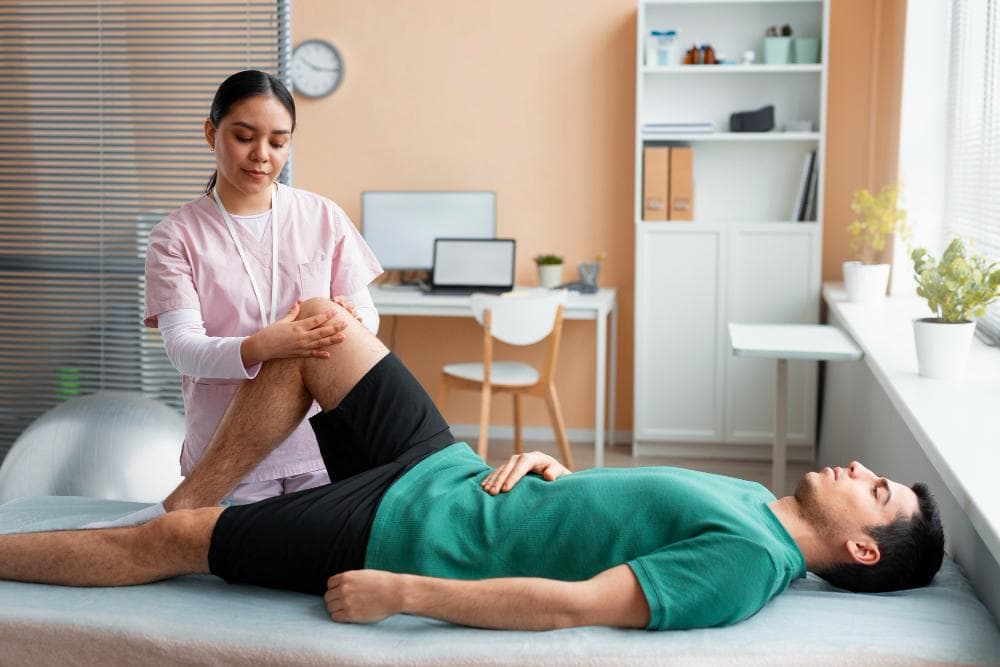
Short exercise sessions three to five times a day work better than one long session.
The operation is over. The new knee is in. And now the real work begins. This surprises many people. They assume the surgeon "fixes" the knee, and recovery is mostly a matter of waiting for the pain to fade. In reality, what you do in the weeks after surgery decides how far the knee bends, how strong the leg gets and how comfortable daily life feels a year from now.
Exercise after knee replacement needs to be regular and progressive. Too little, and the knee stiffens. Too much, and swelling and pain flare. The programme below follows the stages most surgeons and physiotherapists use. Always follow the specific instructions of your own surgeon and physiotherapist, as protocols vary with the type of surgery and your health.
Why exercise matters so much
- Prevents stiffness. Scar tissue forms quickly after surgery. Regular movement keeps the knee bending and straightening.
- Restores muscle strength. The thigh muscles weaken after surgery, and strength does not return by itself.
- Reduces swelling by pumping fluid out of the leg.
- Lowers the risk of blood clots by keeping the circulation moving.
- Improves balance and walking.
- Helps pain. Gentle movement usually eases stiffness-related pain.
Two goals matter most in the early weeks: getting the knee fully straight (extension) and getting it to bend progressively (flexion).
Ground rules
- Follow your surgeon's and physiotherapist's plan. Variations exist between patients.
- Take your pain medicine as advised before exercise sessions, so that you can move well.
- Exercise little and often. Short sessions, three to five times a day, beat one long session.
- Expect some discomfort, but not severe pain. A stretching or aching feeling is normal. Sharp, worsening pain is not.
- Ice and elevate after exercise to control swelling.
- Don't force the knee. Progress comes with time.
- Walk every day, gradually increasing distance.
- Report warning signs (see the end of this article).
Stage 1: Days 0 to 3 (in the hospital)
The aim is to wake up the muscles, keep the circulation moving and start bending the knee.
Ankle pumps
Lying or sitting, move your feet up and down briskly, 10 to 20 times every hour you are awake. This helps prevent clots and swelling.
Quadriceps sets
Lying with your leg straight, tighten the front thigh muscle, pressing the back of the knee down into the bed. Hold for 5 seconds. Repeat 10 times, several times a day.
Gluteal sets
Squeeze your buttocks together. Hold for 5 seconds. Repeat 10 times.
Heel slides
Lying on your back, slide your heel toward your buttocks, bending the knee as far as is comfortable. Hold for a few seconds, then slide back. Repeat 10 times.
Straight leg raise (as tolerated)
Tighten the thigh muscle, keep the knee straight and lift the leg a short distance off the bed. Hold for 3 to 5 seconds, lower slowly. Do not do this if you cannot keep the knee straight; build up with quadriceps sets first.
Standing and walking
With your physiotherapist's help, you will stand and walk with a walker or crutches, usually on the day of surgery or the next day. Follow weight-bearing instructions.
Breathing exercises
Deep breaths several times an hour keep the lungs clear.
Stage 2: Weeks 1 to 2 (at home)
Focus: control swelling, achieve full straightening and improve bending.
Continue stage 1 exercises
Do these several times a day.
Seated knee bends
Sit on a chair with your feet on the floor. Slide the operated foot backward, bending the knee, as far as comfortable. Hold for 5 seconds. Repeat 10 times.
Seated knee extensions
Sit upright and slowly straighten the knee, lifting the foot. Hold for 5 seconds, then lower. Repeat 10 times.
Supported knee extension stretch
Lie on your back with a rolled towel under your ankle (not under the knee), letting the knee sag toward the bed to encourage full straightening. Stay for a few minutes, as comfortable. Straightening is vital, and it is harder to regain later.
Short arc quads
Lie with a rolled towel under the knee. Lift the foot to straighten the knee, hold for 5 seconds, lower slowly. Repeat 10 times.
Walking
Walk indoors every hour or two. Gradually add short walks outside. Use your walker or crutches as advised.
Elevation and ice
Between exercise sessions, rest with the leg elevated and apply ice for 15 to 20 minutes, with a cloth barrier.
Targets
Your physiotherapist will typically check that you can reach near full straightening and bend to around 90 degrees by the end of the first two weeks. Don't be discouraged if you are behind. Bodies differ.
Stage 3: Weeks 2 to 6
Focus: improve range, begin strengthening and walk without aids.
Stationary cycling
When the knee bends enough (often about 90 to 100 degrees), pedal gently on a stationary bike with the seat high at first, lowering as bend improves. Start with 5 to 10 minutes. Backward pedalling can help early on.
Wall slides or mini squats
Stand with your back against a wall, feet shoulder-width apart, and slide down a short way, then back up. Hold for a few seconds. Repeat 10 times.
Sit to stand
Practise rising from a chair and sitting back down slowly, using armrests if needed. Aim for equal weight on both legs. Repeat 10 times, several times a day.
Step-ups (low step)
Step up onto a low step with the operated leg, then step down slowly. Hold a rail for safety.
Hamstring curls (standing)
Holding onto a counter, bend the knee, bringing your heel toward your buttock. Hold for 3 seconds. Repeat 10 times.
Heel raises
Standing with support, rise onto your toes and lower slowly. Repeat 10 to 15 times.
Hip strengthening
- Side leg raises (lying on your side or standing)
- Hip extension (leg back, standing)
- Clamshells (lying on your side, knees bent)
Strong hips protect the knee.
Balance
Standing near a counter, practise weight shifting, then standing on one foot for a few seconds.
Walking programme
Build up gradually. Many people move from a walker to a stick and then to walking unaided over these weeks. Aim for a smooth heel-to-toe pattern, with an upright posture.
Stage 4: Weeks 6 to 12
Focus: build strength, endurance and function.
Progress your strengthening
- Leg press or resistance band exercises with light resistance
- Squats to a chair, going a little deeper as comfortable
- Step-ups on a higher step
- Lateral step-downs from a low step, for control
Stairs
Practise going up and down stairs, using a rail. A common rule: "up with the good, down with the bad" while you are still weak, leading with the stronger leg going up and the operated leg going down. As strength improves, you will alternate feet.
Longer walks
Gradually extend to 20 to 30 minutes, then longer.
Swimming and water exercises
Once your wound is fully healed and your surgeon agrees, swimming is an excellent low-impact exercise. Water walking is also useful. Avoid breaststroke kick at first if it hurts.
Balance progression
- Single-leg stands for 30 seconds
- Walking heel to toe in a line
- Standing on a cushion with support
Flexibility
Keep up daily stretches for the calf, hamstring and quadriceps.
Stage 5: Three months and beyond
Focus: return to the activities you enjoy and maintain the gains.
- Keep up a regular exercise routine, at least three days a week
- Continue strength training for the legs and core
- Walking, cycling, swimming, golf, dancing and gardening are generally encouraged
- Avoid high-impact activities such as running, jumping and contact sports unless your surgeon has approved them
- Know your limits with kneeling, squatting and sitting cross-legged. Many people can do these to some degree, but flexibility varies, and some positions are avoided or modified. Our upcoming article on sitting cross-legged and squatting after knee replacement deals with this.
Improvement continues for up to a year. Don't judge your knee too early.
Common problems and what to do
The knee will not bend well
Keep up your exercises, apply heat before and ice after, and tell your physiotherapist or surgeon early. Significant stiffness in the first six weeks sometimes needs further treatment.
The knee will not fully straighten
This needs attention. Do extension stretches, avoid keeping a pillow under the knee when resting, and tell your physiotherapist.
Swelling and warmth
Some swelling lasts for weeks to months and flares after activity. Elevate, ice and pace yourself. Increasing redness, heat and pain, especially with fever, needs medical review.
Pain at night
Common in the early weeks. Take pain medicine as advised, change positions and use pillows to support the leg.
Weak leg or "giving way"
Strengthen consistently, and take care with stairs and uneven ground. Report repeated giving way.
Numbness around the scar
Common and often permanent, but not harmful. It usually shrinks over time.
Clicking
Clicks and clunks from the implant are common and usually harmless, unless associated with pain.
What to avoid
- Doing too much too soon. More exercise is not always better
- Kneeling on hard surfaces early on
- Twisting on a planted foot
- Carrying heavy loads in the first weeks
- High-impact sports unless approved
- Sitting for long periods without moving
- Putting a pillow under the knee when resting, as this encourages a bent knee
- Skipping physiotherapy appointments
- Stopping exercises when pain eases
Warning signs: call your surgeon
Contact your surgeon or go to the emergency department if you notice:
- Increasing redness, warmth, swelling or discharge from the wound
- Fever or chills
- Calf pain, tenderness or swelling
- Sudden breathlessness or chest pain (a possible blood clot, which is an emergency)
- Severe pain that is not controlled by your medicines
- Inability to bear weight, or a sudden loss of movement
- A fall with new pain in the knee
Prakash Hospital in Noida has a 24 hour emergency department.
Knee replacement care in Noida with Dr. Mayank Chauhan
A successful knee replacement is a partnership between surgeon, physiotherapist and patient. Dr. Mayank Chauhan is a senior orthopedic and joint replacement surgeon at Prakash Hospital, D-12A/12B, Sector 33, Noida, next to the ISKCON Temple. He has more than 15 years of experience, completed an arthroplasty fellowship at Hallym University Hospital, South Korea, and trained at Maulana Azad Medical College, Delhi. His patients rate him 4.9 out of 5 on Google.
Prakash Hospital is NABH and NABL accredited, with 24 hour emergency care, and works with CGHS, ECHS, ESI and major insurers. OPD hours are Monday to Saturday, 10 AM to 8 PM, and Sunday, 10 AM to 2 PM.
To book a consultation, call the number listed on the website.
This article is for general information and does not replace the instructions of your surgeon or physiotherapist. Exercise protocols vary between patients; follow the plan you have been given.