Reviewed by Dr. Mayank Chauhan
Rotator Cuff Tear: Does It Need Surgery or Physiotherapy First?

Strength and movement tests help show whether a tear can be managed with physiotherapy first.
You cannot lift your arm to reach a shelf. Pulling on a shirt sends a spike of pain through the shoulder. At night, rolling onto that side wakes you up. A scan comes back with the words "rotator cuff tear," and the next question arrives almost immediately: will I need an operation?
Not always. That answer surprises many people, because "tear" sounds like something that must be stitched. In practice, the right treatment depends on how big the tear is, whether it came from an injury or from gradual wear, how much it limits you and what you need your shoulder to do.
What is the rotator cuff?
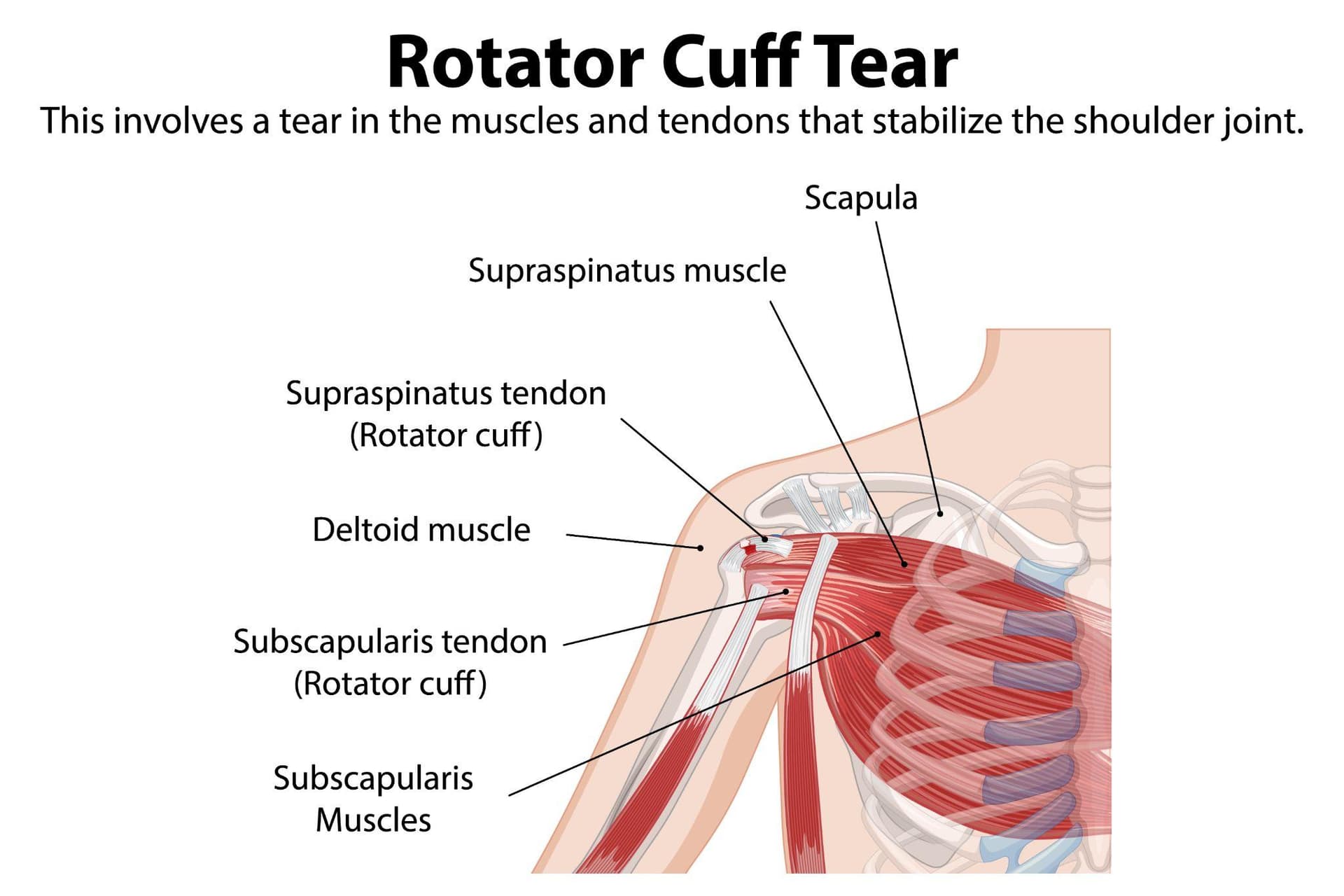
The rotator cuff is a group of four muscles and their tendons that wrap around the top of the upper arm bone (the humerus), holding the ball of the shoulder snugly in its socket. They are called the supraspinatus, infraspinatus, teres minor and subscapularis. Together they lift and rotate the arm and keep the joint stable.
The supraspinatus, which runs over the top of the shoulder, is the tendon torn most often.
Types of rotator cuff tears
By cause
- Acute (traumatic) tears. A fall on an outstretched hand, a sudden heavy lift or a shoulder dislocation can tear the tendon suddenly. Pain is immediate, and the arm may feel weak.
- Degenerative tears. Tendons weaken with age, repeated overhead use and reduced blood supply. Many tears develop slowly, and some are found on scans in people who have little or no pain. These are far more common after 50.
By size and depth
- Partial thickness tear. The tendon is frayed or partly torn but still attached to the bone.
- Full thickness tear. The tendon has torn all the way through. Sizes range from small to massive, where several tendons are involved.
Symptoms
- Pain at the top or outer side of the shoulder, often spreading down the upper arm
- Night pain, particularly when lying on the affected side
- Weakness when lifting or rotating the arm
- Difficulty reaching overhead, behind the back or to the side
- A catching or clicking feeling with movement
- Reduced range of movement, though often less stiff than frozen shoulder (see our article on frozen shoulder exercises)
- A sudden tearing sensation followed by weakness after an injury
Some people with degenerative tears get along for years with mild symptoms.
How it is diagnosed
Examination
The doctor checks the range of movement, strength, tenderness and specific tests that stress each tendon. Weakness lifting the arm out to the side or rotating it outward suggests tendon involvement. An inability to actively raise the arm while it can be passively lifted points to a significant tear.
X-ray
An X-ray cannot show tendons but is useful for ruling out fractures, arthritis and bone spurs. In larger tears the ball of the joint may ride upward in the socket.
Ultrasound
A quick and effective test in skilled hands, ultrasound can show tears and allows movement to be seen in real time.
MRI
MRI gives the clearest view of tendon tears, their size and the quality of the muscle. It also reveals fatty changes in the muscle, which affect whether a repair is likely to succeed.
A scan must always be read together with your symptoms. Rotator cuff tears are found in a large share of older people with no shoulder pain at all, so a tear on an MRI does not automatically explain your pain.
What does the evidence say about surgery versus physiotherapy?
This is one of the more studied questions in shoulder surgery. A systematic review and meta-analysis of seven randomized trials, with 326 patients with degenerative rotator cuff tears, compared conservative treatment (mainly supervised exercise) with surgical repair. At one year, patients in the surgery group had slightly better pain and function scores, but the differences were small and did not reach the threshold considered clinically meaningful. The authors concluded that a proper rehabilitation programme gives results similar to surgery in the short term, and that long term data are needed to know whether repairing the tendon protects against further degeneration.
What this means for you:
- For many degenerative tears, starting with physiotherapy is reasonable and often effective.
- Surgery is not an emergency in most degenerative cases.
- Surgery is still the right choice for some people, particularly those with traumatic tears, large tears with severe weakness, or those who do not improve with rehabilitation.
The research averages many patients. Your own shoulder, work and goals shape the decision.
When non-surgical treatment makes sense
A trial of rehabilitation is a good first option when:
- The tear is partial or small to medium
- It is degenerative and came on gradually
- You still have reasonable strength and movement
- You are older or less active, or have health conditions that raise surgical risk
- Your daily needs are met by a pain-controlled, functioning shoulder
- You are willing to commit to regular exercise
What non-surgical treatment includes
- Activity modification. Reducing overhead work and heavy lifting for a period.
- Medicines. Short courses of pain relievers or anti-inflammatories, taken as advised.
- Physiotherapy. Strengthening the remaining cuff and the muscles around the shoulder blade, improving posture and restoring movement. Programmes typically run for around three months, with regular exercises at home.
- Corticosteroid injection. Occasionally used to calm pain and allow rehabilitation. Repeated injections can weaken tendons, so they are used sparingly.
- Sleep strategies. Pillow support under the arm, avoiding sleeping on the painful side.
When surgery is more likely to be advised
Surgery is discussed when:
- The tear is acute and traumatic, especially in a younger or active person, since early repair gives better results
- The tear is full thickness with marked weakness or loss of function
- Symptoms have not improved after about three to six months of proper rehabilitation
- The tear is enlarging on follow-up imaging
- You have demanding overhead needs, such as sports or heavy manual work
- A partial tear has not responded to treatment
Waiting too long with a large tear can let the muscle become fatty and the tendon retract, making repair harder or impossible. This is why follow-up matters when you choose to try physiotherapy first.
The operation
Most rotator cuff repairs are done arthroscopically, through small keyhole incisions. The surgeon:
- Inspects the joint with a camera
- Smooths away bone spurs if needed
- Reattaches the torn tendon to the bone using small anchors and stitches
For very large or irreparable tears, other options exist, including partial repair, tendon transfers, patch augmentation and, in selected older patients, reverse shoulder replacement.
Recovery after repair
- The arm is placed in a sling, usually for around four to six weeks, to protect the repair.
- Gentle passive movement begins early under physiotherapy guidance.
- Strengthening starts later, commonly after about 12 weeks.
- Many people return to full activity at around six to twelve months, though lighter daily tasks return much sooner.
- Tendon healing takes time, and rushing the process raises the risk of re-tear.
Rehabilitation matters as much as the surgery. Skipping physiotherapy, or lifting too soon, is a common reason for a poor result.
What can you do while you decide?
- Avoid repetitive overhead activity and heavy lifting
- Do not sleep on the painful shoulder; use a pillow to support the arm
- Keep the shoulder moving gently within comfortable limits to avoid stiffness
- Maintain good posture, as a slumped upper back reduces the space for the tendons
- Strengthen the shoulder blade muscles with your physiotherapist's guidance
- Avoid smoking, which impairs tendon healing
- Control diabetes, which raises the risk of stiffness and slower healing
Questions people often ask
Can a rotator cuff tear heal by itself? A full thickness tear does not usually knit back together on its own, because the torn tendon end pulls away from the bone. A partial tear may settle enough that pain disappears, and many people function well with an unrepaired tear, particularly if the muscles around it are strong.
Will the tear get bigger if I do not operate? Some do, especially larger tears and tears in people who keep doing heavy overhead work. Others stay the same for years. Follow-up examination and, where needed, repeat imaging show which way yours is going.
Is pain on the MRI the same as pain in daily life? No. The scan shows structure. Your symptoms show function. The two do not always match, and decisions are better made on both.
Is a steroid injection safe? One injection can help settle a painful shoulder and make rehabilitation possible. Repeated injections can weaken tendon tissue, so they are used sparingly and not as a long term plan.
How soon can I drive or work after surgery? It depends on the operation, the arm that was repaired and the kind of work. Desk work is often possible within a few weeks with the arm in a sling, while heavy overhead work may need several months. Your surgeon will give guidance specific to you.
Red flags
See a doctor promptly if you have:
- A sudden loss of the ability to lift the arm after an injury
- Severe pain after a fall, or a visible deformity
- Numbness or weakness spreading down the arm
- A hot, red, swollen shoulder with fever
- Chest pain, sweating or breathlessness with left shoulder pain (this can be a heart problem and needs emergency care)
Prakash Hospital in Noida has a 24 hour emergency department.
Shoulder care in Noida with Dr. Mayank Chauhan
A rotator cuff tear on a scan is the beginning of a conversation, not an instruction to operate. Dr. Mayank Chauhan is a senior orthopedic surgeon at Prakash Hospital, D-12A/12B, Sector 33, Noida, next to the ISKCON Temple. He has more than 15 years of experience, trained at Maulana Azad Medical College, Delhi, and completed an arthroplasty fellowship at Hallym University Hospital, South Korea. His patients rate him 4.9 out of 5 on Google.
Prakash Hospital is NABH and NABL accredited and works with CGHS, ECHS, ESI and major insurers. OPD hours are Monday to Saturday, 10 AM to 8 PM, and Sunday, 10 AM to 2 PM.
To book a consultation, call the number listed on the website.
This article is for general information and does not replace a medical examination. Research findings mentioned reflect published studies at the time of writing.