Reviewed by Dr. Mayank Chauhan
Shoulder Dislocation — First Aid, Treatment, and Preventing It From Happening Again
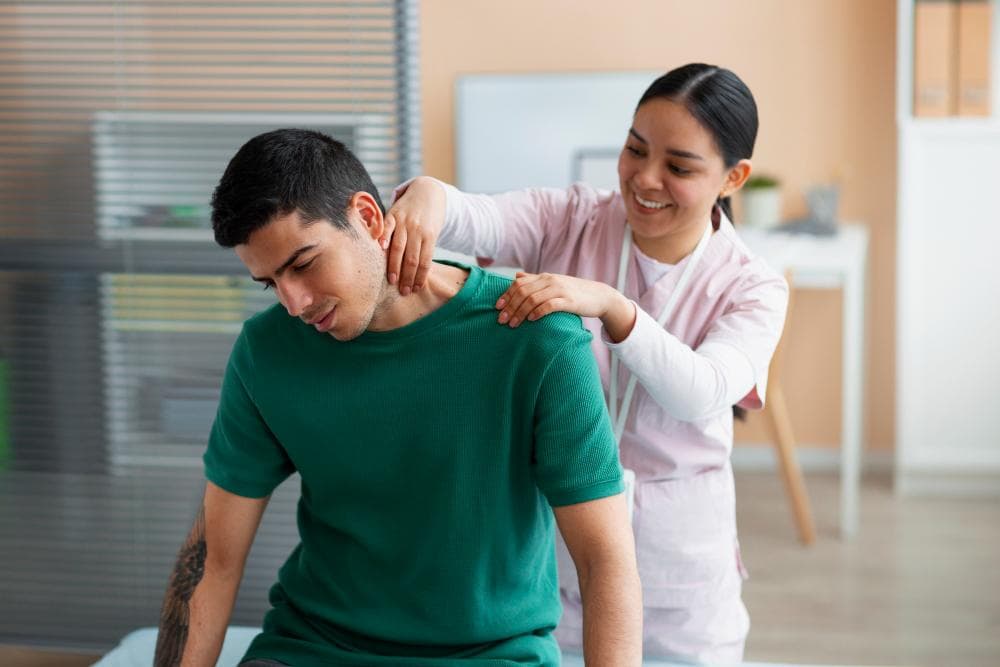
A healthcare professional with dark hair, wearing a pink uniform, is smiling as they massage the shoulder of a man in a green shirt. The man appears relaxed but slightly pained, leaning forward with a neutral expression.
Shoulder dislocation is the most frequently dislocated major joint in the human body. Across global emergency department data, shoulder dislocations account for approximately 50% of all major joint dislocations. In India, they occur regularly — in cricket (diving fielders, bowlers landing awkwardly), football, kabaddi, wrestling, and in older adults following falls.
The immediate event is memorable: a sudden, severe pain, the shoulder visibly deformed, the arm held stiffly away from the body, the inability to move. It's an injury that looks as serious as it feels.
Most first-time shoulder dislocations are treatable conservatively. But recurrence — particularly in young males — is remarkably common, and recurrent instability usually leads to progressive joint damage that eventually requires surgery.
Understanding what to do immediately, how the reduction is performed, and when surgery is genuinely the right choice helps patients navigate this injury correctly from the outset.
What Happens When the Shoulder Dislocates
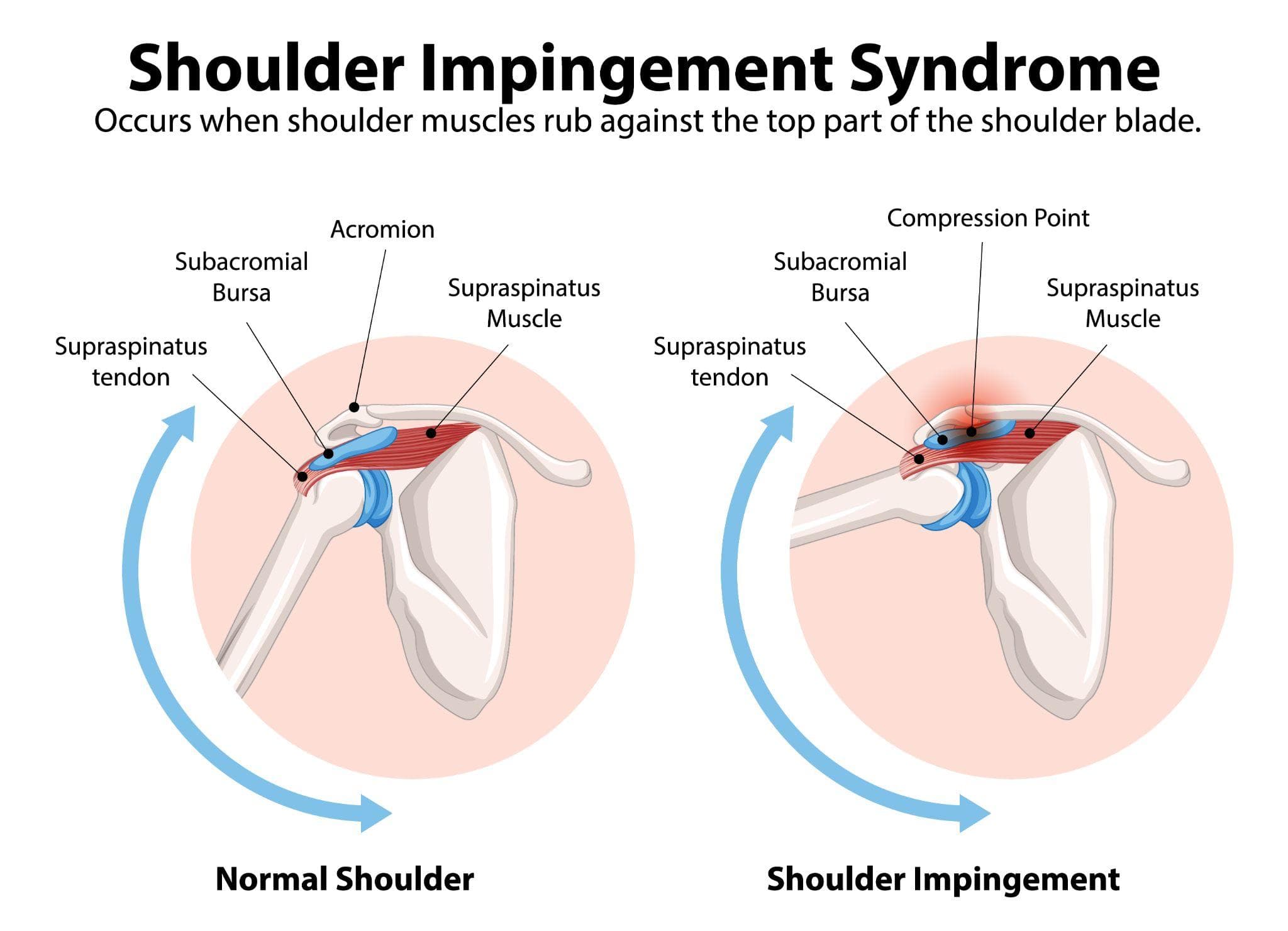
The shoulder ball (humeral head) slips out of its socket (glenoid). In approximately 97% of cases, the ball goes forward (anterior dislocation) — pushed out by a force applied to an arm that is extended, abducted, and externally rotated (as in catching a hard ball or breaking a fall with an outstretched arm).
When the ball dislocates, several structures are typically damaged
- Bankart lesion: The cartilage ring (labrum) at the front of the socket tears away from the glenoid rim. This is the injury found in about 85% of anterior dislocations.
- Hill-Sachs lesion: A dent on the back of the humeral head created when it impacts the glenoid rim during dislocation.
- Capsular stretching: The joint capsule is stretched or torn.
- In severe cases: fractures of the glenoid rim (bony Bankart), rotator cuff tears, or damage to the axillary nerve.
The Bankart lesion is the key determinant of recurrence: it disrupts the primary restraint to anterior instability, and without proper healing, the shoulder becomes susceptible to dislocating again with progressively less force.
First Aid: What to Do Immediately
Do not try to put it back yourself. This point cannot be overstated. Attempting self-reduction — or having a friend or bystander attempt it — risks fracturing the humeral neck, damaging the brachial plexus, or causing rotator cuff tears. Reduction must be performed by a trained healthcare professional after imaging confirms there is no fracture.
Immediately after dislocation:
- Immobilise the arm in the position most comfortable for the patient (usually slightly away from the body, elbow bent). A sling, or simply the other hand supporting the arm, provides this.
- Apply an ice pack wrapped in cloth to the shoulder to reduce swelling.
- Do not give food or water if hospital treatment is anticipated — sedation may be needed for reduction.
- Go to the nearest emergency department or call for ambulance transfer.
Reduction: Putting It Back
The procedure of returning the humeral head to the socket is called reduction. It is performed by a doctor in the emergency department.
Before reduction:
- X-ray to confirm dislocation and exclude fracture (a fractured humeral neck or greater tuberosity changes the management significantly)
- Pain relief and muscle relaxation — intravenous sedation (Entonox, midazolam, fentanyl) relaxes the muscle spasm that holds the ball out
Common reduction techniques:
- Cunningham technique: Patient seated, arm hanging naturally, gentle muscle massage until the shoulder reduces spontaneously. No force required.
- Milch technique: Slow abduction and external rotation of the arm.
- Stimson technique: Patient prone with arm hanging, gentle traction.
- External rotation method: Gentle slow external rotation of the arm while the elbow is held at 90 degrees.
After successful reduction, X-ray confirms the ball is back in the socket. The arm is placed in a sling. Most patients are discharged the same day with analgesia and physiotherapy instructions.
The Recurrence Problem
Here is the uncomfortable reality about shoulder dislocation: once it has happened once, the risk of it happening again is substantial — and the risk is highest in the group you would most expect to recover fastest.
Recurrence rates by age group:
- Under 20 years: Up to 80–90% will dislocate again without surgery
- 20–30 years: 60–70% recurrence rate
- Over 40 years: Recurrence less common, but rotator cuff tears more likely
The reason young patients have higher recurrence is partly biological (more elastic tissue, more years of activity ahead) and partly activity-related (they return to the same high-demand sport).
After a second dislocation, the risk of a third is even higher. Each subsequent dislocation typically requires less force than the previous one — the shoulder becomes progressively more unstable as the Bankart lesion accumulates damage.
Non-Surgical Treatment: When It's Appropriate
After a first dislocation, conservative management is appropriate for many patients — particularly older adults (over 40) and those who do not participate in high-risk activity.
Immobilisation: 3–4 weeks in a sling, followed by graduated return to movement. There is some evidence that immobilisation in external rotation (rather than the traditional internal rotation sling) keeps the labrum in a better position for healing, though this remains debated in practice.
Physiotherapy: The cornerstone of conservative management. Focuses on:
- Strengthening the rotator cuff (particularly subscapularis and infraspinatus) to actively stabilise the joint
- Proprioceptive training — retraining the shoulder's sense of position and dynamic stability
- Progressive return to sport-specific movement
The honest limitation: Physiotherapy does not repair the Bankart labral tear. It compensates for it by improving dynamic muscle stabilisation. For young active patients returning to contact sport, muscle strengthening alone may not be enough to prevent recurrence.
Surgery: Who Needs It and What It Involves
Surgery is recommended when
- Recurrent dislocations occur despite appropriate physiotherapy (typically 2 or more dislocations)
- First-time dislocation in a young athlete (under 25) who wants to return to high-risk contact sport — the evidence increasingly supports early surgery in this group to prevent the progressive joint damage of repeated episodes
- Significant structural damage (large glenoid bone loss, engaging Hill-Sachs lesion) that makes physiotherapy alone unreliable
- Neurological involvement (axillary nerve neuropraxia) that affects shoulder function
Bankart Repair (Arthroscopic Labral Repair)
The most commonly performed stabilisation procedure for anterior instability. Through arthroscopic portals, suture anchors are placed in the front of the glenoid rim. Sutures are passed through the torn labrum and tied down, reattaching it to the bone.
This is an arthroscopic (keyhole) procedure, typically taking 45–90 minutes. It restores the anatomical restraint of the labrum.
Outcomes: Good to excellent in 85–90% of cases in patients without significant glenoid bone loss. Recurrence rate approximately 10–20% in athletes who return to contact sport.
Latarjet Procedure
When glenoid bone loss exceeds 20–25% (a significant amount of the socket has been eroded by repeated dislocations), Bankart repair alone is insufficient — there isn't enough bone for the labrum to attach to, and recurrence rates after Bankart repair are high.
The Latarjet procedure transfers a piece of bone (the coracoid process, from the front of the scapula) with its attached tendon to the front of the glenoid, simultaneously:
- Enlarging the bony socket
- Adding a dynamic sling effect from the transferred tendon
Outcomes: Recurrence rate approximately 3–5%, significantly lower than Bankart repair in cases with bone loss. A 2025 analysis confirmed Latarjet's superiority in high-risk athletes.
Recovery after surgery: Sling for 4–6 weeks. Physiotherapy for 4–6 months. Return to contact sport at 6–9 months.
Shoulder Dislocation Assessment in Noida
Dr. Mayank Chauhan at Prakash Hospital, Sector 33, Noida, evaluates acute shoulder dislocations and recurrent instability. He assesses the degree of labral damage, glenoid bone loss, and rotator cuff integrity before recommending the appropriate management — whether rehabilitation alone, Bankart repair, or Latarjet procedure.
To book a consultation, call the number listed on the website.