Reviewed by Dr. Mayank Chauhan
Failed Back Surgery Syndrome — When Back Surgery Doesn't Fix the Pain
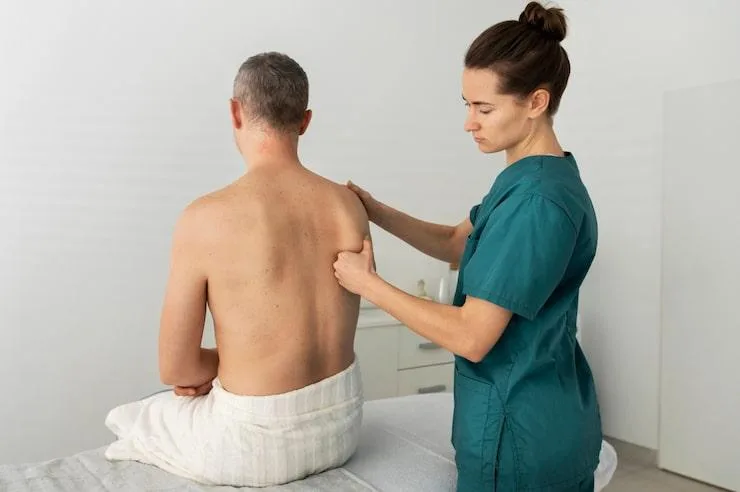
a man getting physical therapy post surgery
The name is more honest than most medical terms. Failed Back Surgery Syndrome (FBSS) describes a condition where a patient continues to have significant pain and disability after lumbar spine surgery that was intended to provide relief.
It doesn't mean the surgeon made an error. It doesn't mean the surgery was unnecessary. It means that, despite technically successful operation, the expected improvement in pain and function has not materialised — or materialised briefly and then returned.
FBSS is more common than most patients are told before spine surgery. Estimates vary, but studies suggest 10–40% of patients who undergo lumbar spine surgery experience inadequate relief or recurrence of significant pain within a year. In a country where hundreds of thousands of spine surgeries are performed annually, this represents a significant number of patients living with persistent post-surgical pain who are often unsure of what comes next.
What FBSS Is and Isn't
FBSS is not a specific diagnosis — it's a clinical state. It encompasses
- Persistent pre-operative symptoms that did not resolve after surgery
- New symptoms that developed after surgery
- Recurrence of symptoms that initially improved and then returned
- Symptoms in a different distribution from the original problem
Importantly, FBSS does not necessarily mean the surgery was wrong. Many patients who fall into this category had appropriate surgery that addressed what imaging showed — but the pain generator was different from what imaging appeared to show, or there were additional generators the surgery didn't address, or the spine has developed new problems since the original operation.
Common Reasons Why Back Surgery Doesn't Work
Wrong Diagnosis or Incompletely Addressed Pathology
This is the most preventable cause. If the imaging shows a disc herniation, but the patient's primary pain generator was actually a facet joint or sacroiliac joint, removing the disc provides no relief. Back pain has multiple potential generators — disc, facet joints, sacroiliac joints, muscles, nerve roots — and identifying the correct one requires careful clinical correlation, not just imaging findings.
Similarly, if a patient has stenosis at multiple levels but only one level is decompressed, the unaddressed levels continue to cause symptoms.
Scar Tissue Formation (Epidural Fibrosis)
After spine surgery, scar tissue forms around the nerve roots in the epidural space. This epidural fibrosis can encircle and tether nerve roots, causing chronic pain similar to the original radiculopathy — even though the original disc herniation or stenosis has been addressed.
Epidural fibrosis is more common after repeat surgery. It can be difficult to treat.
Recurrent Disc Herniation
A disc can reherniate at the same level after microdiscectomy. Studies show approximately 5–15% recurrence rates within 10 years. Recurrent herniation produces the same radicular symptoms as the original — pain and tingling radiating down the leg. In many cases, a second microdiscectomy is appropriate and produces good results.
Adjacent Segment Disease
When spinal fusion immobilises one or more motion segments, the segments above and below the fusion are subjected to increased mechanical stress. Over years, these adjacent segments can degenerate more rapidly than they would have without fusion — producing disc disease, stenosis, or instability at the level next to the fusion.
Adjacent segment disease is one of the arguments for preserving spinal motion where possible (disc replacement rather than fusion, or decompression alone rather than decompression-plus-fusion when stability is not required).
Hardware Problems
Pedicle screws can loosen over time, particularly in osteoporotic bone. Rods can fracture after years of loading. Interbody cages can shift or subside into osteoporotic vertebral endplates. Any of these mechanical failures can produce new or recurrent pain.
Failed Fusion (Pseudarthrosis)
When fusion is attempted, the vertebral bodies may not successfully fuse — the bone graft doesn't bridge the segment, and motion persists at the intended fusion level. This unstable non-union (pseudarthrosis) causes pain and may require revision surgery.
Psychological and Social Factors
This is a sensitive area but an important one. Persistent pain after spine surgery is more common in patients with significant pre-operative depression, anxiety, catastrophising, ongoing litigation related to a workplace injury, and previous unsuccessful treatments. These factors don't cause fake pain — they affect how pain is processed and experienced, and influence outcomes from any treatment, surgical or otherwise.
Assessment: What Needs to Be Evaluated
When back pain persists or recurs after surgery, a systematic reassessment is required:
Clinical history: When did the symptoms change? Are symptoms the same as before surgery, different, or new? What has been tried since surgery?
Physical examination: Neurological assessment — reflexes, strength, sensation. Specific clinical tests to try to identify the pain source.
MRI with contrast: MRI with gadolinium contrast distinguishes epidural fibrosis (enhancing scar tissue) from recurrent disc herniation (non-enhancing disc material). This is the key imaging distinction.
CT scan: For hardware assessment (screw position, cage placement, fusion status).
Diagnostic nerve blocks: Targeted injection of small amounts of local anaesthetic around specific structures (facet joints, nerve roots, sacroiliac joint) can identify which structure is generating pain. If a facet block temporarily eliminates the pain completely, the facet joint is the pain generator. This information guides further management.
Treatment Options
Physiotherapy and Pain Rehabilitation
The foundational approach. Targeted physiotherapy addressing any residual movement impairment, scar tissue management, core stabilisation, and aerobic conditioning. Many patients with FBSS have significantly deconditioned muscles — rebuilding function is both therapeutic and mood-improving.
Pain rehabilitation programmes (multimodal, including psychological support) produce better outcomes than single-modality treatments for complex persistent pain.
Medication Management
Pain specialists can optimise medication for neuropathic pain from nerve root scarring — pregabalin, gabapentin, duloxetine, and low-dose tricyclic antidepressants all have evidence for reducing neuropathic pain. These are not "sleeping pills" — they are specific treatments for a specific mechanism.
Injections
- Epidural steroid injection: Can reduce nerve root inflammation and provide relief for inflammatory radiculopathy persisting after surgery
- Facet joint injection: For facetogenic pain identified on diagnostic blocks
- Sacroiliac joint injection: For SI joint pain, which is frequently undiagnosed in back pain patients
- Selective nerve root block: For isolated radicular pain from specific levels
Repeat Surgery
Sometimes appropriate — particularly for recurrent disc herniation, hardware failure, new adjacent segment disease requiring decompression, or failed fusion requiring revision. The success rate of revision surgery is generally lower than primary surgery and the decision requires careful consideration.
Spinal Cord Stimulation
An established intervention for FBSS that has failed other treatments. A small electrode is placed in the epidural space near the spinal cord, connected to a generator similar to a pacemaker. The electrical stimulation modifies how the nervous system processes pain signals, reducing the pain perception.
Spinal cord stimulation has a strong evidence base for FBSS-related neuropathic leg pain (worse leg pain than back pain) and is recommended in international guidelines for appropriately selected patients. It requires careful patient selection and is performed at specialist pain management centres.
The Honest Reality
FBSS is difficult to treat. There is no single treatment that reliably eliminates pain in all patients after failed back surgery. Management is multimodal and requires patience, often trial and error, and a realistic recalibration of goals — not necessarily complete elimination of pain, but meaningful improvement in function and quality of life.
The most important thing is not to give up and not to assume that more surgery is the automatic answer. A systematic reassessment of what is causing the ongoing pain, by an experienced team combining spine surgery and pain management expertise, is the appropriate first step.
Spine Assessment at Prakash Hospital, Noida
Dr. Mayank Chauhan evaluates patients with persistent pain after spine surgery at Prakash Hospital, Sector 33, Noida. This includes careful clinical review, imaging interpretation, and discussion of all available options — including whether additional surgery is appropriate or whether pain management is the more realistic path.
To book a consultation, call the number listed on the website.