Robotic Vs Traditional Knee Replacement - Which Is Better?

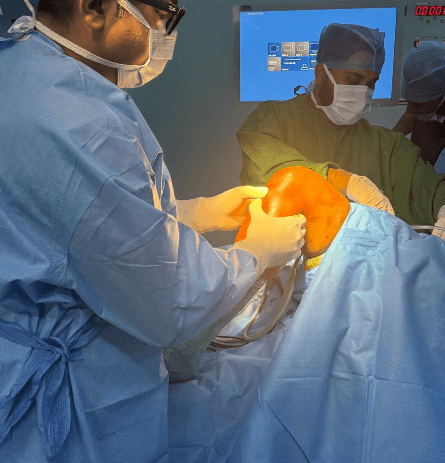
Two surgeons operating on a person's knee in a hospital.
There is a version of this conversation happening every day in orthopedic clinics across Noida. A patient comes in with advanced knee arthritis, the surgeon recommends knee replacement, and then the question arises: "Should I go for robotic?"
It's a fair question. Robotic knee replacement has been marketed heavily by hospitals, by implant companies, and by an enthusiastic wave of online content that sometimes oversells what the technology actually does. On the other end, some patients dismiss it entirely as an expensive gimmick.
Neither extreme is accurate. The honest answer is somewhere in the middle, and that's exactly what this guide covers. What does the clinical evidence actually say? What are the real differences between robotic and conventional surgery? And how do you decide which is right for you?
What Both Surgeries Have In Common
Before getting into the differences, it helps to understand what robotic and conventional knee replacement share.
Both procedures remove the damaged bone and cartilage surfaces of the knee joint and replace them with prosthetic components, metal on the femur (thigh bone) and tibia (shin bone), with a polyethylene plastic spacer in between. Both use the same basic surgical approach, the same anaesthesia options, and the same implant materials. Both begin the recovery process with physiotherapy within 24 hours of surgery. And both, when done correctly, produce outcomes that are dramatically better than living with severe knee arthritis.
The difference is not in the surgery itself. It's in the precision with which that surgery is executed.
How Conventional Knee Replacement Works?
In conventional (traditional) knee replacement, the surgeon uses mechanical alignment guides and physical instruments that are mounted to the bone to determine where to cut, at what angle, and how deep. The alignment of these cuts determines how the implant sits in the joint. Implant positioning that is accurate to within a few degrees is considered excellent.
This approach has decades of evidence behind it. The success rate of conventional knee replacement performed by experienced surgeons is very high, 85-95% of patients report significant improvement in pain and function at long-term follow-up. Implants typically last 15-25 years. The procedure is well-standardised, widely performed, and does not require expensive technology in the OT. Skilled conventional surgery is excellent surgery. There is no argument about that.
How Robotic Knee Replacement Works?
Robotic knee replacement adds two layers of precision that conventional surgery cannot fully match.
Layer 1 - Pre-operative digital planning: A CT scan of the patient's knee is taken before surgery. The surgical planning software uses this scan to build a precise 3D model of that specific patient's anatomy, bone shape, size, alignment, and joint geometry. The surgeon plans the exact cut positions, angles, and implant size on the digital model before the patient ever enters the OT.
Layer 2 - Real-time intra-operative guidance: In the OT, a robotic arm is used during the surgery. This arm is programmed with the pre-operative plan. When the surgeon cuts bone, the robotic system provides real-time feedback if the cutting instrument deviates even slightly from the planned boundaries; the arm either resists (in haptic systems like MAKO) or alerts the surgeon (in active robotic systems). The result is that bone removal is confined precisely to what was planned, no more, no less.
The surgeon retains complete control throughout. No robot makes an independent decision. The robotic arm is a precision instrument controlled entirely by the surgeon, one that enforces accuracy in ways that human hands and mechanical guides alone cannot.
What The Evidence Says - An Honest Look
The clinical literature on robotic vs. conventional knee replacement has grown substantially in the past five years. A 2025 umbrella review published in the Journal of Clinical Medicine synthesised ten systematic reviews on the topic. The findings were consistent across studies.
Where robotic surgery clearly wins:
Implant alignment accuracy: This is the area of strongest evidence. Robotic-assisted knee replacement produces significantly more accurate implant positioning than conventional surgery. Studies consistently show that the percentage of alignment "outliers", cases where the implant ends up positioned outside the target range, is substantially lower with robotic assistance.
Why does alignment matter? Because the angle at which the implant sits determines how evenly the force is distributed across the joint. A misaligned implant wears unevenly. Over 15–20 years, that uneven wear can lead to premature implant failure and the need for revision surgery. Better alignment means better long-term survival of the implant.
Less bone removal: Because the cuts are confined to the planned zone, robotic surgery typically removes less bone than conventional surgery important for younger patients who may need revision surgery later.
Potentially shorter hospital stay: Several studies have found marginally shorter hospital stays and earlier mobilisation in robotic surgery patients, though this difference is not consistent across all studies.
Where the evidence is still accumulating:
Functional outcomes and patient satisfaction: Here, the picture is more nuanced. Multiple studies show that pain scores, range of motion, and functional outcome measures (Knee Society Score, WOMAC) are similar between robotic and conventional surgery at 1-2 year follow-up. Some studies show a slight advantage for robotic surgery in patient-reported outcomes; others show equivalence.
The critical missing data point is long-term survivorship. Because robotic systems only became widely used in the 2010s, the 15-20 year data that would definitively show whether better alignment translates into longer implant survival is still being collected. The hypothesis is well-supported; better alignment should mean better longevity, but the long-term clinical data to confirm it are not yet complete.
Short-term functional recovery: Early recovery (first 4-6 weeks) is often reported as slightly smoother by robotic surgery patients, likely due to reduced soft tissue disruption from more precise cuts. But by 3-6 months, most patients from both groups report similar outcomes.
The Surgeon Factor - More Important Than The Robot

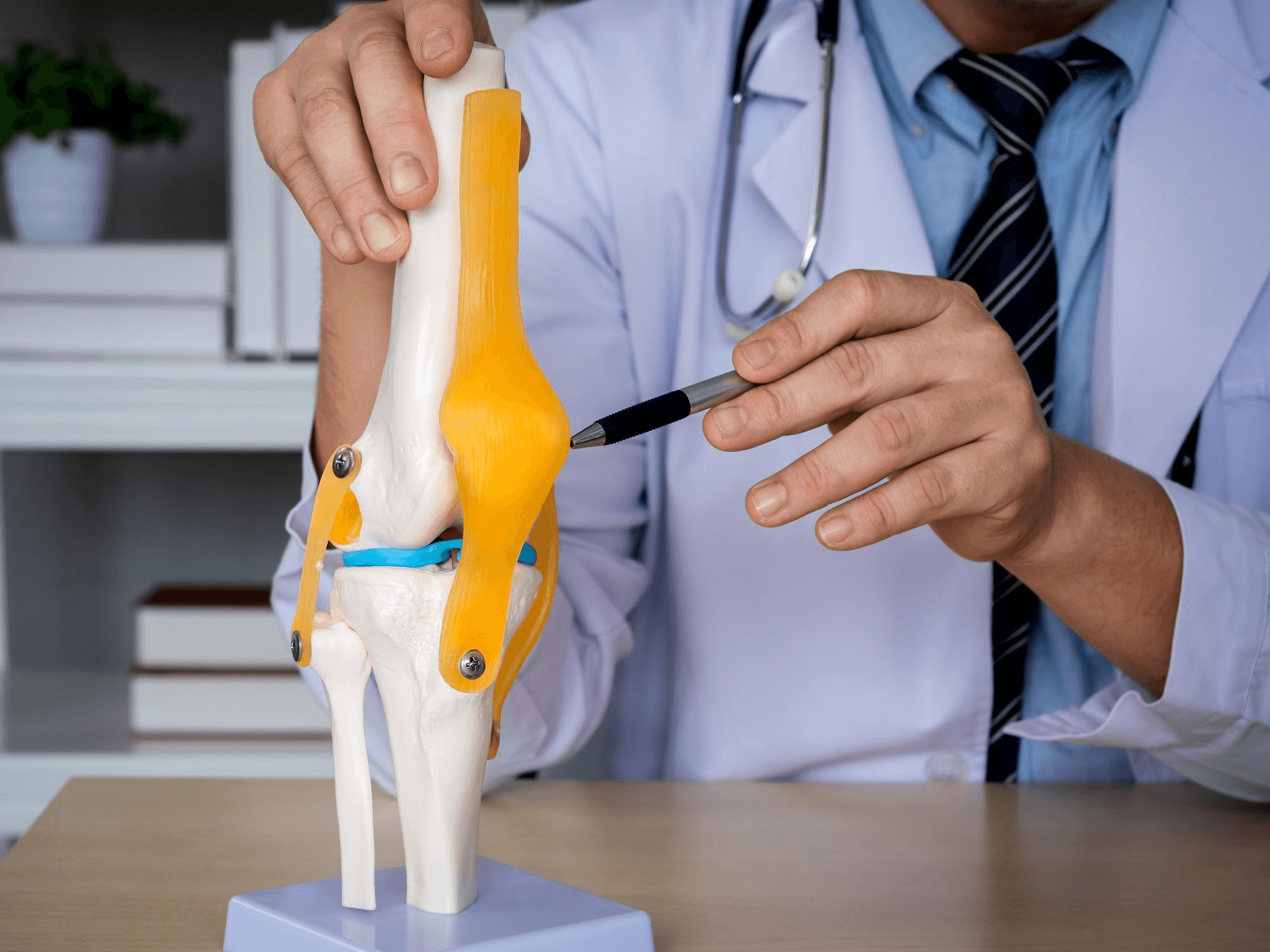
Surgeon showing a knee joint model while explaining types of knee surgery.
One thing the evidence consistently reinforces: the surgeon's experience matters more than the technology. A highly experienced conventional surgeon performing thousands of procedures has developed skills, instincts, and pattern recognition that produce excellent alignment and outcomes without robotic assistance. A less experienced surgeon using robotic technology will produce better results than without it, but may not match the outcomes of a high-volume conventional surgeon.
The ideal combination and the one that produces the best results is an experienced surgeon who is also proficient with robotic assistance. Not robotic technology as a substitute for skill, but as a precision tool that amplifies skill.
When evaluating a surgeon for knee replacement in Noida, ask not just whether they use robotic surgery, but how many cases they have performed with that specific system. Volume with the technology matters as much as the availability of the technology.
Who Benefits Most From Robotic Knee Replacement?
Robotic assistance is not equally beneficial for all patients. Some patients gain more from it than others.
Robotic surgery is particularly valuable for:
- Younger patients (50s and early 60s) for whom implant longevity is the highest priority, better alignment increases the probability that the implant lasts 20+ years without revision.
- Patients with unusual anatomy, significant deformity, post-fracture anatomy, or anatomical variations that make standard alignment guides unreliable.
- Partial (unicompartmental) knee replacement, where precision in preserving the healthy compartment is even more critical than in total replacement.
- Patients where the surgeon's pre-operative planning reveals complexity, such as a flexion contracture that needs precise correction.
Robotic surgery offers less additional benefit for:
- Elderly patients (75+) with straightforward anatomy and limited activity requirements, for whom a conventional knee replacement by an experienced surgeon will produce excellent results.
- For patients who are poor candidates for surgery on health grounds, the technology doesn't change the fundamentals of surgical risk.
Practical Differences - What Patients Actually Notice
Surgery duration: Robotic surgery typically takes 15-30 minutes longer than conventional surgery, due to the setup time for the robotic system. This is not clinically significant for most patients.
Incision size: Both approaches typically use similar incision lengths for total knee replacement. For partial replacement, robotic assistance may allow a smaller incision.
Pre-operative requirement: Robotic surgery requires a CT scan before surgery (for planning purposes). This is an additional step before the operation, not a major imposition, but worth knowing about.
Post-operative recovery: The physiotherapy protocol is essentially the same for both. There is no meaningful difference in what recovery looks like day-to-day.
What you won't notice: You will not be able to tell from the way your knee feels after surgery which type of surgery you had. The prosthetic components are the same. The scar is similar. The recovery milestones are identical. The difference is in the precision of positioning, which matters for how the knee performs over decades, not for how it feels in the first few weeks.
Robotic Knee Replacement In Noida
Robotic knee replacement systems used across Delhi NCR include the MAKO system (Stryker), the ROSA system (Zimmer Biomet), and the CUVIS system, among others. Not all hospitals in Noida have robotic systems, and not all surgeons who work in hospitals with robotic systems are equally experienced with them.
Dr. Mayank Chauhan, Senior Orthopedic Surgeon at Prakash Hospital, Sector 33, Noida, performs both conventional and robotic-assisted knee replacement. For each patient, the surgical approach is determined by clinical evaluation, patient age and anatomy, and an honest assessment of where robotic precision adds the most value.
Dr. Chauhan does not recommend robotic surgery universally; it is recommended when the clinical picture makes it the clearly superior option. Equally, he does not discourage patients from asking specifically about robotic surgery for their case. To book a consultation and discuss whether robotic or conventional knee replacement is right for your situation, call the number listed on the website.
The Bottom Line - An Honest Verdict

An orthopedic doctor explaining knee joint anatomy to a patient during consultation.
| Factor | Robotic | Conventional |
| :---- | :---- | :---- |
| Implant alignment accuracy | Superior | Very good (in expert hands) |
| Bone preservation | Better | Good |
| Personalised planning | Yes (CT-based) | Standardised guides |
| Surgeon experience dependency | High | High |
| Early recovery | Marginally better | Excellent |
| Long-term outcomes (15-20 yrs) | Likely better (data accumulating) | Proven excellent |
| Surgery duration | Slightly longer | Shorter |
| Technology availability | Select centres | Widely available |
The verdict: Robotic knee replacement represents a genuine advancement in surgical precision, not marketing hype. For younger, more active patients and those with complex anatomy, it offers meaningful benefits that justify the additional technology. For elderly patients with straightforward anatomy being operated on by a high-volume, experienced surgeon, conventional knee replacement produces excellent, well-proven outcomes. The best approach depends on the patient, not on a blanket policy in either direction.
To discuss your specific case with Dr. Mayank Chauhan, Senior Orthopedic Surgeon at Prakash Hospital, Sector 33, Noida, call the number listed on the website.